
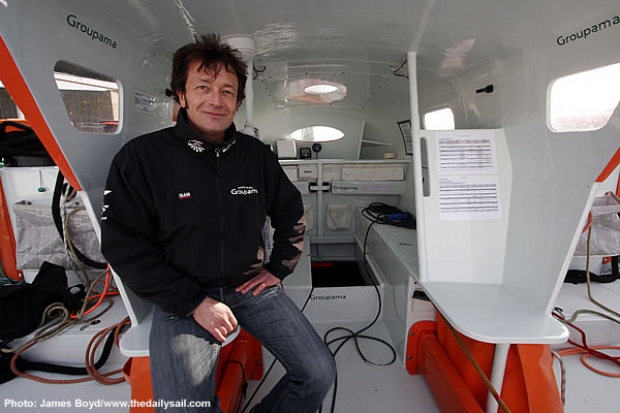
Round the world at 40 knots
Wednesday January 23rd 2008, Author: James Boyd, Location: none selected
Finally the PR machines in France have been working together. No sooner has Francis Joyon arrived back from his fantastic singlehanded round the world record voyage, so Franck Cammas and his team on board the maxi-trimaran
Groupama 3 are to continue the jamboree, as they set sail tomorrow (Thursday) round the world non-stop on their Jules Verne Trophy attempt - the same as Joyon, but fully crewed.
The forecast is good, but not ideal, there are a few potholes they may run over between Ushant and the Equator, but tommorrow morning the Azores high will be heading east allowing Groupama III to zip out of the Bay of Biscay tomorrow morning in the strong northwesterlies preceeding it. A significant benefit of leaving in this scenario is that it is likely to come with flat water, enabling the men in green to sail their tri at maximum warp factor.
On Monday we popped in to see Cammas' 105ft long three hulled monster, at present the fastest offshore boat in the world, and were kindly given an update by former Tornado Olympic sailor and 60ft trimaran skipper ( Bayer/ Gitana) Fred le Peutrec who joined the Groupama team last year. Fred was on board for Groupama III's impressive record breaking tour of the Atlantic culminating with their setting a new time west to east across the Atlantic and an astonishing 24 hour record when they covered 794 miles in a day at an average speed of 33.1 knots.
Since early December the maxi-tri and her crew have been on stand-by waiting for an appropriate weather window to set sail: the boat has been ready to leave the dock, with food and safety gear and oilskins and boots - in short, everything - already loaded on board. They have solely been waiting for the thumbs up from their routers Sylvian Mondon of Meteo France and Richard Sylvestre. This has finally come and there is an air of excitment among the crew we meet.
"Yes it does feel like a once in a lifetime opportunity. There is only one boat like this in the world. For sure you can’t say no," says le Peutrec. Of Groupama III's 10 crew only skipper Franck Cammas and watch leader Steve Ravussin have not sailed around the world before. A majority of the crew have sailed around previously on Jules Verne Trophy attempts on Orange II or Geronimo while several such as Le Peutrec, Franck Proffit, Solitaire du Figaro organiser Jacques Caraes and Jan Dekker (taking a pay slash from working the bow for Alinghi) sailed around in The Race on Grant Dalton's winning Club Med.
Since we sailed on board Groupama III in July 2006 when she was freshly launched, she is now looking thoroughly sorted. Fred points out the new adjustable wind/spray screens that protect the helm positions either side of the central cabin. In the right conditions Groupama III is capable of sailing at more than 40 knots and at that speed wind and spray become painful in the extreme. "With the apparent wind and the pressure of the water you can’t see forward. It is really impressive."

And in action...

The new screens are fitted on top of the crossbeam at the front of the cockpit and are adjustable in height to protect the helmsmen who in the Groupama III come from short - Cammas and Ravussin - to tall, such as le Peutrec and Sebastien Audiagne. According to le Peutrec they were trying to get another screen erected in front of the pit, as this is located in the slot where downwind it can regularly be blowing 55 knots! Not surprisingly crash helmets and ski goggles are standard wear in big conditions and le Peutrec can contemplate in years to come them wearing some sort of body armour.
"Why not? Like rugby. For sure, if we touch something like a whale you can imagine the crash. It would be massive. Due to the layout of the boat, if you hit something there is not hopefully not too much damage to the crew." But it is definitely a boat where you sleep feet forwards....
Other modifications le Peutrec says are just details to improve reliability. They have now fixed the curved ORMA 60-style foil in their float which broke mid-Atlantic, right at the end of their 24 hour record (which would otherwise certainly have exceeded 800 miles - le Peutrec says that during the record there was a 3-4 hour period where their lowest speed was 38 knots!). Impressively the foil (which from time to time must withstand the entire weight of the boat) broke through fatigue rather than a collision despite being made of solid carbon...
When we saw Cammas in 2006 he was uncertain of how many crew to take on board Groupama III, but has since settled on 10, with three watches of three led by Cammas, Ravussin and Franck Proffit with navigator Yves Parlier out of the watch system but called up on deck for manoeuvres.
According to le Peutrec, the Groupama III crew is full of good helmsmen, typically two per watch, indicating what a premium the team place on good drivers - on large multihulls this can represent the difference of several knots boat speed. Typically each helmsman will steer for 1.5 hours, depending upon the wave conditions. While the helmsman is out in the elements, the other two on watch typically hang on to the sheets, while perched on seats facing aft at the back side of the doghouse.
Going with 10 they have been able to take off the third pedestal in the cockpit. "We tried with 10 guys on board at the beginning for the first Atlantic crossing to know if it is efficient and if we are completely exhausted after one week or not," says le Peutrec. "The problem is that before the round the world record, we have never sailed for more than eight days - crossing the Atlantic the longest time was Cadiz to Miami which took eight days! We don’t know what conditions we will be in after three or four weeks, after we’ve been through the Southern Ocean. But that is one of the interesting parts of the project - to discover something new. Even for the guys who have sailed a lot of years on 60ft multihulls, it is another story to sail at 40 knots rather than 30 knots."
The transition from ORMA 60 to G-Class maxi-multihull has taken some time. "On Groupama III it is safer for sure, but everyone has had to learn how to live on board, learning all the new songs of the boat. Trying to sleep at the beginning was an exercise."
So what is it like sailing with the great Yves Parlier? "He is so excited by this. He thought that he would never go to the Southern Ocean again, no more Vendee Globes. He is a bit injured [following a paragliding accident that nearly killed him] so it is not so easy for him. He saw Franck Cammas during the first day of the Salon Nautique [Paris Boat Show] and he said 'one thing I’d like to do in my life would be to sail around the world with 10 crew on a boat like yours'. The day before Marcel van Triest said he could not be on board. Franck said nothing in the discussion, but 10 minutes later... He is really excited. It is a great pleasure."
When it comes to manoeuvres, pretty much all of the headsails furl. The longest sail change is peeling between gennikers but even so that only involves seven crew, the on and standby watches plus Parlier. It seems that sleep for the off-watch on such a brutal boat is regarded as a high priority.
According to le Peutrec to date the top speed of Groupama III has been 43 knots, however they regularly sail in the early 30s. "For sure it is a really impressive boat. Sailing upwind with one hull flying, like a 60 footer but at 20-21 knots..."
But the million $ question of course is can Groupama III beat Orange II's existing record for the Jules Verne Trophy of 50 days 16 hours, 20 minutes and 4 seconds? Le Peutrec has no doubt that if they can make it around and have half decent weather they can. Despite Orange II being a catamaran, while Groupama III is a tri the boats are otherwise like chalk and cheese.
Having now experienced Club Med and Groupama III, le Peutrec is well qualified to comment. "The problem with the cat is that if you want to be not so close to the waves you have to make it big. And that is too heavy. Then if you want to sail fast you have to be on one hull which means you have to make a boat not so beamy. It is efficient downwind in strong wind and a lot of big waves, but this one is so fast all the time, including light winds. So the part of the round the world course where we can take some advantage is essentially the Atlantic. That will be the best part for this boat."
Orange II is 125ft long is thought to weigh at least 30 tonnes, whereas Groupama III is only 105ft long but according to le Peutrec weighs just 18 tonnes fully laden. "We pulled out the engine, which means we saved 500kg and that is about the weight of the food." There is of course quite a bit more diesel on board than they carried around the Atlantic last year, including some kept in a spare tank that can be moved fore and aft down below to trim the boat according to the conditions.
"If we break the record it is a success. That means 48-49 days. But after Francis, when I saw him sailing on a boat not as fast as this one - this one sails at about 10 more knots all the time - and 10 people on board... If we have good conditions in the Atlantic and on the way back we can expect to be 45 days no problem and maybe less."
While they may be fast in the Atlantic there will be the interesting problem in the Southern Ocean. Here the giant depressions typically move east at a certain speed, hence why sailing here is regularly referred to as 'being on the conveyor belt'. But Groupama III can sail faster than this...
"They move at about 25-30 knots but that is about the speed of Francis," says le Peutrec. "He crossed the Indian Ocean on one front at 25 knots average." If Groupama III would be averaging in the low 30s in the same conditions it is likely that she will sail away from the front preceeding the depression and into the high pressure east of it. It will then be a case of attempting to get through the high and into the depression ahead.
"To be able to go in front means that the high pressure between the two lows needs to be very small with a bit of wind too. But we jumped ahead of a system during the Atlantic crossing, when we were faster than the front."
The Jules Verne Trophy was first sailed 15 years ago at a time when the objective was to make it round in less than 80 days, like Phineas Fogg. It was uncertain whether a big maxi-multihull could even make it around let alone achieve them. And yet, in 2008 we have a boat in Groupama III that could conceivably lap the planet in almost half this time... Impressive stuff.
To read our feature on Groupama III - click here
See our video from sailing on board - here
And our interview with Franck Cammas about his new boat... here
More photos on the following pages...

Most Read
Most Commented
Comments
Businesses


Pro businesses
-
Italy
-
-
France
-
United Kingdom
Editor's choice
Member blogs
-
 Ned Collier Wakefield: MOD70 round BarbadosWell that was intense. 12 hard fought for seconds for the win. In idyllic conditions, Tony Lawsons MOD ...
 -
 Mini Transat leg 2 reportThe second leg of the Mini Transat started on 31st October, just over a month after ...
 -
Leg 1 reportI’ve been working towards the Mini Transat now for three years. In 2013 I was part ...
Business blogs
-
 The Island Sailing Club in Cowes, Isle of Wight, is delighted that Prince Michael of Kent ...
 -
Peta Stuart-Hunt chats with the 25 year-old British solo sailor Lizzy Foreman before she sets sail ...
-
The 2015 Student Yachting World Cup (SYWoC), an ISAF-recognised event hosted and run by students for ...
Editor's Choice
All time favourites...
-
 Three legs down into Ian Walker’s
 -
 Winning all but two races at
 -
 For the first time in its
Latest Comments
Add a comment - Members log in