
Gathering of the clans
Monday March 17th 2008, Author: James Boyd, Location: United Kingdom
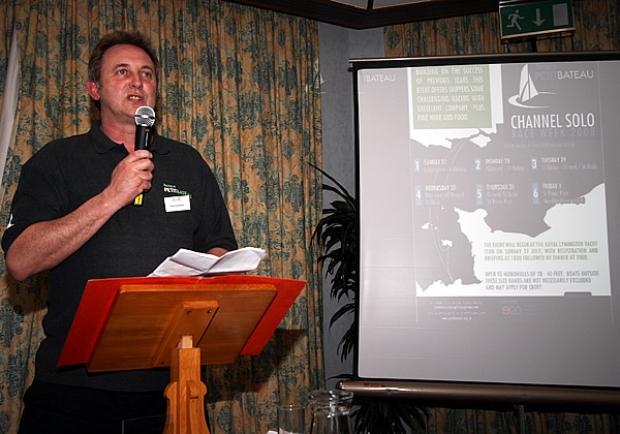
On Saturday thedailysail attended a very informative day down at the Royal Southampton Yacht Club where the Solo Racing Festival was being held. Run by Petit Bateau, specifically in the form of one time
Alice's Mirror owner Jerry Freeman with his team of able helpers, this annual event was taking place for the second time and was a gathering of the clans of the UK's singlehanded offshore racing community.
In the UK singlehanded offshore racing essentially divides into two camps with a bit of grey in the middle. On the one hand there are the pros, or at least those who do it full time, going up the pathway from Mini to Figaro/Class 40 and hopefully on to the IMOCA 60 and the Vendee Globe, while on the other there are the more Corinthian sailors who have proper jobs but enjoy solo offshore racing in Petit Bateau's events, the doublehanded program run by the Royal Southampton YC and the Royal Western YC's historic landmark races such as the OSTAR and twohanded Round Britain Race.
The Festival brought together both parties from solo sailing royalty such as Sam Davies, Miranda Merron and Brian Thompson, Figarists such as Nigel King and Paul O Riain, Mini sailors like Oliver Bond to leading lights of the Petit Bateau community such as former Mini sailors Paul Peggs and Simon Curwen to eminent veterans such as former BOC and OSTAR competitor Desmond Hampton.
There was also considerable 'industry' representation including yacht designers Simon Rogers and Guillaume Verdier [with Merf Owen lurking around the bar area...] and several marine suppliers. While the centrepiece of the festival was the seminars there were also displays of new designs such as Charles Bertrand's Fox 9.50, an example of the new Class 9.50 we knew little about, as well as several boats tied up outside the Royal Southampton YC including the Rogers-designed Class 40 Simon Clarke and Dave Lindsay sailed in the last year's Transat Jacques Vabre.
The seminars opened before lunch with a talk on one of the most important subjects for solo offshore racers: sleep. While in the past we have attended several talks on this by Harvard's Dr Claudio Stampi, this presentation was a fresh take for us on this fascinating subject, given by Dr Chris Idzikowski of the Edinburgh Sleep Centre. Did you know that some mammals such as dolphins can send one half of their brain to sleep, while others sleep for only one second at a time? Even with your eyes closed, we were told, there are photosensitive elements to your eye that can tell your brain when it is night and day. Dr Chris confirmed that the most efficient sleep to be had are the first minutes of deep sleep and that sleep should be taken when one's bio-rhythm most demands it, ie during the night, siesta time in the afternoon, etc - just a few salient points from a complex and still largely mysterious subject.
Following this, the seminars were effectively divided in three, the first being design. Simon Rogers opened the batting with a talk about the Class 40 and his design for it and also revealed some new details about Jonny Malbon's soon-to-be-launched IMOCA Open 60 Artemis. Paul Metcalf, the Isle of Wight builder of the Owen-Clarke designed Express 40, continued the Class 40 theme while Charles Bertrand spoke about how his Fox 9.50 design is now in production in Sweden. Guillaume Verdier rounded off with a fascinating blow by blow account of the build of Marc Guillemot's IMOCA Open 60 Safran.
 By far the most poignant talks came after lunch on the topic of safety.
Ideal Stelrad skipper Ross Hobson described in detail the capsize of his 40ft trimaran during the 2006 Route du Rhum and the lessons he learned from it - think about the layout of the safety gear on board and where it might end up should your boat invert. He wasn't wearing a lifejacket - if he had he might not have made it out from beneath the upturned hull of his trimaran. Hobson also frankly admitted to the trauma the incident caused for his family - in the period between his EPIRBs going off and his being hauled on board a ship he had not been able to communicate with anyone ashore as his Iridium phone had got soaked. Does anyone make a waterproof case for an Iridium phone? Apparently not. Read more about this incident
here.
By far the most poignant talks came after lunch on the topic of safety.
Ideal Stelrad skipper Ross Hobson described in detail the capsize of his 40ft trimaran during the 2006 Route du Rhum and the lessons he learned from it - think about the layout of the safety gear on board and where it might end up should your boat invert. He wasn't wearing a lifejacket - if he had he might not have made it out from beneath the upturned hull of his trimaran. Hobson also frankly admitted to the trauma the incident caused for his family - in the period between his EPIRBs going off and his being hauled on board a ship he had not been able to communicate with anyone ashore as his Iridium phone had got soaked. Does anyone make a waterproof case for an Iridium phone? Apparently not. Read more about this incident
here.
The big hitter was the presentation by Graham Elliot on the capsize of the MaxFun 35 Hooligan V. Elliot was a crewman on board for the routine delivery trip from Plymouth back to the Solent last year, when in the middle of the night the boat lost her keel and inverted resulting in the loss of crewman Jamie Butcher. While Hobson's presentation was dramatic, Elliot's was all the more chilling as he gave an uncoloured blow by blow account of the facts of the incident. This raised a number of points: Where do you hang on to the upturned hull of a yacht? What should you do in a liferaft if one of your colleagues is suffering from hypothermia?
 Some of these questions were subsequently answered by Mike Tipton, Professor of Human and Applied Physiology at the University of Portsmouth and co-author of the
Essentials of Sea Survival. Did you know for example that the human body is 'thermo-neutral' (ie when it won't get colder or hotter) at 35degC and even at the equator the sea temperature in the Atlantic Ocean is still only 27degC? Tipton describes the stages leading up to hypothermia and the best tactics to minimise it, particularly 'cold shock' - 56% of fatalities happen within the first 20 minutes of being in the water, pre-hypothermia.
Some of these questions were subsequently answered by Mike Tipton, Professor of Human and Applied Physiology at the University of Portsmouth and co-author of the
Essentials of Sea Survival. Did you know for example that the human body is 'thermo-neutral' (ie when it won't get colder or hotter) at 35degC and even at the equator the sea temperature in the Atlantic Ocean is still only 27degC? Tipton describes the stages leading up to hypothermia and the best tactics to minimise it, particularly 'cold shock' - 56% of fatalities happen within the first 20 minutes of being in the water, pre-hypothermia.
Tipton provided valuable advice on the most effective type of lifejackets, how these must fit well, have a crutch strap to prevent their rising up over the wearer's head - and most critically must have a robust screen over the face to prevent drowning. Tipton showed a great video of a Royal Marine who had been sitting in a chair submerged in cold water for a while attempting to unpeel the plastic packaging from a flare, a process that under normal circumstances would take 14 seconds but which proved all but impossible due to the numbness in the Royal Marine's hands.
 After another break it was time for the solo sailors themselves to make their presentations. Nigel King talked about his Figaro campaign last year, the Figaro training school he attended in La Rochelle, dispelling many of the myths - while it might seem intimidating looking at the singlehanded one design class from this side of the Channel, in fact the class are gagging for international sailors and make you feel most welcome as Paul O Rioin confirms in today's article. London-based Australian Nick Brennon described his Mini campaign and his competing in last year's Mini Transat and all its highs and lows. Finally golden girl Sam Davies rounded off with an update on her Open 60 campaign with Roxy including the work they have done on the boat (the former
PRB, winner of the last two Vendee Globes) over this winter such as changing the single central daggerboard over to twin assymetric boards.
After another break it was time for the solo sailors themselves to make their presentations. Nigel King talked about his Figaro campaign last year, the Figaro training school he attended in La Rochelle, dispelling many of the myths - while it might seem intimidating looking at the singlehanded one design class from this side of the Channel, in fact the class are gagging for international sailors and make you feel most welcome as Paul O Rioin confirms in today's article. London-based Australian Nick Brennon described his Mini campaign and his competing in last year's Mini Transat and all its highs and lows. Finally golden girl Sam Davies rounded off with an update on her Open 60 campaign with Roxy including the work they have done on the boat (the former
PRB, winner of the last two Vendee Globes) over this winter such as changing the single central daggerboard over to twin assymetric boards.
In short the Solo Sailing Festival was a great success and we expect will only grow next year. For anyone involved with or interested in this side of the sport in the UK (or elsewhere) it is a must for the diary. Aside from the talks it is a valuable gathering of the clans. Inevitably there never seems to be enough time at these events to talk to all the people you want to. Hopefully next year the event may be held over a weekend and they might be able to entice an Open 60 or two along?
Congratulations to Jerry, Royal Southampton YC and the Petit Bateau team for holding a top event.
Most Read
Most Commented
Comments
Businesses


Pro businesses
-
France
-
Italy
-
-
United Kingdom
Editor's choice
Member blogs
-
 Ned Collier Wakefield: MOD70 round BarbadosWell that was intense. 12 hard fought for seconds for the win. In idyllic conditions, Tony Lawsons MOD ...
 -
 Mini Transat leg 2 reportThe second leg of the Mini Transat started on 31st October, just over a month after ...
 -
Leg 1 reportI’ve been working towards the Mini Transat now for three years. In 2013 I was part ...
Business blogs
-
 The Island Sailing Club in Cowes, Isle of Wight, is delighted that Prince Michael of Kent ...
 -
Peta Stuart-Hunt chats with the 25 year-old British solo sailor Lizzy Foreman before she sets sail ...
-
The 2015 Student Yachting World Cup (SYWoC), an ISAF-recognised event hosted and run by students for ...
Editor's Choice
All time favourites...
-
 Three legs down into Ian Walker’s
 -
 Winning all but two races at
 -
 For the first time in its
Latest Comments
Add a comment - Members log in