
The Lymington rocket
Tuesday April 8th 2008, Author: James Boyd, Location: United Kingdom
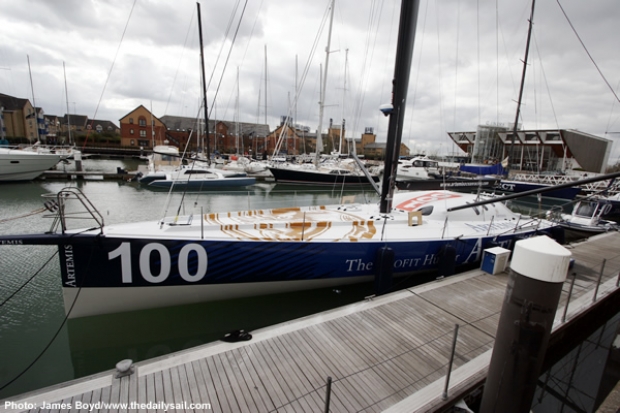
The second last of the 20 new generation IMOCA Open 60s was unveiled to a modest gathering in Southampton’s Ocean Village Marina yesterday. The new
Artemis Ocean Racing 2 for young blade skipper Jonny Malbon is the first boat in this class to come from Rogers Yacht Design and the first new 60 to be backed by the Edinburgh-based investment house, an increasingly familiar name in shorthanded ocean racing with their support of next month’s The Artemis Transat.
While this is their first 60, Simon Rogers and his Lymington-based design team are not new to Open boats. Their Minis have performed well in the hands of Jonathan McKee and Brian Thompson and more recently they have entered the Class 40. The Roger Minis were fitted with a canting keel (and canting daggerboard), the keel also able to be moved fore and aft and with the new Artemis Rogers has equally shown no fear in taking pioneering steps.
So where does the new boat sit in the wide array of new boats? Generally with the latest generation of IMOCA Open 60s, designers have tended to go for minimum weight, particularly in the case of the VPLP/Guillaume Verdier-designed boats Safran and Groupe Bel, which are in the 8-8.5 tonne region, followed by the Farrs and Owen-Clarkes. However maintaining lightweight has been hard to achieve in the latest boats as they feature ever increasing volume in their hulls, chines, kick-up rudders, longer daggerboard, in some case masts literally several metres taller than even four years ago, more sail area and thus larger deck gear such as winches, etc – all very much contributing to total weight. One boat that is out on a limb is the Juan K-designed Pindar, believed to weigh in at around 11.5 tonnes, partly through having a deliberately larger bulb, but also through being fitted with the tallest wingmast rig, the beamiest platform and generally being the most powerful of the new generation. Within the weight span the new Artemis is expected to hit the scales at around 10 tonnes, the nearest in concept to the new Pindar, for she, like the boat from Scarborough, is a giant beast.
We’ll save our reservations about her giant elliptical-shaped wingmast until later in this article, but with what must be approaching 25 sqm of area her rotating spar is certainly the largest in terms of its area compared to the other new generation boats. Although designer Simon Rogers says this will be no taller than the 28.5m (or so) high rigs found on the likes of PRB, there are of course concerns about what happens to the mast if ever the boat encounters storm force winds. As Malbon puts it with a detectable wince: “one of the warnings they made is that is you have 70 knots have an axe ready and be in a dry suit!” The last two Vendee Globes have been fortunate in that the weather has rarely reached half this amount.
Clean decks
Aside from the shape of the mast, Rogers has attempted to keep the deck of the new boat as clean as possible and one novel feature is that the substantial ball on which the mast sits, allowing it to rotate, is hidden below deck with a rotating circular plate at deck level above it. While the pivot point at the foot of some rotating spars varies (some rotate from closer to the aft or forward end of the mast foot) Artemis' rig rotates around its centre point.
Simon Rogers explains: “We’ve done a lot of FE work on the rig and we can’t really why you wouldn’t want to rotate in the middle. I’ve done four or five wing rigs before and we’ve done them on the back and run into trouble, not badly, but they are more difficult to tune. A lot of multihull [campaigns] have different views. We’ll see how it goes.”


Top: Part of the trench (plus proud skipper). Above: the end of the tunnel and the 'bitch' winch
Another clever feature of the boat we like is that while many boats have a trench for running lines aft from the mast, on Artemis there is a trench running the length of the boat - including the mast rotation lines. As Malbon puts it: “All the tack lines, furling lines, trip lines, purchases for all of the front sails, etc etc - they all come through back to the bitch winch [the pit winch]. So you are reducing friction. You have a lot of lines, but you are going to have that anyway.” A lot of lines indeed. Open 60s are fiendishly complex boats and approaching 50 lines will exit this tunnel at the cockpit once the boat is fully rigged up in around one week’s time.
Rudder cylinders
While the mast sits on a turntable, the rudders work on a vaguely similar system. One of the interesting aspects of the Artemis campaign is Malbon and his team between them have worked on all of the UK's leading Open 60 campaigns, including Graham ‘Gringo’ Tourell who was Mike Golding’s right hand man for many years, and have pooled all their ideas into the new boat. Malbon himself was Ellen’s boat captain on Kingfisher and a feature these two boats share is their rudder system. While all Open 60s have twin rudders due to their outrageous beam, some have them conventionally mounted beneath the transom, while more of the new generation have opted for the complex transom-mounted kick-up mechanisms. However these are not without problems, as Alex Thomson and Andrew Cape found in the Barcelona World Race when their rudders began to kick up of their own accord.

On the new Artemis the rudder blades are mounted in a slot in larger rotating cylinders running from deck to hull exit. Want to lift out a rudder to reduce drag or repair it? Simply pull it out by hand from on deck – a great system that not only featured on Kingfisher but can also be seen on the single-ruddered Henderson 30 sportsboat. In addition the wider bearing surface of the cylinder spreads the load, not only those generated by water passing over the foils but in the event of a collision. The blades can be swapped in a matter of minutes and the bottom of each blade is sacrificial.
“I have been very nervous about kick-up rudders,” says Simon Rogers. “They seem to be vulnerable and cause more damage as a result. We wanted to make sure we could maintain them from on deck completely, so they are liftable. We can replace the whole system from on deck, from the safety of the cockpit which for a Vendee seems to be a sensible thing to do. Jonny will carry a spare blade and a set of spare bearings. You can take it [a broken rudder] down below and do any composite work you need to do in the relative dry and have half a chance of being able to fix it properly.”
Rogers reckons the weight of the system is perhaps 10kg heavier than a conventional fixed set-up but around 40kg lighter than the transom-hung set-ups.
Yes, an interceptor...
Lurking on the transom of the new Artemis, just above the waterline, is an interceptor as similar to what we have previously seen on the new Owen-Clarke designed Ecover and Aviva. We have written about these previously, but a few of the latest generation 60s feature either these, or in the case of Gitana 80 and Paprec-Virbac 2, a more substantial planing board – both technologies borrowed from motorboat or ship design and something we’ll certainly see more of in the future.
 On
Artemis the system differs from the
Ecover/
Aviva set-up in that the casing has been bolted to the transom lowered into the water by a small hydraulic ram at each end of it. While it looks retrofit, according to Malbon it was something they were considering back in the
Kingfisher days and Simon Rogers confirms it has featured in their tank test work from the outset. “We did a lot of research at 1/3 scale and it worked really well," says Rogers. "It allows us to mode the boat. The thing about beamy boats is that they do carry a lot of surface area and we have tried to develop different ways of moding the boat for light, medium and heavy [conditions]. The interceptor is certainly going to be a powerful tool in that arrangement.”
On
Artemis the system differs from the
Ecover/
Aviva set-up in that the casing has been bolted to the transom lowered into the water by a small hydraulic ram at each end of it. While it looks retrofit, according to Malbon it was something they were considering back in the
Kingfisher days and Simon Rogers confirms it has featured in their tank test work from the outset. “We did a lot of research at 1/3 scale and it worked really well," says Rogers. "It allows us to mode the boat. The thing about beamy boats is that they do carry a lot of surface area and we have tried to develop different ways of moding the boat for light, medium and heavy [conditions]. The interceptor is certainly going to be a powerful tool in that arrangement.”
Rogers won’t expand at this stage on how the interceptor is used other than saying “the boats are inherently have a lot of wetted area and it allows you to change the mode of the boat with one single control. Effectively you are modifying the hull shape.” Read designer Merf Owen’s explanation of their arrangement here. Certainly the interceptor arrangement is substantially lighter than planing boards seen on the two Farr boats.
A reliable keel foil?
Forward the new Artemis has the now conventional canting keel twin toed-out daggerboard set-up. With the problems Mike Golding has experienced once again with the keel foil on his new Ecover, this has been area Rogers and the team were keen to get right. Their solution has been to build the foil in fabricated stainless steel.
“We think it is a very good way to go,” explains Rogers. “The failures [on other keel foils] eminate from welds and the lovely thing about stainless is that it welds beautifully. It is a more ductile material and weld-tolerant. The welds fail on high tensile steels where the problem is that it is a bit like trying two bits of spring steel together and they don’t like it - you have to use a lot of heat and you have to work hard to keep it straight and you do get fatigue problems. We’ve tried to come up with a solution where you don’t have to think about it too much.” He adds that the foil weight ends up 50-60kg heavier but this is low down and as ever with this boat security and reliability have been paramount.
Another area where the team may have made a development is with the giant hydraulic rams for the keel canting. According to Rogers they managed to source these from a German company that supplies them for use in underwater JCBs. “The rams we have are proper industrial rams and have been around for 10 years - they are not one-offs.” Perhaps most surprising is that while many Open 60 teams have gone for exotic and highly expensive rams made in titanium, with the Artemis rams, both cylinder and stock are made in hard anodised aluminium, wrapped in carbon. Rogers explains: “The ally deals with the compression/tension and the carbon the bursting. They are nice rams. They are very light. While a lot of rams have been designed for other applications these have been built for the environment we are operating in. These have been designed for use in salt water from the very beginning.”

Hull-wise, the new Artemis is certainly one of the most beamy of the new generation boats but the overall beam is not as much as Pindar according to Malbon. “I think they are wider than us, 6.3m or something. We are ‘round about’ 6m. But we have quite a different hull shape to them. We are wide but I think we have more rocker and it is a slightly more varied shape than they’ve got.” Artemis’ chine, although running pretty much the full length of the hull, is less extreme than Pindar’s.
A deep, well protected cockpit
The cockpit layout is fairly conventional by modern 60 standards with a pit area between two companionway hatches. Rather than having doors on hinges, each companionway features a smart washboard that pulls up from a housing below and can be locked off at any height - neat. For a laugh the team got Simon Rogers down below for the 180deg inversion test last week and apparently only around 5lt of water got in through the washboard handle fittings when the boat was upside down... This washboard arrangement also frees up a useful space immediately behind the cockpit bulkhead, beneath the substantial cabintop overhang where Malbon can hang out on his beanbag, protected from the elements.
The cockpit features a single coffee grinder powering the collection of five Lewmar winches. Instead of a tiller or tillers, the boat has twin wheels and the giant Fleet 77 satcom dome mounted at the aft end of the cockpit. Encircling the whole deal is a MichDes-style circular main sheet track, however according to Simon Rogers this will work slightly differently to the French set-ups. While this arrangement typically has a separate mainsheet and vang, both running between this track and a long track on the underside of the boom on Artemis the sheet and vang are all in one.


Temporary rigged mainsheet/vang
“You have a traveller and a mainsheet,” says Rogers. “The main sheet won’t release more than 0.5m and it is really our vang control. It is a bit heavy, but it means Jonny won’t have to put preventers on and screw around in an area we consider to be very vulnerable for singlehanded sailors.” How well this will work with the mast/mainsail arrangement we wait to see...
Up on the foredeck there is nothing particularly unusual, save for the large collection of Karver furling drums for the headsails. However all the sails, including the mainsail, will be on hooks made by the sparmaker Formula Spars and cranked from the tack on a 3:1 purchase (hence the miles of rope hiding in the central trench).
Down below - welcome to the black abyss
A reasonable amount of finishing off work still needs to be done on the new Artemis. Clambering around down below and she is a mass of bare black carbon. Her water ballast arrangement for altering fore and aft trim and varying the boat’s displacement appears to be no different to the majority of other new Open 60s with a humungous capacity of sea water able to be brought on board into twin tanks (port and starboard) in the bow, midships and in the stern.
While some new generation 60s have interesting easy stacking arrangements (on Gitana 80 and Paprec Virbac 2 the stack is moved to weather on a giant turntable for example) some thought has gone into this on board Artemis. What appear to be pipecots to port and starboard will in fact be stacking bins, their shape noticably different to pipecots in that the corners of their carbon fibre rectangle aren’t square. The idea is that prior to a manoeuvre the inboard end of the frame is lowered, the stack to weather tumbles down to leeward (the engine and generator compartment covers running down the middle of the ‘saloon’ area have a deliberately slippery gloss finish to ease this) directly into the lowered pipecot/stack bin down to leeward which is then hoisted, scooping up the stack...very simple.

The chart table is similar to what we have seen on several of the other 60s – in fact less of a table and more of a panel that can be rotated to port or starboard (ie up to weather) around a column. Malbon will operate the PC on board from a wireless keyboard while perched on another of his bean bags.
While down in Lymington Neville Hutton and his team did a magnificent job of the all carbon-Nomex build, Artemis’ structural work was carried out by Gurit/SP. Open 60s have a minimum number of water tight bulkheads but where Artemis differs is that they have the openings in the bulkheads (along with the foredeck hatch) substantially larger than typically seen on Open 60s in order that sail stacking or repair work can be carried out more easily. Another evident difference to other boats is what the team call the boats’ D0 bulkheads – these part bulkheads are angled in towards the mast step and are there to counter the substantial compression loads brought to bear by the deck spreaders. So bringing us neatly back to the rig...

The tricky cigar
While there is a lot radical about the new Artemis, the most extreme aspect of her design is the wingmast. With its tapered cigar shape, including an elliptical shape to its trailing edge, the rig resembles the spar used on Tony Bullimore’s Spirit of Apricot trimaran back in the 1980s and before that on Eric Tabarly’s Pen Duick IV tri and originally the Clarence Farrar-conceived rigs used on the Lady Helmsman C-Class cats back in the 1960s. In aircraft terms think Spitfire, where the trailing edge of the wing was elliptical in order to promote uniform lift along the length of the wing.
Part of the influence to go down this route is certain to have come from designer David Alan-Williams, who has been Project Manager for the boat, and who’s Steinlager 1 trimaran design for Sir Peter Blake had a similar rig.
“Having sailed on the multihulls, and now these boats are sailing faster and faster, it made a lot more sense than previously. The thinking was that if you are going to go for a wingmast, you might as well GO for a wingmast!” explains Malbon. “My concerns with wingmasts and 60s is that they are very noodly. All the Lorimar rigs – most of the French skippers will admit that they spend a lot of time up the rig, concerned about it. This is a very different rig to what has been done before. It is a lot stiffer and the way the aft rigging ties in with the forward rigging it is similar to a classic rig as far as logical steps down go. It is very very stiff. When we picked it up from the end we just had the strops at the butt and it was straight up. It will be heavier, but judging what happened at the end of last year, with the boats now a lot more powerful, I think you’ll find that the new generation of rigs will be heavier and I think we’ll be heavier than that again but it is peace of mind and reliability that we’re trying to go for.”
On Artemis the maximum chord of the wing is approaching one metre at its widest and while a beautiful bit of kit, we feel it is certain to lead to all manner of problems. Firstly you have a curved luff track, but the team hope they have got around this by having a substantial laminated track. Secondly you end up with some exciting friction issues making simply getting the main up and down the track somewhat harder than it would be were the track straight. Lastly the sail designer has to come up with a mainsail that will operate on the curved track, including working efficiently when the sail is in its three reef positions as well as tackling how the sail flattens differently along its height as the mast is rotated. While the sails are being built by North UK, they have been designed at North’s New Zealand loft by Emirates Team NZ’s lead sail designer Burns Fallow, one of the most talented men in the business, but we suspect even he will be tearing his hair out attempting to come up with a half acceptable solution. It is no coincidence that for almost two decades now none of the French multihulls have had an elliptical trailing edge on their wingmasts.
On the plus side, at a time when Open 60 spars are collapsing or breaking aplenty, the tapered shape of the wing makes it very strong structurally, however it will also be substantially heavier than other spars and frequently more draggy. Provided it is properly trimmed all the time (which singlehanded is unlikely), it will make for a very powerful spar in light conditions and this is the principle reason Simon Rogers has opted to go in this direction.
In the R&D for the new Artemis they worked with the last 14 years worth of weather files and ran the seven models they created around the world virtually along with the old Artemis and according to Rogers “13 or 14 other configurations”. He says on the Vendee Globe race course there was about an eight day difference between the fastest and slowest or around a 15% difference. “We broke it into three section, north-south, round the bottom and south-north. There was about two days between all the boats around the Southern Ocean and the majority of the gains were made in the Atlantic.”
No shocking news here but this is the reason for Artemis’ powerful rig – this should enable her to haul the mail in the Atlantic despite having a beamy and potentially very sticky hull shape, the same philosophy as Pindar. “The nice thing about having the power is that you can turn it on and turn it off when you want as well," Rogers continues. "When you are singlehanded sailing, it is not about having the biggest sails up, it is about maintaining the highest averages. And if you have the power there you can use it and have a greater sense of security. Another nice thing about the wing is that it gives you that half gear: If you are a bit overpowered you can take some rotation off the rig, so you don’t have to go for the sail change immediately. The big concern is what happens in 60 knots of breeze, but then you can rotate them to windward and slow the boat down.”
Artemis is due to have a second rig built and fitted prior to the Vendee. We sincerely hope it ends up having a straight back end.
In summary, the new Artemis represents a fine step forward in many areas, the problem is that it is in many areas and despite having one of the largest shore teams of any IMOCA campaign we wonder given the lateness of the whole program whether even they will be able to iron out all the inevitable bugs prior to the Vendee Globe start. No question - it is a weapon.
More photos on the following pages...
And also what is this? It looks like the underwater bubble maker used to reduce friction in the boundary layer between the water and hull as was used on Hunter's Child eons ago. Your thoughts to us here...


Most Read
Most Commented
Comments
Businesses

Pro businesses
-
-
United Kingdom
-
United Kingdom
-
Editor's choice
Member blogs
-
 Ned Collier Wakefield: MOD70 round BarbadosWell that was intense. 12 hard fought for seconds for the win. In idyllic conditions, Tony Lawsons MOD ...
 -
 Mini Transat leg 2 reportThe second leg of the Mini Transat started on 31st October, just over a month after ...
 -
Leg 1 reportI’ve been working towards the Mini Transat now for three years. In 2013 I was part ...
Business blogs
-
 The Island Sailing Club in Cowes, Isle of Wight, is delighted that Prince Michael of Kent ...
 -
Peta Stuart-Hunt chats with the 25 year-old British solo sailor Lizzy Foreman before she sets sail ...
-
The 2015 Student Yachting World Cup (SYWoC), an ISAF-recognised event hosted and run by students for ...
Editor's Choice
All time favourites...
-
 Three legs down into Ian Walker’s
 -
 Winning all but two races at
 -
 For the first time in its
Latest Comments
Add a comment - Members log in