
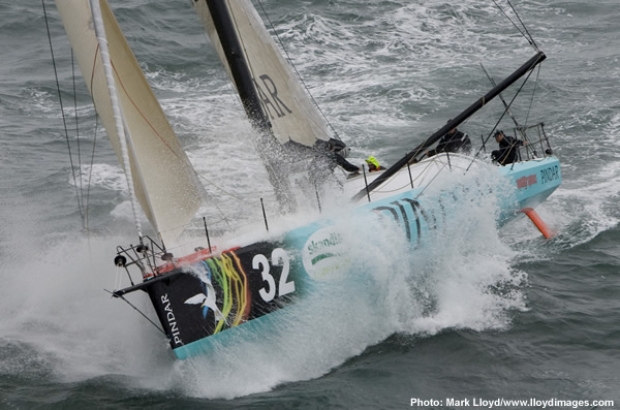
The big beast
Thursday August 7th 2008, Author: James Boyd, Location: United Kingdom
As we wrote earlier this week, a dark year including a skipper change and two dismastings finally came to an end on Tuesday (touch wood) for the Pindar IMOCA Open 60 campaign when she won the Artemis Challenge. There are no doubt detractors putting this victory down to it being a fully crewed race or to there being reasonable breeze and her having the most stability of all the IMOCA Open 60 fleet, but in that race on all but the deepest downwind legs she was putting distance on her competitors. Given Tuesday’s performance does
Pindar represent the way ahead for the IMOCA Open 60 class?
Being a Juan Kouyoumdjian design, of course there has been no shortage of controversy surrounding the latest Pindar. While on the one hand there have been the issues with her first mast, on the other Juan K’s extreme approach to designing an Open 60 with the tallest mast (that initially could be canted fore and aft), biggest sail area, widest beam, most water ballast and biggest bulb, has prompted the IMOCA class to start looking at whether it should be limiting these areas of their supposedly ‘open’ box rule.
The class’ biggest area of concern was certainly the mast canting. The Sodebo Open 60 in the late 1990s, originally built for Raphael Dinelli and then taken over by Thomas Coville, was fitted with a mast that canted from side to side. Despite winning the 1999 Transat Jacques Vabre in this configuration it was subsequently banned by the class in order to limit costs. Thus adjustable fore and aft rake was almost certain to be banned too so one of the modifications the Pindar team made to the boat over the winter has been to fix their new rig.
The new spar, built by Lorimar, is of the same height as the old one – ie 30m off the deck and with a mainsail 12sqm larger than a VO70’s! - but she has been engineered by Herve Devaux who has worked on many of the top French wingmasts on both monohulls and multis, as well as the rigs for ABN AMRO One. Following their dismasting, the new mast is ‘bulletproof’ and its carbon fibre laminate is all monolithic, up to 35mm thick in places. With the rig now fixed fore and aft, so all the hydraulics on board (apart from the keel) have been removed, including the substantial hydraulic ram tucked inside the bow for the no2 stay. This was a major operation for the team over the winter, but has resulted in a substantial weight saving in one of the ends of the boat.
The latest trend in Open 60s is for this stay, one in from the bow, to be fixed permanently. The previous set-up on board required the rig to be canted forward in order for the J1 to be fitted. However now all the headsails, apart from the no2, have halyard locks and a tack line system running back through a jammer along the foredeck via a cascade - a straight copy from ABN AMRO One (and previously used on the ORMA tris). The only change they are likely to make to this is fitting a new type of Spinlock jammer that can be opened and closed by remote from the cockpit (as Leopard currently have).
On Pindar, they have halyard locks on the J1, J3 and the fractional halyard and these are made by French manufacture Facnor, who’s locks are also used on many of the top French IMOCA 60s such as Foncia and Gitana Eighty. According to Pindar’s shore manager Nick Black, Facnor’s hooks are geat when it comes to simplicity and ease of use but are larger and chunkier than the competition, so not good for windage. “If you had a bigger mast and could build them on the inside, like a big multihull then they would be shit hot. Unfortunately we couldn’t build them in,” says Black.
Other changes to the rig/sail plan have been the bowsprit. The conventional solid bowsprit has been replaced by a tubular affair that has been designed to make it easier for skipper Brian Thompson to get the tack of kites out to the end of the bowsprit without them falling in the water to leeward.
The deck spreader arrangement has also been changed as these no longer have to follow the cant of the mast. According to Nick Black: “The deck spreaders are longer. This increases the shroud base and there is a bigger angle that the cap shroud comes in at the top. So the cap shroud ratios are different and the way they enter the mast is different.”
Another major job for the team over the winter was changing the position of the padeyes on the sidedecks used for the barber hauler controls for the ABN AMRO-style ring headsail sheet leads.
Of course while the mast no longer cants fore and aft it is still a giant rotating wingmast with a large spanner protruding from its forward side fitted with lines to controls its rotation - a feature Brian Thompson will be very used to following his lengthy career racing big racing multihulls.
One of the most scary features of the rig is the boom and in particular its low height above the cockpit. According to Nick Black this is actually higher than it was previously, but still seems perilously low particularly given Pindar's towering skipper. An unusual aspect of the boom is that it is fitted with no vang system. Traditionally Open 60s have their boom attached to the foot of the mast and are angled up as they go aft thereby avoiding the headroom issue. However when he redesigned the rig for the previous Pindar (now Artemis 1) Mike Sanderson re-established the trend for a conventional horizontal boom attached to the back of the mast. On that boat the boom was fitted with a rope cascade vang arrangement (also used on ABN AMRO One) but on the new Pindar there is no vang at all, which Nick Black attributes to their having such a wide boat and a full width mainsheet track.
As we mentioned in Tuesday’s article, another substantial alteration to the boat was the reworking of the back end of the cabintop and the addition of the coamings along the sides of the cockpit. The coaming now encloses all the lines running aft from the mast (previously they were run externally). A further modification is to be made when the boat goes into refit in September, will be the fitting of a big spray dodger covering the gap between the coamings that will fit on a rail allowing it to be drawn back to the forward grinder.
While many Open 60s now are fitted with kick-up rudders, with many skippers viewing them as a mixed blessing, on Pindar they have gone down the same route as the Owen Clarke designs in having their twin rudders fixed. So what happens if they break one? “We’ll have a spare cassette arrangement that you drop over the back,” says Black. “It’s a little like what Artemis have done, but it is on the back on the boat. It is not an emergency rudder, I think of it like another rudder.”
Like Ecover, Pindar has twin wheel steering and twin pedestal grinders. Two grinders might seem excessive for a boat destined to be singlehanded in the Vendee Globe, but it is relatively light weight and allows the aft pedestal, primarily used to control the mainsheet, to be within easy reach of the helm. It is also something to grab hold of in the middle of the cockpit. On the back of the aft pedestal are the controls for the engine and the keel canting.
The only other unusual aspect of Pindar’s cockpit layout is that she has seven winches including a dedicated mainsheet and runner winches with the pit area divided (unlike the central pit area and single winch set-up to be found between the twin companionways on the Farr Open 60s).
For electronics she uses B&G H3000 and has two pilots - one fitted to each rudder stock. According to Black the autopilot set-up on the British Open 60s is now becoming fairly standardised with the B&G performance instrument package controlling Raymarine electric rotary driven rams (B&G’s ram is hydraulic, uses a lot of power and is heavy). Many of the French boats also have this set up but many are also using an all-NKE package.
Down below is of course a massive expansive of unpainted black carbon fibre, showing off Mick Cookson’s immaculate build quality. Entirely free of mod cons, the only feature of the main accommodation area is the tiny chart table. No laying out of Admiralty charts here…the chart table, with its large bank of electronics above, is wide enough only for a laptop computer fitted beneath a carbon fibre turntable with only the screen popping out (a remote keyboard is used), but this is adequate for Brian Thompson to sit in the well beneath it to face forward or to sit up to weather.
The chart table is slung off a V-shaped bulkhead that also handles the loads for the deck spreaders at its top and the aft end of the canting keel pin at the bottom. According to Nick Black this bulkhead alone cost more than a Mini Transat boat to build with 3,500 manhours going into its creation.
The big gear is of course to be found in front of this bulkhead in the form of the canting keel. On Pindar they have a Cariboni twin ram set-up that is fairly belt and braces. According to Black the keel set-up is very similar to ABN AMRO but when we start trying to find out if the pin is on the horizontal plane or angled (remember the controversy over this aspect of ABN AMRO Two prior to the start of the last Volvo?) and what effect this might have on the foil and bulb our man starts getting shifty and looking at his watch…
Aft of the chart table is a carbon fibre hump hiding the engine compartment but the rest of the ‘floor’ is made up of either fuel tanks or water tanks, their slightly irregular shapes due to Juan K and his team optimising the positioning of this ballast.
While the majority of Open 60s have three sets of water tanks each side ( Ecover in fact has five with three sets aft), Pindar strikes the medium with four tanks - forward, middle, cockpit aft and aft. So why the need for two sets of tanks aft? The reason seems to be that the tanks are used on different occasions. When the boat is heeled only the aft cockpit tank is filled while when the boat is sailing flatter both sets of aft tanks are used.
Interestingly the way they use the water ballast tanks appears to be very different to how they use them on the Finot-Conq designed Hugo Boss, with whom they are carrying out testing. As Black explains: “We have not used the forward tanks on this yet. It is very different. We did some testing with Hugo Boss and they sit quite heavily on their stern whereas we are quite nose down. So we ballast aft all the time and they ballast forward all the time.”
On either side of what might be terms the ‘saloon’ area, are two giant manifolds for the water intakes, beautiful affairs custom-built in carbon fibre by Mick Cookson. But the most striking feature of Pindar’s water ballast is the sheer volume of it. While the majority of IMOCA Open 60s are carrying around 5 tonnes of ballast roughly along the centreline of the boat (although tanks are separated in the aft compartment due to their beam in this section) on Pindar it is much more. If the boat weighs perhaps 10 tonnes (roughly 1.5-2 tonnes more than other IMOCA Open 60s) then according to Black very roughly they can bring on another two thirds of their displacement (6.6 tonnes) in water in their weather tanks! So if in the Vendee Globe Pindar trucks away from the fleet in big conditions then you will understand why.
However there remains the issue of the sheer size of the rig and its sails and how a singlehanded sailor is supposed to handle them. Thompson is a big, if not burly guy. There are coffee grinders of course but according to Black when Thompson is out on the water he simply reefs earlier. He cites the example of the J1 which singlehanded they use in up to 12 knots but on a fully crewed boat might be pushed to 15-17. And in turn because they reef earlier they can reduce the dernier of the sail cloth making the sails lighter and more manageable. “You just change the way you think about the whole thing,” says Black.
In addition to this, due to the size of the mainsail they are believed to be the only Open 60 with four reef points in the mainsail. Interestingly the top two reef positions are close to full main, within 3m of full hoist, so that rather like the twin set of gears you find on a bicycle, Thompson will be able fine tune his mainsail area as well as his headsails. As a result the intention is to sail the Vendee with just nine sails (some teams are believed to be taking as many as 13) thereby further saving weight.
Longer term there remains the issue of whether the future of Open 60s is in boats like the new Pindar. The IMOCA class generally thinks not, although throughout the lengthy history of the class there are examples of boats which have taken a quantum leap in terms of sail area and power. At a time when costs of Open 60s are soaring, Pindar stands out as a boat that compared to the ‘norm’ is too big and too powerful - two items that the class are claiming as being linked with cost (which they of course can be). However in the case of Pindar we suspect she cost very much less than any of her European-built rivals - the figures of £2.2 million for the boat sailing back in the UK, compared to around £2.6 million for a European built boat have been bandied about. Nick Black also says that wide, powerful boats are also much safer since they are so much more stable when gybing.
The IMOCA class association are absolutely correct in attempting to limit the costs of Open 60 campaigns, especially at a time when the global economy is looking shakey, in order to prevent their class going the same way as the ORMA 60, but will the effect of limiting the IMOCA Open 60 box rule place the lid on costs? Not a chance! Look at America's Cup or Volvo Ocean Race campaigns where the box rules in both classes are all much much tighter and yet the teams still manage to spend zillions more than is spent on Open 60s. In fact history shows that in most instances the tighter the box the more money is typically spent by teams as they have to work harder in attempting to get the edge. IMOCA are much better off limiting the potential big spends of sail development and materials and hoping that eventually there does come a size when a boat is too big and powerful for one man to sail efficiently. In this respect we wait to see if Pindar has gone beyond the limit.
Most Read
Most Commented
Comments
Businesses


Pro businesses
Editor's choice
Member blogs
-
 Ned Collier Wakefield: MOD70 round BarbadosWell that was intense. 12 hard fought for seconds for the win. In idyllic conditions, Tony Lawsons MOD ...
 -
 Mini Transat leg 2 reportThe second leg of the Mini Transat started on 31st October, just over a month after ...
 -
Leg 1 reportI’ve been working towards the Mini Transat now for three years. In 2013 I was part ...
Business blogs
-
 The Island Sailing Club in Cowes, Isle of Wight, is delighted that Prince Michael of Kent ...
 -
Peta Stuart-Hunt chats with the 25 year-old British solo sailor Lizzy Foreman before she sets sail ...
-
The 2015 Student Yachting World Cup (SYWoC), an ISAF-recognised event hosted and run by students for ...
Editor's Choice
All time favourites...
-
 Three legs down into Ian Walker’s
 -
 Winning all but two races at
 -
 For the first time in its
Latest Comments
Add a comment - Members log in