
The ugly duckling
Tuesday June 10th 2008, Author: James Boyd, Location: United Kingdom
One of the novel features of this year’s Volvo Ocean Race is that thanks to Juan Kouyoumdjian signing exclusively with Ericsson, and subsequently Farr with Telefonica, so a lot more design houses have become involved. And so it is that Rob Humphreys and his team, now including able son Tom, at Humphreys Yacht Design in Lymington have penned their first Volvo boat since
Dolphin & Youth back in 1993-4.
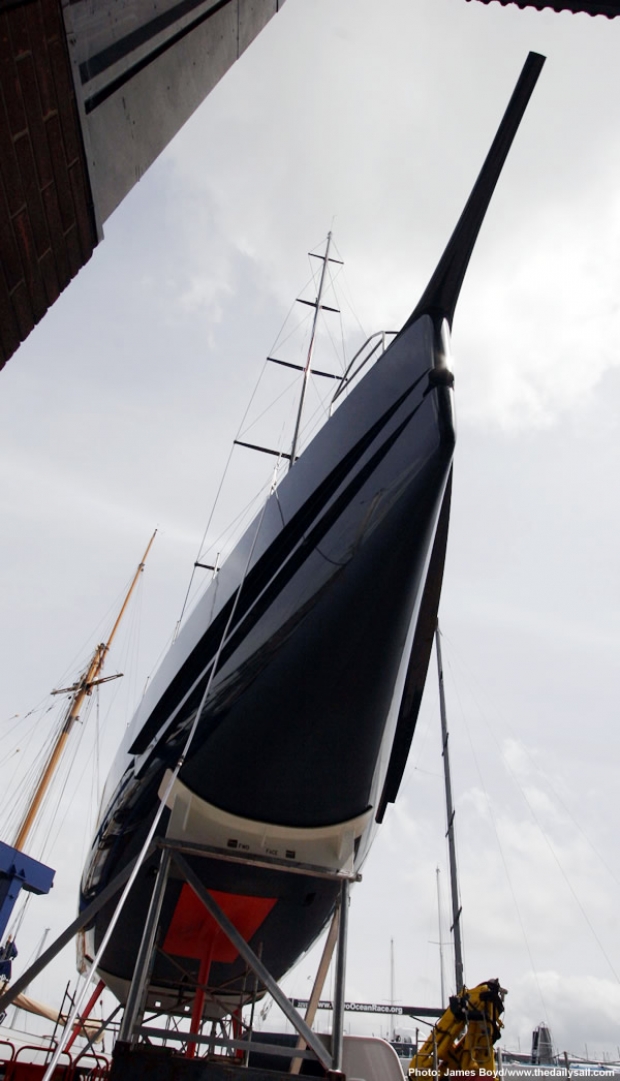
Traditionally Humphreys does not shy away from design innovation and so it was that when Oleg Zherebtsov’s Team Russia VO70 emerged from Green Marine recently, there were gasps of amazement, for aside from a rather blunt looking bow, just above the waterline running down each side of the hull were a pair of pronounced spray rails. These are not the stick-on variety seen recently on some of the Farr Open 60s, but are fully part of the hull. And 7m back from the bow they simply stop. Abruptly. As the regular hull resumes.
“They are just there to keep the crew dry!” quips skipper Andreas Hanakamp, who has co-ordinated the project on behalf of the Lenta hypemarket chain boss, Zherebtsov, who is fielding the race’s only privately funded campaign.


On a more serious note Hanakamp adds that Humphries recently has carried out a lot of design work on power boats and this included R&D into spray rails, which are a common feature of high speed power boats. “The whole concept started up when we were talking about how these boats are sailing and there is not so much different to power boats now. They are like sail-driven powerboats the speeds they are doing. And Rob said ‘I think there are some concepts from powerboats you might want to look at’. He obviously had the idea in his mind for quite some time, but he wasn’t sure whether he could approach us and whether it was too radical.”
Obviously the idea behind spray rails - as is the case for the Open 60s (see Patrick Shaughnessy's explanation of these here) - is to shed water from the topsides and therefore reduce drag. As the bow is immersed they also provide an increase in volume and lift. “And there are some other things we recognised too…” says Hanakamp cryptically. Fast power boats tend to have four or five smaller spray rails but Team Russia has two sets which is presumably a function of her 30-40 knot speed potential rather than 90-100 knots. The spray rails are designed so that they are not immersed in light conditions. Significantly it also allows a narrower waterline forward compared to some of the other VO70s. “It also means that you also get more lift out of that, and if you get more lift there you need less rocker, less rocker means you can get a faster planning hull with higher speed,” Hanakamp adds.

The spray rails are technically ‘hollows’ but under the VO70 rule these are allowed within the front 7m of the boat. “The results in the tank were so promising that by fairing them in we would have lost too much,” says Hanakamp of why they stop so suddenly. “The other issue was that they had to be part of the hull, so you can’t put them on as a fitting, so you couldn’t put them on and off. So you have to make the call - do it or don’t do it and they are part of the hull now. We don’t think people can retrofit them unless they chop off the bow – which would be a big call.”
However one of the added unspoken benefits is certain to be a slight element of the ‘stepped hull’ – another powerboat feature, we have written about previously when it was tried on Yves Parlier’s ultra-radical catamaran Mediatis Region Aquitaine (read more about this here)
The downside is a weight penalty, plus windage in light conditions and presumably drag in light-moderate, but one imagines the crew will sail the boat very conscious of heel angle. While the boats this time will spend a lot more time in the Doldrums with the new Indian Ocean and Far East sections of the race and there is certain to be more light wind, it should not be forgotten that VO70s are powered up in just 6 knots and looking at full ballast in less than 10.
According to Hanakamp the concept of the boat - and this is something which appears to be the case with all the new VO70s - is to go for maximum power, which in VO70 terms means maximum bulb/keel weight, maximum beam and allowable sail area. Hanakamp explains that Team Russia CEO, Michael Woods (Race Director of the VOR before Glenn Bourke) advised that usually in the race it was the boat that could handle the most power that typically won (along with being best prepared). However he adds that while they have made bold calls in some areas of their boat such as the spray rails, they have not gone so extreme elsewhere - an example is the chines, which are not as extreme as some of the other boats.
“If you compare these boats with Open 60s they are not very radical,” says Hanakamp. “The length:beam ratio is slightly narrower than Kingfisher which is an eight years old boat. People perceive them as radical boats but the design parameters are not so radical.”
There were a few other factors influencing how their boat ended up. Significant last summer the goalposts changed. Initially Hanakamp says that Oleg Zherebtsov had wanted a lower budget campaign, but after competing in the Rolex Fastnet Race last year, decided that instead he would prefer a stab at winning. So at this point the budget was increased.
Design-wise Hanakamp points out that there seemed to be little point in going down the same route Juan K/ABN AMRO route as Ericsson have done - starting a year later and with less budget, it would have been all but impossible to overtake them. From the outset Hanakamp tried to establish a creative environment where the team members could express their ideas. This creative group included a wide range of people from on the design side the Humphreys team, engineer Will Brook (ABN AMRO/Prada, etc), Richard Pemberton (CFD), project manager Tim Dean, North UK sail designer Jeremy Elliott, members of the sailing team such as Guillermo Altadill and Stig Westergaard, to weather routers Jean-Yves Bernot and Jure Jarmin, etc.
Ideas were added to the melting pot and the ones chosen were duly put through their paces in CFD and in the tank. According to Hanakamp four models were tested in the tank, including more R&D into the spray rails.
The significant problem - of teams paring the maximum amount of weight from the boat in order to slap it on the bulb - doesn’t appear to have been solved, despite Volvo introducing a maximum combined weight for the keel and foil this time. In fact teams have been struggling to shed enough weight upstairs to achieve maximum bulb weight, perhaps an indication of what a good job the ABN AMRO One team did last time.
“You are limited with the keel weight and with the overall boat weight, so to get to the maximum keel weight you really have to turn every individual item upside down and consider whether you can make it lighter,” confirms Hanakamp. “One way to see it is a trade off between beam and keel weight - you are driven to go as light as possible to get maximum beam and maximum bulb weight. If you have a maximum beam boat and you fulfil all the rule requirements, it is very very hard to achieve. You are spending a lot of money for the odd kilo.”
While Team Russia doesn’t have the budget of say Ericsson or Telefonica, they have spent their money wisely. As an example they chose to build at Green Marine, who in the past have been responsible for many of the top builds - typically Atlant’s projects such as EF, Assa Abloy and Ericsson, along with of course an assortment of TP52s and Cup boats.
“They have a very good track record. They are probably not the cheapest, but 18 months out from the start there was not a lot of room for errors or hiccups," says Hanakamp. "There is a brilliant boatyard in the middle of Croatia, but going there with our own team - we would have lost so much time. One way of avoiding creating a very big team early on, and the troubles of growing too quick, is pulling together independent entities and making them collaborate. So that’s what Michael and I focussed upon.”
Another reason to go to Green Marine was after the numerous breakages in the last Volvo Ocean Race, combined with the change of course and sped up schedule for this race, they were adamant that the boat be reliable from the outset. “If you look at the pace of the race and the duration of the stopovers, you don’t have time to make a full repair of the boat if you have a major failure. If you come into a stop very late you miss the next leg and you pick up so many points that it is very hard to recover. And you might miss two legs.
HallSpars in the US have built the rig (Hall in Holland have an exclusive arrangement with Telefonica), although with input from project manager Tim Dean, formerly of Sparcraft and Formula Spars. At present Team Russia have locks on all halyards, a mix of Hall’s own system and Karver locks, but they are having a second rig and this will be all Hall locks. While all the other VO70s have gone for Southern Spars’ C6 carbon fibre rigging, Team Russia is the only one to go for Future Fibres PBO. “We have wind drag analysis with the carbon rigging, and we don’t see too much disadvantage for what will hopefully be a more reliable solution," says Hanakamp. Certainly there are many more boats that have made it around the world with PBO rigging that carbon.
With the design and build in Lymington, Hanakamp says they vaguely attempted to keep suppliers local. This is one reason why they have fitted a Lewmar winch and triple pedestal package, with Ronstan deck gear - however there is also Harken gear on there too. Navtec have supplied the hydraulics for the sail controls, however Greg Waters/Central Coast have supplied and fitted the hydraulics for the canting keel mechanism. We weren’t able to have a look at this as Hanakamp says that the structure around the keel area is another departure from the norm – some cunning conjured up between engineers Will Brook and John Lovell.
Looking around the deck, the steering positions at present lack the giant scaffolding being fitted on other boats (as seen on ABN AMRO One) last time to protect the helmsman. Significantly there is a lack of winches - around three less, losing the runner winches and a pit winch. The boat also has an elevated main sheet track (something they shed on ABN AMRO One to save weight compared to ABN AMRO Two).
Another significant difference this time around is that boats are allowed to fly masthead furling Code Zeros. This has presented another puzzle to solve. “It will be a handful,” admits Hanakamp. “The challenge is with 300sqm they are just on the limit to make it a nice upwind sail. If you have a little bit too much forestay sag you have to add girth at the end to sheet it otherwise you fall under the 300m. To be spot on the 300sqm you have to have minimum headstay sag which means you have to apply considerable load on the topmast backstay, and so you have to put structure in the boat and in the rig. Some teams might say they don’t need the Code Zero so much upwind - they are going to have it more reaching orientated and sacrifice a real VMG upwind Code Zero, then you can build the structure lighter. The rule gives some freedom in a very subtle way but it is a strategic decision you have to take very early on and it drives you throughout the project. But if you don’t have a stiff enough boat and you need this upwind VMG, then you are stuffed. That was my racing background as well as Stig’s – it might be a reaching race, so you have to have a boat that is very good at reaching, but in every race you just want to be able to sail higher and faster than the other guy or lower and faster. So that is something that has to drive the design.”
While their boat has no more protection in the cockpit than any of the other new generation VO70s (added protection equals added and unwelcome weight that could be in the bulb) Hanakamp says they are well aware of what crew-breaking boats VO70s are. They have attempt to develop their sail wardrobe with this in mind.
“With the speeds these boats are doing, you want to limit the number of sail changes you have to do on one stay. So you try to develop a system where you go from the headstay to an inner forestay or to the sprit and develop the sails in this way. We don’t know if we will go with a TuffLuff or the PBO stay. We have designed the mast so that we can do it. We are aware of the danger of wearing down people if we make sail changes too aggressively.”
As of today the Team Russia boat has been sailing for the first time, but only under mainsail. The team intend to work her up slowly in Gosport until the end of the month where they will decamp to Portland.
According to Hanakamp most of the crew has been finalised. While he will be skipper Stig Westergaard and Guillermo Altadill will be watch captains with Wouter Verbraak navigator. However they are still trying hard to get some more Russians on board. At present the only Russian announced aside from owner Oleg Zherebtsov is 49er ace Rodian Luka who has been part of the team since last year. However getting more Russians on board is proving problematic. There is the issue of language but also experience on such fast powerful boats counts for a huge amount. The only past Volvo experience they have on the team is one of their sailmakers who was with Fazisi, Hetman and Odessa.

Most Read
Most Commented
Comments
Businesses

Pro businesses
-
Italy
-
France
-
France
-
Editor's choice
Member blogs
-
 Ned Collier Wakefield: MOD70 round BarbadosWell that was intense. 12 hard fought for seconds for the win. In idyllic conditions, Tony Lawsons MOD ...
 -
 Mini Transat leg 2 reportThe second leg of the Mini Transat started on 31st October, just over a month after ...
 -
Leg 1 reportI’ve been working towards the Mini Transat now for three years. In 2013 I was part ...
Business blogs
-
 The Island Sailing Club in Cowes, Isle of Wight, is delighted that Prince Michael of Kent ...
 -
Peta Stuart-Hunt chats with the 25 year-old British solo sailor Lizzy Foreman before she sets sail ...
-
The 2015 Student Yachting World Cup (SYWoC), an ISAF-recognised event hosted and run by students for ...
Editor's Choice
All time favourites...
-
 Three legs down into Ian Walker’s
 -
 Winning all but two races at
 -
 For the first time in its
Latest Comments
Add a comment - Members log in