
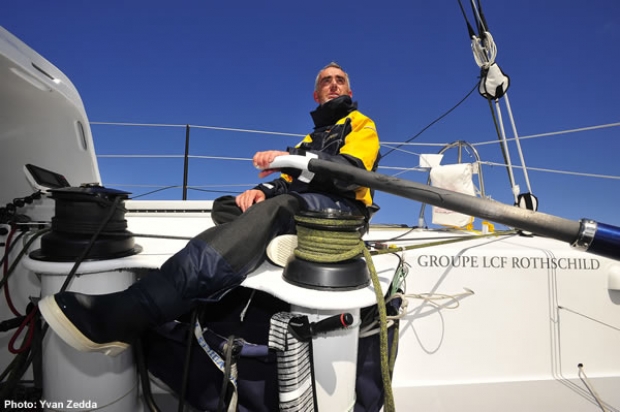
From ORMA to Open 60
Tuesday May 20th 2008, Author: James Boyd, Location: United Kingdom
Vincent Riou must not be in a very nice place at the moment - for closing on him in the Artemis Transat is Loick Peyron and
Gitana Eighty. One of the most experienced shorthanded offshore racing sailors in France, Peyron has previously competed in more than 40 transatlantic races, and, incrediblly, this will be his 17th singlehanded. Significantly his lengthy track record includes two wins in this race in 1992 and 1996 aboard his trimaran
Fujicolor.
Aside from being Gitana Eighty’s skipper, Peyron also runs the Gitana team and its impressive fleet of Baron Benjamin de Rothschild's yachts and so far 2008 has been good to them. Before the Artemis Transat Gitana Eighty won the speed trials in Douarnanez (admittedly there were only two races) and before that they won the Open 7.50 class at Spi Ouest ahead of his old ORMA 60 rivals Franck Cammas, Marc Guillemot and Pascal Bidegorry.
Before the start of the Artemis Transat Peyron arrived in Plymouth fresh from Lake Geneva where he had been racing on Nicolas Grange’s D35 Okalys, winning the Grand Prix Chopard – only point ahead of Alinghi, steered by Ernesto Bertarelli but including a crew of Cup heavy weights such as Murray Jones while Alain Gautier’s Foncia was third, and Franck Cammas and John Kostecki sailing on Zen where way down the results table...
The significant difference for Peyron in competing in the Artemis Transat this year is that this is the first time, in 24 years of competing in this race, that he is aboard a monohull. Since he last sailed in it in 1996, the route has also changed with the finish moving from Newport, Rhode Island to Boston and this year there is also the ice gate he passed through last night, further altering the race course.
His new steed is of course Gitana Eighty, from Farr Yacht Design and sistership to Barcelona World Race winner, Jean-Pierre Dick’s Paprec Virbac 2. Both boats were built down at Southern Ocean Marine in New Zealand, Peyron’s boat benefitted from being the second to launch.
Among the new Farr-designed IMOCA Open 60s, these boats are unique for having a movable trim tab/planing board beneath their transom. They are believed to have a tad less beam, and Peyron says they are a bit fuller in the bow section (‘the cheeks’ as they are nicely described in French) and certainly have more rocker - a function of being fitted with the trim tab/planing board.
Having crossed the Atlantic twice already prior to the Artemis Transat, how has Peyron been getting on with the trim tabs/planing boards? “They are useful if you have more rocker,” he emphasises. “The goal with no flaps is to make a natural exit for the water. When they are down you become like PRB/ Foncia, etc. The interesting thing is that you can become MORE like that [ie you can have an even more powerful stern profile] because sometimes when you are upwind or reaching you can push the bow more in the water and that is interesting.” This effect seems similar to that found on International 14s which are fast when the crew are standing right at the back of the rack counteracting the lift derived from the T-foil on their rudder. On Gitana Eighty pumping water ballast into the aft tanks powers up the boat, while lowering the tabs pushes the bow down.
“The flaps are working -2° to +5°,” Peyron continues his explanation. “The -2 is very useful in light wind when you have less drag at the back and in very strong winds you have the +5 when you want push your ‘ass’ hard with ballast, etc.”
Does this mean you can get away with less water ballast? “It means, it could be useful to have more water ballast at the back,” Peyron rights us. “But it means you have another thing to do. There is a lot of work on these boats, a lot of things to adjust all the time – daggerboard, keel, rudders, etc. A multihull is a lot more simple!”
While Paprec Virbac 2 is similar to Peyron's 60 in many ways – they have the same hull, deck, appendages and sail area - Gitana Eighty is free of hydraulics (with the exception of the keel) and Peyron has modified some details of the deck set-up such as a port sheet winch that rotates the opposite way, a different pit layout and no jib tracks - lightweight, but a slight complication singlehanded Peyron admits.
Both boats have the three part sliding hatch that effectively protects the entire cockpit while down below they have the extraordinary turntable arrangement that has the chart table at one end and the stack at the other (see the video of this spectacular set-up on Paprec Virbac 2 here). However on Gitana Eighty more of the electrics are fitted to the stack end that can be hauled up to weather.
But the most obvious difference is aloft. While Paprec-Virbac 2 has a rig set-up similar to Mike Golding’s Ecover, with a small section rotating wingmast with a lower rotating diamond, Gitana Eighty is fitted with a fixed mast. This seems an odd decision given Peyron’s multihull background (in fact Marc Guillemot, who comes from the ORMA circuit too, also has a fixed rig on Safran).
Peyron says he doesn’t like the idea of a wingmast on IMOCA Open 60s. “I know how efficient a wingmast can be on a multihull for sure. The first work with J-P [Dick] on Virbac was to have a wingmast, but not a big one, just a small cord and when you are talking about a small cord on a monohull you need to have classic rigging - so some rotating spreaders and everything else. So we first started with the same rig as Virbac and after a while I saw the evolution of that rig and I wasn’t happy with it, because the other goal - because of the rules, the stability rules and a lot of other reasons - I think maybe it is more efficient to have a lighter rig. That is my feeling. For efficency.
“On a multihull you have high aerodynamic efficiency because those boats are fast and because the main is very heavily sheeted, which is not the case on monohulls. A lot of time you are twisting sails on monohulls, which is not the case on multihulls. So when you have a look to the external part of the wing which is not twisting, which is straight, and the sail after that which is twisting, that is a lot more awful than a classic small mast and a twisting sail.”
In fact Peyron admits he doesn’t particularly like the rigid wingmasts found on multihulls and in the past with his ill-fated Fujifilm trimaran he attempted to get the wingmast structured in such a way that it could twist. Sadly that mast came tumbling down at the ORMA Fecamps Grand Prix in 2001.
Returning to his monohull Peyron says that instead of a wingmast they chose a classic fixed rig focussing on reducing weight from the rig and lowering windage. To achieve this Peyron and the Gitana team have developed some new continuous PBO rigging with Italian manufacturer Maffioli (as Spars Spars have with their carbon Element C6 rigging).

Peyron says he considered carbon rigging but reckoned the technology to be too new to take on the Vendee Globe. Doing some crystal ball gazing he reckons the ultimate step will be to have rigging bonded to the mast so that the mast and rigging will no longer be thought of separately.
Since returning from Brazil last year in the singlehanded Ecover Transat B2B, which Gitana Eighty won, they have also changed the mast. The new spar is made in M46 carbon and is lighter, however the significant difference is that despite it being fixed the spreaders are hinged. “On these boats most of the time the main is pulling a lot on the lower spreader, so the mast is twisting far too much,” says Peyron. So the hinge simply allows the spreaders to move as they want.
On the subject of rigs Peyron provides a view on Artemis’ new wingmast with its concave trailing edge. “It was a nice rig for multihulls, but it was not really useful because with the trailing edge like that it is a mess to adjust the mainsail. When you need full main all the time, like on sand yachts, it is okay. But I really don’t agree with it. It is made to change the shape - if you twist the mast you flatten the middle of the main a lot - if it is up... By the time you take a reef the shape of the main is totally different and it is a big mess to adjust.”
Peyron says the Artemis/ Pindar approach is entirely the opposite of what they have tried to achieve on Gitana Eighty. “We have been working on weight and I think it is important to be as light as possible at the top for the righting moment, and the safety and the rule, etc, so we can see you have two totally different responses.”
Peyron’s observation of the Anglo-Saxon boats - in particular he is referring to Hugo Boss, Artemis and Pindar - is that they appear heavy and more powerful and generally look like boats designed for crewed racing. While on paper they are fast because they are powerful, how efficiently can they be sailed singlehanded?

Back to Gitana Eighty and generally this year Peyron says they are focussing on the reliability of everything on board prior to setting off on the Vendee Globe. “We are looking at what happens with all the pieces, all the lines - hopefully we have no structural problems, no keel problems. On the rudder all the parts are now perfectly smooth and perfectly adjusted, which was not the case before.” Over the winter they have also added two bubbles in the cabintop enabling Peyron to check on the sail trim while down below.
While the IMOCA class is hugely buoyant at present with 20 new Open 60s having been built over the last four year cycle, there is a widely held fear that the class will blow apart after this Vendee Globe just as the ORMA class did following the disastrous 2002 Route du Rhum when the bumper fleet of 60ft trimarans competed, but only three finished and only one without stopping (in this race Peyron had to abandon Fujifilm when it broke up beneath him).
“It is interesting to see that everyone is looking carefully to the future and thinking about what could be done to reduce the speed of the game,” says Peyron. However he adds that IMOCA’s present situation is different to that of ORMA. Despite the carnage in recent months with numerous boats experiencing mast breakages, these breakage have not been as terminal or as expensive to fix as they were when the tris were breaking up or were lost. Given past history we can expect that during the Vendee Globe there will be roughly a 50% attrition race (more if the weather is bad, less if it is easier going) but given that there are so many more boats the perception will be that there is more carnage.
Also Peyron points out that the make-up of the IMOCA class is very different. While the ORMA was exclusively French, in IMOCA there are many top competitors from abroad - in particular the UK, but also Switzerland, the US, Canada and Spain. And unlike ORMA there is no Groupama 2 equivalent - one boat winning all the races or unrivalled inshore at least. Recently different boats have been winning all of the IMOCA races: Virbac Paprec 2 the Barcelona World Race, Gitana Eighty the Transat B2B, Foncia the Transat Jacques Vabre, PRB the Rolex Fastnet Race, etc.
Back to the Gitana team and following his successful attempts on the New York-San Francisco and San Francisco-Yokohama records, Lionel Lemonchois is now taking Gitana 13 on a record setting tour of the Far East. Meanwhile of their two ORMA 60 trimarans, Gitana 11 is being launched shortly to carry out some PR sailing for clients of LCF Rothschild bank. While Peyron says the tri won’t be racing this year, he anticipated that they will compete in the Transat Jacques Vabre in 2009. This year it is believed that Groupama II and Banque Populaire will race in the Quebec-St Malo, so the ORMA class is not absolutely dead.
As to his future on the IMOCA circuit after the Vendee Globe, Peyron says that at present this is undecided. It depends upon the wishes of the Baron. Competing on the class’ proposed European tour could be interesting for the bank but at present they don’t know the course nor whether it will be singlehanded or fully crewed.
In the shorter term it will be interesting to see over the course of this week whether Peyron can show any of his old magic and nail Riou and his rivals in the 900 miles they have left to run in the Artemis Transat.
Most Read
Most Commented
Comments
Businesses


Pro businesses
Editor's choice
Member blogs
-
 Ned Collier Wakefield: MOD70 round BarbadosWell that was intense. 12 hard fought for seconds for the win. In idyllic conditions, Tony Lawsons MOD ...
 -
 Mini Transat leg 2 reportThe second leg of the Mini Transat started on 31st October, just over a month after ...
 -
Leg 1 reportI’ve been working towards the Mini Transat now for three years. In 2013 I was part ...
Business blogs
-
 The Island Sailing Club in Cowes, Isle of Wight, is delighted that Prince Michael of Kent ...
 -
Peta Stuart-Hunt chats with the 25 year-old British solo sailor Lizzy Foreman before she sets sail ...
-
The 2015 Student Yachting World Cup (SYWoC), an ISAF-recognised event hosted and run by students for ...
Editor's Choice
All time favourites...
-
 Three legs down into Ian Walker’s
 -
 Winning all but two races at
 -
 For the first time in its
Latest Comments
Add a comment - Members log in