
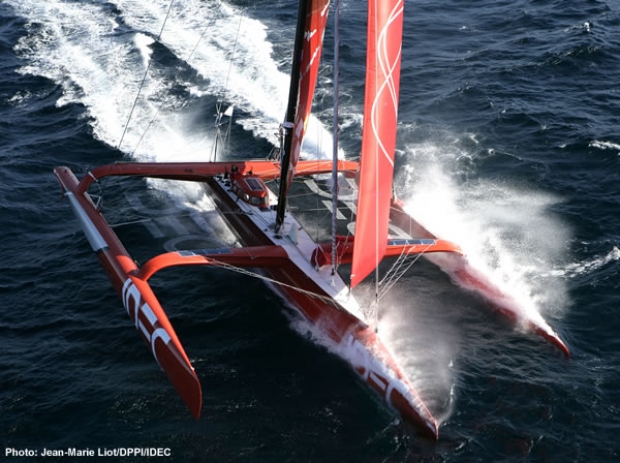
The long snouted round the worlder
Monday January 21st 2008, Author: James Boyd, Location: none selected
|
||||||||||||||||||||||||||||||||||||||||||||||
| Unquestionably one of the main contributors to Francis Joyon's extraordinary solo around the world record was his faithful steed,
IDEC2.
Designed by Nigel Irens and Benoit Cabaret, the boat is a development of Ellen MacArthur's B&Q Castorama. If Ellen's tri was the first boat purpose-built to be sailed singlehanded non-stop around the world, then IDEC2 and Thomas Coville's sistership Sodebo are second generation versions of this. When designing a boat without limitations (ie a rule) for solo sailing or fully crewed for record attempts, the only constraint is the physical power of the solo skipper or the crew. Hence while there may be a signficant difference in LOA between B&Q Castorama and the new big fellas, there is far less in the size of their sail plans. While maxi-trimarans such as Groupama III and Olivier de Kersauson's Geronimo, both designed to be sailed with a full crew, are 'big' boats for their length, IDEC2 may be just 7ft shorter, but is a very much smaller boat. Essentially if you took Ellen's 75ft B&Q Castorama and extended the length of her main hull, for the most part forward, you would end up with the latest generation Irens-Cabaret. Nigel Irens (left) and Benoit Cabaret "This long snout was my thing, but it’s been my thing for 30 years! It is Ilan Voyager…" comments Nigel Irens referring to his slender hulled motorboat quasi-trimaran design from the 1980s, believed to be currently in the Cape Verde islands. "The tradition in the last decade or so has been to make multihulls wider always and the idea is you get a lot heavier, but you get a lot more powerful and you get more powerful quicker than you get heavier and that has been the winning formula. Clearly all that goes out of the window when you are working with singlehanded sailing when your power is absolutely finite." In short ORMA 60 trimarans are limited by their length and have extended outwards and upwards in terms of their sail area. While this may look the business, it probably would not have been the natural evolution of racing trimarans had they not been limited by length. In fact taking on features evident in IDEC2 and Sodebo would certainly have prevented much of the carnage experienced and possibly even the demise of the now defunct ORMA 60 class. Irens continues: "I’m always interested with this idea of going longer, but the first concept is that when you're in the Southern Ocean you have some buoyancy forward in the shape of a fine hull that doesn’t have any weight on it. This allows you to crash into the back of a wave with no problem." On ORMA 60s the floats are generally 60ft long, like the mainhull, however on IDEC2 and Sodebo they are shorter as they were on B&Q Castorama. This comes down to a structural limitation based on the positioning of the forward crossbeam fore and aft - Irens says they would like to extend the bow on the floats further forwards too, but there is a structure-weight limit to this and if they went too far the bow would snap off (as occurred to several 60ft tris in the mid to late 1980s). Unlike the ORMA 60s (but as is also the case with Groupama III) the mast step and forward crossbeam positioning on the main hull have been separated. This has allowed the crossbeam to be moved forward of the mast step, but even so, the floats are still shorter than the main hull. Structurally it is much easier to make the bow longer on the main hull, says Irens. Aside from the longer snout, IDEC and Sodebo have slightly higher crossbeam clearance from the water than Ellen's tri. Otherwise their hull shapes are an elongated version of B&Q Castorama's. Some CFD work was carried out on Sodebo, but Irens says this told them little they didn't already know. "The differences were minimal," he says of the changes they made to the hull when subsequently designing Sodeboafter IDEC. "One of the problems is that tank test work is about optimisation and if you are designing a passenger ferry that is going to operate at 28 knots then that works, but if you are going around the world singlehanded - optimisation for what? So in the end we did change the hull shape, but in a marginal way." 


Showing the particularly long snoutedness of the more recent designs Irens, as he says, has long been an advocate of very long, very narrow hull shapes on his multihull designs. Aside from merely adding buoyancy forward, one aspect of this is that it stabilises pitching, most evident when seeing IDEC2 sail upwind. However it also gives the boat tremendous directional stabiity and this dramatically reduces the power drain from the autopilot (one reason Joyon was able to power IDEC2 round the world only using an alternative energy set-up). Irens cites another advantage of narrow long hulls: "If the main hull is only half in the water on a 60 footer you are left with a very nasty wide convex shape in the water which has quite a lot of drag associated with it, because it is a round surface being sucked downwards all the time. With the long, very unrockered hull and very fine waterline even when it is half in the water it is still a very pleasant shape, with very little drag associated with it." The fact is that the performance of IDEC2 far exceeded the designer's expectations. Prior to the start Irens and Cabaret were expecting the boat to be 2-3 days quicker than Ellen - not two weeks... "The speeds are well beyond what the VPP was suggesting," admits Irens, who says that IDEC2's performance has generally been up across the board, whatever the conditions. This may be due to some little investigated features that occur to hull forms once they get beyond a certain length:beam ratio. "I have always thought that the wave-making drag associated with a slender hull has been more than has been attributed to it, and so obviously when you go longer and thinner you get more wetted surface and less wave making, so maybe that is true." IDEC2 even goes upwind well despite the modest size of her daggerboard (the new Irens-Cabaret boats are not fitted with curved ORMA 60-style foils in their floats - although the structure is in place ready to accept them). Skippers of Irens-designed tris often comment upon their seakindliness and Joyon himself referred to this when comparing IDEC2 to his last boat: "It doesn’t fight the waves. It goes with the waves." However Irens says this is not something they consciously incorporate into their designs. "You need stiffness for the rig obviously. It is the fine waterline. A lot of energy can be lost - that’s why catamarans upwind with both hulls in the water are such a dead loss with both hull fighting each other and energy being pumped away." While slender hulls are key to IDEC2's design it is also true of Sodebo and equally intriguing is that while the two boats are ostensibly very similar, the approach of their two skippers is completely different. IDEC2 is as deliberately low-tech as Sodebo is high tech. For example the construction of IDEC2 by Marsaudon Composites in Lorient was in carbon fibre and foam sandwich (Irens doesn't believe Nomex to be an appropriate core material for these boats due to the intense and prolonged hammering they must withstand) but was built using resin infusion, as some production boats are. In comparison Sodebo was fully pre-preg. Here Irens provides some fascinating insight into the Joyon psyche: "Infusion is way off the pace, but Francis has a philosophy which is based on his wanting to cheapen everything. He knows it is going against the current trend so he uses as an excuse 'that we have a small budget, we don’t have a choice', but in fact he loves it that way and it allows him to experiment and produced things that are revolutionary in a way, but by being cheap and simple rather than being complicated and expensive." This is not a criticism of Joyon, more a tribute. Rumour has it that Coville's campaign budget for Sodebo could be as much as twice that of IDEC2, but it may just seem this way, skewed by Joyon's unique approach. "We are dying to see how Sodebo will do when she really gets a go at this - on paper she is faster." continues Irens. "But the fact that Francis is here [in record time] shows that his approach is not wrong, but we don’t know what the other one can do. Technically it is very interesting - it is very convenient that the approaches are so opposite because maybe we’ll learn something when both have had their say." In comparison to IDEC2, Sodebo is 8ft longer, has a slightly taller mast and more sail area. She also has a different crossbeam configuration - while IDEC2 has twin beams like ORMA 60s of the early 1990s, Sodebo has an X-beam configuration like later ORMA 60s, where the aft end of the cockpit is enclosed by a separate elliptical beam used to mount the main sheet track. Sodebo also has a doghouse to sit in to protect the skipper from the elements, whereas IDEC2 doesn't. 

Sodebo also has the added ORMA 60 go-faster feature of a rig that can be canted to weather. In addition to the weight of ths and the large hydraulic cylinders that go with it, Sodebo is fitted with state of the art satcoms including a sizable Fleet 77 dome and the necessary fuel to run it - none of which was carried on IDEC2. As Joyon puts it he used 15lt of methanol to power his fuel cell round the world while his wind generator weighed around 20kg as did his solar panels. Typically in comparison a marine diesel generation might weight around 150-200kg and on a round the world voyage would need to carry around twice this amount in fuel. While Joyon's approach was low-tech and simple in the extreme, it came with the significant benefits of less gear potentially to break and was also extremely lightweight. So while the displacement figures in the table above suggest there is only a tonne of difference between the two boats, we suspect in ready to go around the world trim there is substantially more variation between the two. One has to ask of Irens what he might try for a third generation of these boats. "Now this is working out well, this whole philosophy of downward spiral winding, in terms of concentrating on reducing drag rather than increasing power and reducing drag by reducing weight. The obvious thought is that you should apply that to fully crewed boats. We have definitely come out saying we do not think it is right to make a big ORMA boat for a big trimaran [here he is refering to Pascal Bidegorry's new 40m long Banque Populaire V ]. We don’t think that is right." Irens makes no bones of the fact that he and Cabaret are very keen to do a bigger version of IDEC2, possibly as long as 50m (164ft), for fully crewed record attempts. "It would be very long and not very wide. It would be a blow up of this." Irens reckons if you kept the beam and weight right down, it could be cheaper than the new Banque Populaire. That would certainly be some boat... More photos of IDEC2 in Brest on the following pages.... |
||||||||||||||||||||||||||||||||||||||||||||||

Most Read
Most Commented
Comments
Businesses


Pro businesses
-
-
United Kingdom
-
-
France
Editor's choice
Member blogs
-
 Ned Collier Wakefield: MOD70 round BarbadosWell that was intense. 12 hard fought for seconds for the win. In idyllic conditions, Tony Lawsons MOD ...
 -
 Mini Transat leg 2 reportThe second leg of the Mini Transat started on 31st October, just over a month after ...
 -
Leg 1 reportI’ve been working towards the Mini Transat now for three years. In 2013 I was part ...
Business blogs
-
 The Island Sailing Club in Cowes, Isle of Wight, is delighted that Prince Michael of Kent ...
 -
Peta Stuart-Hunt chats with the 25 year-old British solo sailor Lizzy Foreman before she sets sail ...
-
The 2015 Student Yachting World Cup (SYWoC), an ISAF-recognised event hosted and run by students for ...
Editor's Choice
All time favourites...
-
 Three legs down into Ian Walker’s
 -
 Winning all but two races at
 -
 For the first time in its
Latest Comments
Add a comment - Members log in