
The STP 65 phenomenon
Friday July 11th 2008, Author: James Boyd, Location: United Kingdom
Global recession? What global recession? While the IRC pocket maxis may be the latest phenomenon in the big boat world, with several new boats, such as Neville Crichton’s latest
Alfa Junior, expected on to the circuit imminently, so as a subset of this the STP65 class is building up its own head of steam. Among the STP 65s Roger Sturgeon’s Farr-designed
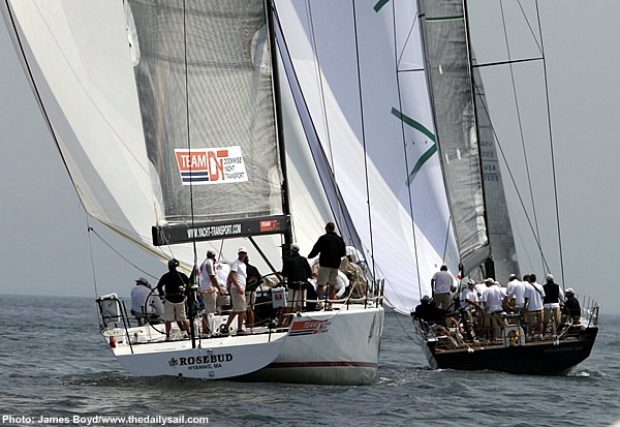
Rosebud was the first to launch, winning last year’s Rolex Sydney Hobart Race, while the latest addition is Jim Swartz’s Reichel Pugh-penned
Moneypenny, that competitors at Cork Week will find themselves up against next week.
Swartz and Sturgeon have been gunning hard to get the class going and at present the tally of STP65s is up to six: in addition to the existing two boats, Udo Schutz’s Judel Vrolijk-designed Container is due to be at the Maxi Worlds in September, while beyond this other new boats are expected for Dario Ferrari, owner of the Farr 40 Cannonball, and also for Prada boss and America’s Cup veteran Patricio Bertelli. More news on this next week.
“We have a lot of interest from one other American group and another European group,” adds Malcolm Park, technical advisor to the class and also project manager for the Rosebud campaign. “It wouldn’t surprise me by the end of the summer if we aren’t announcing two more boats as well. We are thrilled. We were very fortunate to have performed as well as we did in the Hobart to give the class some recognition that even as a box rule boat we can perform well under IRC.”
So what is an STP 65?
In essence, it is a box rule, that could be viewed as the boat the TP52 might have been, had the class not been hijacked by the Audi MedCup and Mediterraneanised.
Park provides some background: “The rule evolved because there was a Storm Trisail 65 rule and Roger [Sturgeon] was going to step forward and build a 65ft boat. But when we looked at that rule it was a little too conservative for our tastes in terms of the sail area:displacement ratio for what we envisioned. So we approached the Transpacific YC [the original creators of the TP52 rule] and with the help of design groups such as Farr Yacht Design and Reichel Pugh and Allan Andrews and Bill Lee, we came up with what we thought a 65ft boat to look like. Then we approached the STC through Ken Read with our proposal. So what is now the STP rule is a compromise between what the ST 65 was and what we envisioned for the TP65.”
So the STP65 is defined by a box that is roughly as follows:
LOA: 19.5-20.01m
Beam: 4.5-4.8m
Draft (max): 4.8m
Freeboard (fwd): 1.750-1.9m
Freeboard (aft): 1.280-1.55m
Displacement: 13-13.4 tonnes
Mainsail height (P): 26.4m
Mainsail foot (E): 9.55m
Mast to headstay (J): 7.6m
Spinnaker height (ISP): 28.8m
Mast to bowsprit (TPS): 10.3m
Spinnaker area: 410sqm
Mast weight: 515kg
There are many other constrains of the box rule such as girth measurements for the sails, etc. In addition to this, the STP65 rule bans moveable ballast and goes to some lengths in specifying minimum requirements of the interior: it must have eight berths (of set minimum dimensions) with mattresses, a galley with a two burner stove and minimum sink size, minimum area for the chart table, an enclosed head compartment with a minimum headroom and size restriction and even minimum panel weights for the head compartment walls! Like the TP52 rule was, some aspects of the STP65 rule are based on IMS measurement such as limits on the Vertical Centre of Gravity.
Like many other classes of this type there is a crew weight limit of 1370kg but the class are attempting to prevent the extreme weight loss regimes often required by crew in other classes. So for example there are penalties for a crew that is too lardy.
One of the most significant features of the STP65 rule is that boats must be fitted with a lifting keel, so that while the max draft is 4.8m, the keel can be hoisted up to 3.33m.
“It could not have gotten the Transpacific YC endorsement without a lifting keel because otherwise that boat won’t fit into any West Coast harbours,” explains Park. “So that wasn’t an option. The reality is that once you start sailing it allows the owners to enjoy venues that they couldn’t enjoy otherwise. We went down to Australia and every single day we could pull into the CYCA with our boat because we had a lifting keel. As opposed to having to go down to the boat yard like Wild Oats had to.” A 4.8m draft also presents mooring problems at other venues such as St Maarten and Key West.
Since the rule was introduced, the only modifications have been a rule that allows twin backstays - Rosebud has one, Moneypenny two. “ Moneypenny specifically - and some of the other boats - now view it to be advantageous to have a square headed mainsail under IRC,” explains Park. “And the way the class rule was written with the single backstay was that you couldn’t have the square headed mainsail.” Other than this there has been a small modification to the rules governing cockpit layout.
“One of the goals of this rule when it was created is that owners have no control of it until there are five measured boat. Then the five owners take over the rule. Before that the Board of Directors control the rule,” continues Park. The board comprises two members of the Transpacific YC and the Storm Trisail Club, plus a Technical Adviser, who is Park. The reason for the owners not having control initially is to prevent what happened in the maxZ86 class where the first owner had a fixed keel boat and was then immediately kicked into touch by the subsequent two owners who both wanted to go canting keel.
Rosebud

Moneypenny
While owners may yet have control of the rule, the class has created an ‘Owners Advisory Committee’ which will first sit at the Maxi Worlds, where the owners will also have their own get-together to start defining a circuit. At present Antigua is lining up to be the first place where all six of the boats will meet however there is a clash of dates with Portofino, so it may not be until next summer and the Rolex Fastnet Race that all the boats get to race.
Once the class is fully established Park expects the circuit to comprise a combination of the ‘classic 500 milers’ such as the Fastnet, Rolex Middle Sea Race, Bermuda Race, Hobart race, Pineapple Cup, etc combined with the select few inshore events such as Maxi Worlds, Key West and some of the Caribbean events.
This circuit Park reckons is what will prevent the STP65 rule going down the increasingly inshore route its smaller sibling, the TP52, has taken. The Class Rule firmly states that its objective is that the rule “is intended to produce a class of fast, centreline keel, yachts that shall be capable of racing inshore and offshore” and cites examples as Transpac, Sydney-Hobart, Fastnet, Block Island and Cowes Week.
So ‘inshore and offshore’ and deeper into the rule this is linked to the ABS standard to which boats have to be built, which Park feels has been one of the failings of the TP52. “There was a loophole within the Transpac rule that said the boats had to be built to a Cat1 standard, but what was not addressed is that that rule does not state for what venue. So, within ABS if you build a boat to a specific standard it has to be for a geographic region. What this STP rule does is that it states the type of races that the boat has to be capable of sailing in, therefore the construction standards of the boats is such that it makes these boats capable of sailing out on the ocean.”
So why would an owner go STP65 rather than IRC racing - the two fundamental choices at this size? The main difference is that under IRC you get to build the boat you want, at whatever size you want, but race under handicap, whereas with an STP65 designing and building the boat is much more laborious having to follow the box rule, but ultimately the racing is better as its boat for boat. Park says it is fortunate that IRC seems to look favourably on the STP65, so in practice they can have the best of both worlds.
“You get closer racing without the handicap. I think at the end of the day, IRC has provided a great venue for these boats, but it is not our goal to handicap race, it is to level race. And it has to be understood that IRC was never designed to be a Grand Prix rule. That is how it is being viewed now, but it was never designed to be that.” (We’re sure this thorny subject will rear its head again in the not too distant future).
The question is with two owners in the States, one in Germany and another two in Italy is it likely that boats could end up being quite different within the box as they are optimised for the races and regions they are most likely to sail in?
On this topic Rosebud’s owner Roger Sturgeon has views: “I am guessing they will be more Mediterranean orientated," he told us of what the Italian boats might be like. "But we do talk. We want to be more places together. You read the rules and it says this has to be capable of doing a Sydney Hobart or Fastnet - you have to build a seaworthy boat and some of the TP52s are getting pretty narrow when it comes to serious offshore race. But I don’t think that precludes them from being a buoy racer, maybe not in the lightest of airs - and especially if you are racing each other.”
But Sturgeon adds: “It is a box rule, you can go windward-leeward, or IRC if you want. We [ Rosebud] are built to be all-around. We want to go anywhere and have a good time. If we win isn’t - that great. If we don’t we had a fabulous time - we were fast. And we are not 30m, we are only 20m. This is a very simple boat. There is no spinnaker pole, there is reaching struts. For us there are no running backstays. It is just a big dinghy. It is a lot of fun.”
Even now there appears to be substantial differences between the two existing STP 65s. First Farr-designed Rosebud was launched around a year before the Reichel-Pugh Moneypenny. Both boats raced recently at the New York YC Annual Regatta and then in the Bermuda Race. In the latter Rosebud had the upper hand.
As Park recounts: “We [ Rosebud] have only had one real line-up with them [Moneypenn] and that was in the Bermuda race and we had a starboard tack layline into the finish of about 180 miles and it was sailed upwind in 11-15 knots and during that one tack we were able to pull out a 25 minute advantage on them. But I’m sure they have a lot left on the table - the boat was brand new and I’m expecting that the next time we line up they will be a stronger boat.”
However even a cursory glance at the two boats indicates that Rosebud is the more offshore-orientated boat. “That’s definitely true in terms of the cockpit layout and basic design shape versus Moneypenny,” says Park. “The only thing that is a contradiction to that is that Moneypenny has chines and Rosebud does not. So you would think with chines they would be more reaching orientated but we haven’t seen that advantage from them yet.”
Park reckons that the new Container, the first offering to the class from Judel-Vrolijk, could be different again - more similar to Dan Myers’ J-V designed Numbers in terms of its hull shape (read more about Numbers here). “I have been really impressed with the Numbers program and that boat and hull shape and what they have done with the boat. So I think at this point I would expect something along the lines of what we have seen with Numbers in terms of the hull shape [of Container] with a very full bow section relative to a boat like Moneypenny, which is very flat in the bow section, but not as powerful a transom as Moneypenny - she is very wide. I have been very impressed with how Numbers has performed and I expect nothing less than that from the first STP65 out of the Vrolijk office.”
Of the other new boats - Reichel Pugh is known to be designing one while Italian designer Umberto Felci is creating another.
So is the shelf life of an STP65 likely to be longer than a TP52 competing on the Audi MedCup circuit? Park is confident of it: “It is always hard to guess. At least we didn’t go out and sail against Moneypenny in the Bermuda race and have our doors blown off. We are a year older, they had a year more to develop it, they have a different concept for the lifting keel. There will always be horses for courses, but I don’t think the boats are prone to being out-developed purely because some of the controls we’ve put in place with the building standards. What that does is that it limits the ability for someone to go out and make a construction standard development in the class and turn that into a performance development, because no matter what, at the end of the day you have to meet strict standards under ABS. I think that is going to help.”
So we have yet another of big sailboat that appears to have legs. Park says the STP65 fills a gap in the market. “It shows that rating rules still haven’t satisfied all the needs. There is still room. The niche that we fill is that there are canting keel VO70-style boats, there are inshore niche boats of the Med-style TP52-type which sail windward-leeward courses and there is something in between which is the STP65 which can be sailed offshore as well as on windward-leeward courses.”
While Moneypenny is going to be in Cork this coming week, she and Rosebud will next line-up at the Maxi Yacht Rolex Worlds in Sardinia, before heading down to Malta for the ever expanding Rolex Middle Sea Race. Whether this class goes supernova to the extent we have seen with the TP52s and if there is as much appetite for owners wanting to race offshore - it remains to be seen.
On pages 2-5 see images on deck of Moneypenny
On pages 6-8 see images on deck of Rosebud
Most Read
Most Commented
Comments
Businesses

Pro businesses
Editor's choice
Member blogs
-
 Ned Collier Wakefield: MOD70 round BarbadosWell that was intense. 12 hard fought for seconds for the win. In idyllic conditions, Tony Lawsons MOD ...
 -
 Mini Transat leg 2 reportThe second leg of the Mini Transat started on 31st October, just over a month after ...
 -
Leg 1 reportI’ve been working towards the Mini Transat now for three years. In 2013 I was part ...
Business blogs
-
 The Island Sailing Club in Cowes, Isle of Wight, is delighted that Prince Michael of Kent ...
 -
Peta Stuart-Hunt chats with the 25 year-old British solo sailor Lizzy Foreman before she sets sail ...
-
The 2015 Student Yachting World Cup (SYWoC), an ISAF-recognised event hosted and run by students for ...
Editor's Choice
All time favourites...
-
 Three legs down into Ian Walker’s
 -
 Winning all but two races at
 -
 For the first time in its
Latest Comments
Add a comment - Members log in