
Class 40 round up
Tuesday July 15th 2008, Author: James Boyd, Location: United Kingdom
The classic fully crewed west to east transatlantic race, the Transat Quebec-St Malo, sets sail down the St Lawrence River this Sunday, 20 July. Since the race was first held in 1984, with the arrival just minutes apart of the two giant-cats
Royale and
Charente Maritime, the race ever since has been won by multihulls. But today sadly with the demise of the ORMA class and with the IMOCA Open 60s tied up with their preparations for the Vendee Globe, so the top competition within this race is set to be the Class 40.
21 of the new generation shorthanded offshore box rule boats are entered, but this has dropped to 19 with one Akilaria being damaged while crossing the Atlantic and the new Bleu 40, the first Class 40 from Mini sailor/architect guru Sam Manuard, was dismasted on the way to the start.
Most impressive about the Class 40 is that despite it being just four years old, 76 sail numbers have been allocated to date with membership growing by the day and owners of existing boats now from 16 countries.
So to recap a little - what is a Class 40?
Boats are defined by a box rule, but with its origins in France and the Mini/IMOCA Open 60 classes, the box is considerably less restrictive than say the STP65 rule we wrote about last week. To curb escalating costs from the outset, materials are very heavily restricted.
The box is in essence as follows:
LOA: 12.19m
Beam max: 4.50m
Draft: 3.00m
Medium freeboard: 1.10m
Min displacement: 4650kg
Appendages: one fixed keel and two rudders, no outriggers/deck spreaders
Movable ballast: 750lt water per side
Highest point of sail area: 19m above sea level
Bowsprit/spi pole: 2m belond bow
Sails: limited to eight and to polyester for triangular sails and nylon for kites
Sail area - main and genoa: up to 115sqm
Accommodation: kitchen sink, stove, head, chart table and at least four berths
In terms of stability there is a 90deg test (similar to the Mini) where boats must show positive righting at 90deg when a 220kg weight is hung from the masthead.
Watertight bulkheads must be fitted in the bow and transom, plus there is a deck camber/cabin top volume rule linked to beam.
Carbon, aramids, honeycombs and prepreg are prohibited from the build of the hull, as is titanium from the deck gear, standing rigging must be stainless steel, but carbon is allowed for the spars.
There has been plenty of talk of modifying the Class 40 rule but in February this year the class voted not to make any major changes. As Class Secretary Muriel Robin says: “They were talking about making changes next year to sail area, etc, but they didn’t. And for the bowsprit they put in the box rule that some boats are being grand fathered.”
Who’s doing what?
The class obviously remains most buoyant in France, where it has attracted a wide range of sailors from dedicated amateurs to those making the step up (or across) from the Mini and Figaro classes, or down from 60 footers or those such as Halvard Mabire or Florence Arthaud who are, how shall we say, no longer in their prime but still wish to compete.
In France the market is dominated by two highly successful production Class 40s - the Groupe Finot-designed Pogo built by Structures in Brittany and the Marc Lombard-designed Akilaria, built by MC-TEC in Tunisia. Both models have recently been ‘turboed’.
The new Pogo 40S was raced by Halvard Mabire in the Artemis Transat (see photo below) and as Mabire described to us, the new boat is 500kg lighter, the weight mostly saved through upgrading the construction from regular GRP to foam-cored with vinylester resin, and upping the bulb size.
Meanwhile a new ‘racing version’ of the Akilaria is to be unveiled at this year’s Salon Nautique in Paris in December. This will be an entirely new boat and according to designer Marc Lombard will have a new hull, new appendages and particularly new technology for building it that will enable it to get down to the minimum displacement of 4,650kg. As Lombard puts it: “We are trying to make a production boat at the top level. It is easy to make a prototype at the top level, but to make a production boat with a reasonable price at a top level is much harder.”
A prototype is already sailing in Spain in the capable hands of Spanish former Mini sailor Alex Pella and was supposed to have been competing in the Quebec-St Malo. However delays with the construction and work-up have prevented this from happening.
Certainly the most prolific design house when is comes to Class 40s is Owen Clarke in the UK. Their portfolio of boats is incredible, but is also indicative of the wide span of Class 40 types emerging, ranging from full-on cruising boats to state of the art one-offs pushing the limit of the rule, with all manner of custom builds and production and semi-production runs in between.
Owen Clarke have done particularly well with their semi-production boats. In South Africa, Jaz Marine have built three - Friends of the Earth (recently sold to an Irish owner), the former Bolland Mills (as sailed by Ian Munslow in the 2006 Route du Rhum and now sold to American John Ryan), Peter Harding’s Miranda Merron-driven 40 Degrees and their latest boat for a South African owner to race the Cape-Rio.
Similarly Martin Boulter’s company Composite Creations in the west country of the UK are churning out their own set of Owen Clarke boats. Their first was Alex Bennett’s Fujifilm and they have since built a second for keen Corinthian American sailor Michael Hennessy. The new Dragon, as the boat will be called, is to be based between Newport and Mystic Seaport. While Hennessy has competed in the Bermuda 1-2, he is trying to up his game and so has employed US Mini sailor Ryan Finn to help him.

Composite Creations are now building a third boat for a German owner who uniquely wants his Class 40 to race inshore fully crewed under IRC. This is due for launch in around one month’s time and they have another Class 40 following on from this.
Then there are the Owen Clarke Express 40s built in the Isle of Wight. Three of these are now launched with four more on their way. One of the existing boats is competing in the Portimao Global Ocean Race later this year.
Class 40 have deliberately steered clear of the Josh Hall/Brian Hancock organised round the world race as boats for this event are required to be Category 0 and in the mind of the class this pushes them beyond the requirements of their rule (which only requires Cat 1). Odd, but there you go. But according to Merfyn Owen all their boats to date have been built to Cat 0. “We deliberately built them Cat 0 because we knew about the Portimao Race,” says Owen. “They have the extra bulkheads and they have all the structure as well. So they are a bit heavier in the structure.”
However the next step for Owen Clarke is in what they are terming their ‘third generation’ Class 40s. These are fully custom builds with two sold to date, the first for Irish former Mini sailor Cian McCarthy. Both boats are destined to compete on the Class 40 circuit including the transoceanic races.
The new third generations boats we have also written about, but Owen describes them as being “maximum beam” boats, ie 4.5m wide. But significantly they are also their first boats only built to Category 1. With one bulkhead less and less structure, this will certainly help them hit minimum displacement. However the boat also has a fully fabricated foil for the keel (rather than a central spar and fairing) and Owen says this has allowed them to fit have an L-shaped bulb-foil configuration in order to move weight aft.
According to Owen they have had around 500 enquiries about Class 40 with more hot prospects in North America, Asia and Australia.
Meanwhile Rob and Tom Humphreys have sold their first Orca 40, in what is intended to be semi-production run, built by the Ocean Tec Company in Slovenia. This first boat is due to be sailing by the end of this month. Read more about this here.


The ORCA 40 in build
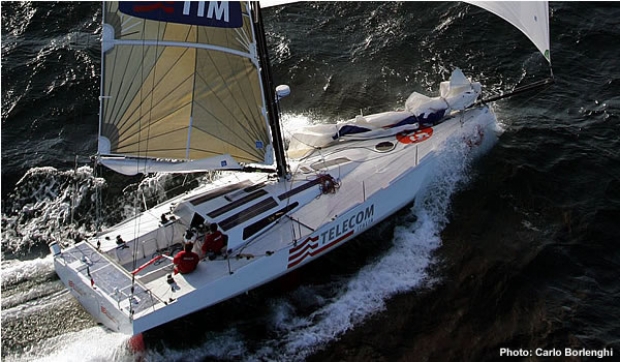
The most successful Class 40 on the race course at the moment is without doubt Giovanni Soldini’s Telecom Italia (read our feature on this here), winner of the Artemis Transat and last year’s Transat Jacques Vabre. This is a design, known as a Tyker 40 Evolution from the talented French architect Guillaume Verdier and is very much at the top end of the custom build spectrum. Despite the success of Soldini’s boat, Verdier has only one other commission – a boat for Chilean Felipe Cubilos, being built in France. This is due for launch in August and is another Cat 0 Class 40, destined for the Portimao Global Race.
Similarly sportsboat builder, JPK, who built Christophe Coatnoan’s Artemis Transat entry Groupe Partouche, have built a second of their Class 40s for Eric Nigon, that is expected to be competing in the 1000 Milles Brittany Ferries.
The US connection
What is perhaps most exciting about the Class 40 compared to other French-originated classes of this type is that it does seemed to be pressing the right buttons abroad and particularly in the US. New owner Michael Hennessy is pushing the class there hard, and also has taken the step of sitting on the main committee in France. Akilarias are now being imported into the US by long term American Open 60 shore crew Brian Harris.
And there is movement not only on the east coast. Over in California Jim Antrim, designer of Tim Kent’s Around Alone Open 50 Everest Horizontal, has cooked up a Class 40 being built by Columbia Yachts in Santa Ana for Southern CA-based couple Barry and Sue Senescu.


The new Antrim Class 40
“We have a few other prospects interested and hope we can develop it into a semi-production run,” says Antrim. The new boat is due for launch in December. Antrim describes the new boat as having maximum beam and minimum displacement and says that its most unique feature is an underwater chine in the bow.
Calendar
So the Class 40s are to set off in the Quebec-St Malo this weekend. Arriving back in Europe, this leads neatly into a repeat of the 1000 Milles Brittany Ferry Race between St Malo-Plymouth-Santander-Roscoff at the end of August with the Worlds in La Trinite-sur-Mer again at the end of September. According to Class Secretary Muriel Robin, they are expecting 25 boats to compete in the Worlds this year.
However Class 40s are also being invited to take part in the new British transatlantic race, the Spice Race, starting from Southampton on 15 November and heading to Grenada. This race has been given the nod by the class as it neatly fills a gap in their calendar but was launched too late to be included in it officially.
While this is going on the Portimao Global Ocean Race sets sail from the south of Portugal on 12 October (annoyingly the day after the Volvo Ocean Race start in Alicante) and will visit Cape Town, Wellington, Ilhabela (Brazil) and Charleston before returning to Portimao in June next year.
Looking further ahead the provisional Class 40 program for 2009, kicks off with a transatlantic race organised by Chocolats Monbana skipper Damian Grimont. The doublehanded Route du Chocolat sets sail from St Nazaire on 4 April, bound for Mexico. After this is a repeat of the Les Sables-Madeira race in July, the Rolex Fastnet Race in August, the Class 40 Worlds - being held in thedailysail's own backyard of Hamble at the end of August - the season concluding with the two handed Transat Jacques Vabre.
So what is the future of the class?
There is every indication that it is good, however we wonder how long the situation can last where full-on custom boats like the third generation Owen Clarkes or the Verdier designs can race like-for-like with less exotic production boats. For if one applies a bit of America’s Cup thinking to the Class 40 rule, it is not hard to find ways to spend a considerable amount of money on a boat even if exotic materials are prohibited. It seems inevitable that as the class gets more competitive this situation will only get worse, so in our view it would make sense to replicate what has worked so successfully in the Minis where there are two class – the Series and Protos – so that one-offs can race against one another competitively as can production boats.
Most Read
Most Commented
Comments
Businesses


Pro businesses
-
United Kingdom
-
-
-
Netherlands
Editor's choice
Member blogs
-
 Ned Collier Wakefield: MOD70 round BarbadosWell that was intense. 12 hard fought for seconds for the win. In idyllic conditions, Tony Lawsons MOD ...
 -
 Mini Transat leg 2 reportThe second leg of the Mini Transat started on 31st October, just over a month after ...
 -
Leg 1 reportI’ve been working towards the Mini Transat now for three years. In 2013 I was part ...
Business blogs
-
 The Island Sailing Club in Cowes, Isle of Wight, is delighted that Prince Michael of Kent ...
 -
Peta Stuart-Hunt chats with the 25 year-old British solo sailor Lizzy Foreman before she sets sail ...
-
The 2015 Student Yachting World Cup (SYWoC), an ISAF-recognised event hosted and run by students for ...
Editor's Choice
All time favourites...
-
 Three legs down into Ian Walker’s
 -
 Winning all but two races at
 -
 For the first time in its
Latest Comments
Add a comment - Members log in