
Around the world in 80 days
Friday November 7th 2008, Author: James Boyd, Location: United Kingdom
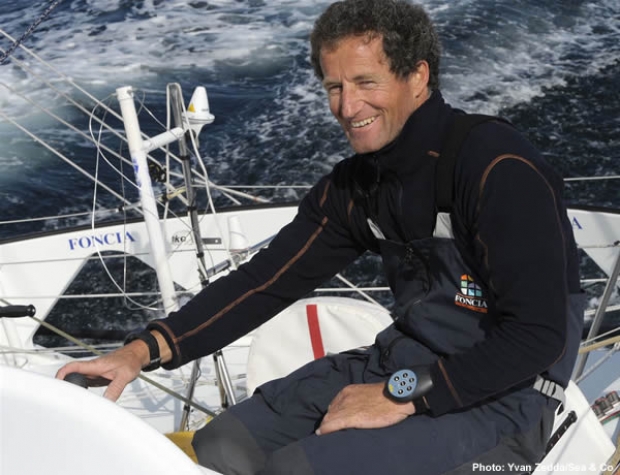
Along with Vincent Riou, Michel Desjoyeaux is the only competitor in this year’s Vendee Globe to have won the race previously. Although it may generally be believed that Ellen MacArthur came first in the 2000-1 race so intense was the media deluge that greeted her on her arrival, in fact MichDes/Le Professeur arrived more than a day ahead of the Derbyshire dragstress, who took second.
After several years campaigning the ORMA 60 Geant, with the sad demise of that circuit Desjoyeaux announced his return to the IMOCA Open 60 class taking over the Foncia sponsorship from 1992 Vendee Globe winner, Alain Gautier. On this occasion Desjoyeaux went to the Farr office for his latest steed, part of a two boat arrangement with Riou, who was shore manager of his campaign in 2000-1 and who later took over the reigns of his boat, PRB and successfully defended Desjoyeaux’s title in 2004-5 (that boat is now Sam Davies’ Roxy). While the new PRB and Foncia campaigns were being run through Desjoyeaux’s company Mer Agitee, Riou’s campaign broke away last year.
Since the launch of Foncia in May last year, she won the 2007 Transat Jacques Vabre and came third in the singlehanded return race, the Ecover Transat B2B, despite a little contra-tent with a fishing on the approach to the finish line. This year Desjoyeaux was forced to retire from the Artemis Transat after colliding with a whale.
Following the Transat, Foncia went back into refit and the keel bulb and foil were changed. According to MichDes the new package, that includes a longer bulb, has shifted the centre of gravity aft, effectively an alternative to what many of the other Farr boats have done in fitting a ‘moustache’, the reaching strake that wraps around their bow. The inference of this is that the Farr IMOCA 60s have a tendency to nosedive when pressed downwind. Desjoyeaux more or less confirms this: “It depends on the boat you want. If we want an OSTAR boat, for sure the boat was well designed. But if you don’t want to have downwind difficulties, we decided to balance the boat further aft.” The keel modification achieves much the same as the ‘moustache’ but without bringing on board extra weight.
As to the result Desjoyeaux states: “For sure the boat is a bit slower upwind than with the previous keel because she is balanced more aft. In fact downwind, it is the not the same picture - the differences are quite significant downwind and the boat is very high at the bow, etc. I think we have balanced the boat just enough not to have problems but not so much that we lose too much upwind.”
Obviously preventing the boat from nosediving can be achieved by loading on water ballast aft, however this has the effect of weighing the boat down which is not what you need downwind.
A new sail wardrobe has been brought on board too, Desjoyeaux once again working with Incidences, where he has been buying sails for the last 21 years. Incidence have lofts in Brest and La Rochelle, each with their own unique clientele. When we ask him which he is with, he responds “I am a Brest man…!”
He is slightly vague about the number of sails he is taking (yeah, right!) but thinks it is around 11, with one more spinnaker than he took in 2000-1. These are all different sails and there are no identical spares. “The only one you could consider as a spare is the staysail. We have a Vectran one upwind and downwind for the Atlantic and I have a Cuben one with a higher clew for the Southern ocean. Otherwise they are much the same.”
Another alteration has been the larger kites, the shape of which was changed in order to generate more lift, again to help the bow pass through the water.
A new mast, another rotating wingspar with deckspreaders to extend the shroud base, was fitted prior to the Transat and Desjoyeaux says it is much the same as the first, only on this the mast exit for the genniker halyard is a bit lower but can still double as a halyard for the spinnaker if need be. Otherwise the boat is the same other than rejigging the winches that the pedestal drives - four of his cockpit winches can now be driven.
While the likes of Bahrain Team Pindar and Artemis are leading the charge in the heavyweight Open 60 stakes, there is no question that Foncia is heading in the opposite direction. Desjoyeaux has had a snoop around Brian Thompson’s Juan K design. “The problem is that Pindar has to carry a lot of weight in the keel, the bulb and in the mast and in the sails. He has no chance of saving weight anywhere.”
Meanwhile on Foncia, Desjoyeaux and his shore team have been attempting to par weight down everywhere. “For example we know exactly how many bottles of gas we need for the stove, so we will just carry one more than is planned, which should be too much because we could save maybe 10 days from eight years ago. But I think that there is no reason for us to carry unused weight on board: My tool box is quite light, spare parts are quite light, we have the minimum of safety gear and clothes, food, spare parts, etc.”
Someone made the observation to us this week that they felt some campaigns were taking radically extreme approachs to taking spares on board - essentially barely carrying any at all, in order to go as fast as possible, with a view to simply retiring if they do break something. “This is a point of view, but it is not mine,” confirms Desjoyeaux absolutely. “We know we will have some problems every day be they small, medium-sized or big ones.”
At the start Desjoyeaux says he is taking food for 90 days, but reckons that given a similar medium forecast to what the leaders saw in the last two races the winner could get around the world at least five days faster than Vincent Riou’s present course record of 87 days. “The increase of the average speed between last time and 80 days is less than half a knot. So it is not much. It is really possible to do it.”
And his observations between Foncia and the boats from different designers? “I think we are faster and easier upwind and we are not slower downwind in light winds, for sure. In high winds with the new balance of the boat we won’t have any problems against other boats. For sure we did have a nice lead over Generali last year. She was very fast upwind and very slow downwind and she had to come back to us in terms of balancing the boat. So now she is slower than us upwind and not faster than us downwind. So we have maintained an advantage.”
So what is Desjoyeaux’s predictions for the start? In short – not ideal. The latest forecast shows the start taking place in 15-20 knots from the southwest but building to 25-30 knots over the first night (ie directly on the nose as the boats head for Cape Finistrre). This building wind will culminate in a front passing over the fleet on Monday after which they will tack south. “We think it will be one of the only tacks we have on this race. Then reaching and kiting and then sun, then….”
See our guided tour to Foncia here
More amazing photos on the following pages...
Most Read
Most Commented
Comments
Businesses


Pro businesses
-
-
France
-
-
United Kingdom
Editor's choice
Member blogs
-
 Ned Collier Wakefield: MOD70 round BarbadosWell that was intense. 12 hard fought for seconds for the win. In idyllic conditions, Tony Lawsons MOD ...
 -
 Mini Transat leg 2 reportThe second leg of the Mini Transat started on 31st October, just over a month after ...
 -
Leg 1 reportI’ve been working towards the Mini Transat now for three years. In 2013 I was part ...
Business blogs
-
 The Island Sailing Club in Cowes, Isle of Wight, is delighted that Prince Michael of Kent ...
 -
Peta Stuart-Hunt chats with the 25 year-old British solo sailor Lizzy Foreman before she sets sail ...
-
The 2015 Student Yachting World Cup (SYWoC), an ISAF-recognised event hosted and run by students for ...
Editor's Choice
All time favourites...
-
 Three legs down into Ian Walker’s
 -
 Winning all but two races at
 -
 For the first time in its
Latest Comments
Add a comment - Members log in