
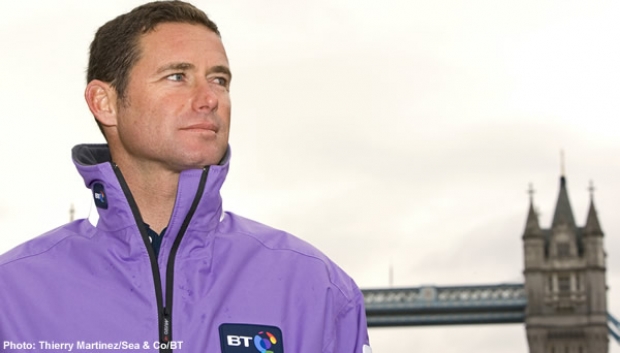
Checking in with a Vendee favourite
Thursday May 1st 2008, Author: James Boyd, Location: United Kingdom
Offshore Challenges/OC Group have taken another step towards Anglo-French d’entente cordiale in appointing French round the world veteran Seb Josse as skipper of their IMOCA Open 60, sponsored by BT (British Telecom).
On Tuesday BT IMOCA 60, as she is to be known, was unveiled publicly for the first time with the help of the Sugababes, in her new colours - all trace removed of the red paintjob, from her previous guise as Jon McKee and Guillermo Altadill’s Estrella Damm (as she sailed in the Barcelona World Race).
In Josse OC have got one of the present day’s foremost offshore sailors. The Vendee Globe will be the 35 year old’s fourth lap of the planet, following his first during Bruno Peyron’s Jules Verne Trophy record on board he maxi-cat Orange 1, the 2004-5 Vendee Globe on his Open 60 VMI (he finished fifth despite hitting an iceberg off New Zealand) and then of course skippering the ‘kids’ boat, ABN AMRO Two, in the last Volvo Ocean Race. This year’s Vendee Globe might have been Josse’s fifth lap, however in the Barcelona World Race, during which he co-skippered Vincent Riou’s PRB, they were forced to retire to Cape Town when the top of the orange boat’s mast broke.
Cape Town is also where his present steed ended up in that race after its ‘rudder problem’. The former Estrella Damm was shipped back to the UK arriving in January and Josse delivered the boat from Sheerness to Lorient where she has been in a shed amid the Breton port’s famous German-built submarine silos ever since.
While this was going on a new mast and boom were in build at Lorimar (and finished by Herbert Desjoyeaux at CDK in Port la Foret), aimed to be better optimised for singlehanded sailing. Josse says the new mast has a smaller section and came from the same mould as the original masts of Delta Dore and Generali, however unlike Delta Dore the spar is fixed. Hwever they have “changed a lot of things”.
The recent Barcelona World Race and the Transats Jacques Vabre and BtoB, showed mast breakage to be the current plague in the IMOCA Open 60 fleet. The principle reason for this seems to be that the boats are getting more and more powerful, and slightly heavier with all the gizmos they now feature, the rigs taller and carrying more sail, at the same time as mast designers and teams have been making great efforts to remove weight from the spars. Other than this, the specific reasons for the breakages seem to be different in every case.
On PRB the Barcelona World Race saw the boat’s second mast breakage. The first occurred in the 2006 Route du Rhum because the spar was simply too lightly built, says Josse, while the second was because the spar manufacturer accidentally left some blue film on the pre-preg during construction (not a great advert for Lorimar). “With the others we don’t know, but I’m sure for the wingmasts you can’t sail them like a classic mast and push with different sail areas,” says Josse. “You have to take care all the time with the balance in the rig and with the hydraulic rams. I think some of these guys don’t have the experience or they didn’t pay enough attention to the mast. You really have to take care and get to know it slowly.”
So the result is that masts throughout the IMOCA fleet are now being built stronger. This means they are heavier, so they require heavier rigging and structure internally to support the rig and possibly more weight on the keel. Josse says this is certainly the case with the route PRB have gone down in order to avoid a third dismasting. “On paper the wingmast on PRB was one of the best for the CoG and the weight, etc but now because people are a little bit scared with the problem they put more carbon into the mast and on paper they start not to be so good compared to classic mast. So the balance has moved.” Josse reckons that a fixed ‘classic’ mast, as they have on BT IMOCA 60 is now around 70kg lighter than a wingmast on an Open 60.
Specifically with the heavier rigs, the centre of gravity moves higher and this starts to play havoc with the stability of the boats as they attempt to stay within the limits of stability requirements demanded by the IMOCA Open 60 class rule.
Other work BT IMOCA 60 was previously reported in Tuesday’s announcement and has been extensive. Since the boat arrived in Lorient, the team have had ten people working on the boat which has been taken part with much of the gear replaced with a view to paring down weight while improving reliability. The engine was taken out as were all the electrics and electronics and for example the batteries have been changed to smaller lighter Ni-Cads and the wiring has now been replaced with a tiny filament aero-grade equivalent, the latter alone saving 10-15kg.
They have been working too on the sail development with North Denmark’s Henrik Soderlund (who also worked with Josse at ABN AMRO) although the sails are finished by North France.
So any interesting sails (like he’ll tell me...)? “Not really. It is not in the culture. With Vincent [Riou] we worked a lot on that for the Barcelona race and we changed a lot of things with the shape and the design area. The problem all the time is money. When we make a sail it is immediately a racing sail, not a test sail. With ABN we tested 50 sails before the start - 25 per boat! Maybe that is too much, but if I hadn’t done the Volvo I would never know the difference between two sail shapes. Now I have a better feeling for that and we have tried that with with this boat. But Vincent has sailed Open 60s for ten years and he sees genoa and he hasn’t tried to do anything different because it is fast enough for him.”
While they may be trying to evolve sail shapes, Josse says that on BT IMOCA 60 they are keeping the headstay and furler format the same as it was before.
The rudders, as mentioned on Tuesday, are to be fixed for the Artemis Transat as Josse says they haven’t had enough time to develop kick-up rudders in the four months since the boat returned from Cape Town. However French designer Guillaume Verdier (who helped Josse develop and optimise VMI prior to the last Vendee Globe) is currently working the kick-up mechanism for the new rudders. Josse says this won’t be the same as the set-up on the Verdier/VPLP-designed Safran but will be similar to PRB. He acknowledges how important a reliable kick-up system is – it is potentially very dangerous if the working rudder kicks up when it is not supposed to (as Alex Thomson and Andrew Cape found during the Barcelona World Race). “This one I know, it works, it is simple,” says Josse of why they are copying the PRB arrangement. “We have started to machine the mechanical parts, so when we come back we will have all the stuff ready on the table and we will start to cut the back of the boat [to fit the rudders].”
The cockpit layout is remaining the same, but they have moved the Fleet 77 satcom dome from there to forward of the mast. This is for balance reasons but principally to make more space for the stack to be positioned aft or moved across the boat. “We don’t do crazy things. We just try and make sure the boat is strong and simple. We do the jobs we have done before and we know work. Like the [Ni-Cad] batteries - it is not a new system. We had it on VMI and I know it works, I tested it for four years. I am sure I will have no surprises with that. And the same for the mast.”
Apart from the dramatic change of paintjob, the most noticable addition is that of ‘the strake’ (see our report on these here) - a wedge just above the waterline fitted around the bow, which we understand is also being referred to as ‘the moustache’. So far we understand this has been fitted to other Farr boats - PRB, Delta Dore and Virbac (but not Foncia or Gitana 80). For some reason, perhaps due to the darker colour of the hull, the strake on BT IMOCA 60 looks a lot better than it does on photos we have seen of it on PRB.
The reason for the strake is allegedly that the new Farr boats have a tendency to nosedive when being pressed downwind or reaching in waves and Josse admits this was a small part of the reason it was fitted. However he says it is more to give the boat another gear. Sure, previously they could get the bow out of the water by putting two tonnes of water in the stern ballast tank but Josse says that in up to 20 knots that makes the boat too heavy and kills performance. “With the strake you can have the balance longitudinally and that increases the righting moment because the back is more in the water and so you only have to use the ballast later. So we hope it is better.”
Josse says they have tested it twice in anger and when you go more than 18-20 knots the strake definitely helps ease the bow up “...and the boat is really light and easy, so I’m sure when you go fast it is a gain. When you are reaching at 14-15 knots of boat speed it feels equal, about the same. Otherwise it is too early to say. Upwind it is maybe more drag. I have to line up with someone else.”
So with the Artemis Transat now 10 days away – what are his predictions? The challenge of this race westbound across the north Atlantic is slightly different from the Vendee Globe in that the conditions tend to be upwind. However the new generation of 60s with their bigger boards and much improved than their predecessors on this point of sail.
“ Generali is good upwind - it has big righting moment,” says Josse. “ Foncia too - Foncia and PRB have the same hull, but they are not the same boat. Foncia is about 400kg lighter than PRB and we are lighter than Foncia for sure!” Josse attributes this to the build quality and all the detailing inside. “The mast is lighter and also I have a lighter bulb - I have a heavy fin keel but a lighter bulb.” Unlike the fabricated steel or carbon foil options on BT IMOCA 60 it is forged steel. “It is the strongest you can have. It is also the least drag,” says Josse.

America’s Cup
A slight surprise for someone who has made a name for himself offshore is that Seb Josse is to get involved with K-Challenge for the 34rd America’s Cup. Josse says that he has been in contact with Team Principal Stephan Kandler for some time and was attracted by Kandler’s idea of getting a younger group of people, plus some new blood, into the team, a concept similar to that of ABN AMRO Two.
However it is very early days. “If we can get the key, the money and the time to try and work together it is not a stupid idea,” says Josse. “If the spirit stays like that I am happy to go. If it starts to go in a different way I am not interested.”
And already he has learned some home truths about the Cup. “Seb Col has done one or two Cups already and he understands it. When you speak with him he says that when you do the Cup you don’t match race. You win the Cup because you have a faster boat and if you want a faster boat you have to be very good technically before the start of the race. Sure the level of match racing - it is not bullshit, you have to have a good level, but you don’t win the race because you win the start. You win the race because you win the start and you go a little bit faster.”
While Josse acknowledges that he not known as a match racer, he says that his involvement will be more for his experience running a big team, the management and the technical development. “I will sail, but if I don’t have to sail, I won’t. I’m not worried about sailing in the Cup because it is not my speciality. It is a new challenge for me. If Seb Col can find a position for me on board that is good – if not, no worry. But at the moment this year it is the Vendee and in 2009 it is the IMOCA season for me with BT. I like the spirit - so why not? But we’ll see what happens in reality. Today I don’t want to speak too much about the Cup because there is no rule, and we don’t know where and when it is and I don’t know if K Challenge will find the money and I don’t know if we’ll be on the same page or not.”
Moths
And finally another string to Seb Josse’s bow is that he is one of France’s first foiling Moth sailors, having been ‘initiated’ when he met up with Rohan Veal during the Melbourne stoppoveer of the last Volvo Ocean Race. He is now the proud owner of a Bladerider (along with BMW Oracle Racing helmsman James Spithill).
Recently he was seen out on his foiler, burning up the race track at the start of the Figaro’s Transat AG2R. “It was 25 knots of wind in big waves - it was like Cape Horn for me! But the boat didn’t break.” says Josse.
“I sail it as much as I can. Another guy in my shore team has a Bladerider and we are trying to get to Weymouth for the Worlds.” He says they are competing in this event principally because they want to learn rather than compete in any meaningful fashion. “In one week we can learn what would take us one year alone. We know we won’t finish all the races but if we can gybe by the end of the week or finish a lap it will be okay.”
More photos on page 2...

Most Read
Most Commented
Comments
Businesses


Pro businesses
Editor's choice
Member blogs
-
 Ned Collier Wakefield: MOD70 round BarbadosWell that was intense. 12 hard fought for seconds for the win. In idyllic conditions, Tony Lawsons MOD ...
 -
 Mini Transat leg 2 reportThe second leg of the Mini Transat started on 31st October, just over a month after ...
 -
Leg 1 reportI’ve been working towards the Mini Transat now for three years. In 2013 I was part ...
Business blogs
-
 The Island Sailing Club in Cowes, Isle of Wight, is delighted that Prince Michael of Kent ...
 -
Peta Stuart-Hunt chats with the 25 year-old British solo sailor Lizzy Foreman before she sets sail ...
-
The 2015 Student Yachting World Cup (SYWoC), an ISAF-recognised event hosted and run by students for ...
Editor's Choice
All time favourites...
-
 Three legs down into Ian Walker’s
 -
 Winning all but two races at
 -
 For the first time in its
Latest Comments
Add a comment - Members log in