
Figaro first timer
Tuesday July 29th 2008, Author: James Boyd, Location: United Kingdom

Competing in the singlehanded one design Figaro class always seems daunting for anyone not French. In fact this is less from any lack of hospitality offered by the Figaro class and its sailors, who tend to fall over themselves to assist foreign competitors, but that the solo sailor wishing to take part must tackle all the logistics and financial commitments alone without others to share the load.
After the likes of Sam Davies and last year James Bird and Nigel King, so this year the sole British entrant in the class’ all-important Solitaire du Figaro, which is probably the closest solo offshore racing has to a world championship, is 26 year old Andy Greenwood.
Greenwood heralds from the northwest, near Chester and has what might be deemed a typical sailing background: starting out in dinghies on the River Dee with the Sea Scouts but getting into yachting as a teenager, working the bow on Sigma 33s in Liverpool and events in the Irish Sea and the Scottish Series. Aged 17 he got a summer job at a sailing school in Poole teaching and racing on boats and since then has been pretty much embroiled in the south coast sailing scene with a mix of jobs working for charter companies such as Formula One and Sailing Logic while racing and running boats - Greenwood currently is in charge of the Farr 45 Rebel when he is not Figaroing. Over the last years he has done a huge amount of racing, from the RORC offshore series, in which he won Class 0 skippering the Farr 40 Creative Play to Round Irelands, etc.
But this comfortable world is a million miles from going it alone, finding the money, securing a boat and diving into a completely new discipline of sailing in an entirely different culture.
“The first time I read about the Figaro was when Damian Foxall did it on the DHL boat,” says Greenwood. “It immediately appealed to me in a way, because I’ve always enjoyed the offshore, its my preferred discipline. I liked the idea of being alone on the boat and the intensity and the distance appealed to me. I enjoyed Fastnet courses, Channel racing and Middle Sea and Round Island and that sort of stuff. I would like to do the Transat and so on, but the Mini Transat and that route didn’t appeal to me. And the chance to compete arguably against the best solo sailors around in a like-for-like scenario - it was a very good chance to see how you are sailing-wise. So that was the appeal of the Figaro.”
Greenwood’s Figaro campaign was no split second decision. He says he was contemplating it for two or three years before the constellations became aligned and, specifically, he secured the necessary funds to press the ‘go’ button.
“The money came from a couple of sources,” he says. “One of the skippered charters I did last year was training some guys for Fastnet with Sailing Logic on one of their Reflex 38s. One of the guys who was on board the boat works for a company called Imtech who are one of the main sponsors of the program for this year.” Imtech describes itself as a ‘marine systems integrator’ for the superyacht and shipping worlds specifically ‘automation, electrical engineering, instrumentation and HVAC’ (this we borrow from their website).
“They were keen to help out, not in a huge way,” Greenwood continues. “It didn’t meet their marketing strategy, but he felt he could push a little bit of cash our way in return for some corporate days on the boat. So that is a where a large chunk came from. And a friend who I sailed with for a while was prepared to put in a chunk of cash which was enough to secure the initial charter of the boat for the start of the season. The two came together at the right time to make it viable to get to the start line.”
Greenwood managed to charter his Figaro (a past leg winner of the Solitaire he believes) at the beginning of March and took it over in April.
For Greenwood this is his first foray into solo offshore racing and it is a case of jumping in a the deep end. However he has done a lot of two handed. In 2004 for example he sailed the entire RORC program doublehanded on John Loden’s HOD35 Psipsina. “We won pretty much all the two handed events we did and came second overall in class 2 that season,” he says. “I’ve actually got good results in crewed boats, so I always felt I could do it and it was just a case of getting out there.”
Greenwood intends for this to be year one of a three year tenure in the Figaro class. “This year is just to dip your tail in, learn about the boat and the cirucit with a view to training with the French this winter and have a more tricked up program for next year.
He cannot stress enough how welcoming the class have been to him. “A few people discouraged me,” he says of when he was first planning this back in the UK. “But having done all the qualifiers the class couldn’t more helpful to accommodate people who are foreign. I don’t speak French, so that is a little bit tricky, but they provide a translator - they are very keen to get more Brits involved.”
This year his Figaro campaign has got off to a promising start. His first race was the Solo des Sables out of Les Sables d’Olonne where he finished 16th out of 32. Mid-fleet might not sound like much, but for a rookie up against Figaro sailors who have been in the class for several seasons, who know the boat inside out and how to get the max from it, this was a good result.
Having been through this same process last year, so Nigel King and James Bird also proved a wealth of knowledge says Greenwood. “Nigel was really helpful, explaining all the little tricks, all the ways of doing scrutineering. They have their own ways of doing things. Often you can blag your way around a few of the finer points, but here they are strict, straight down the line. You have to be prepared for that.”
Among the scrutineering items for example is checking that competitors start with a full tank of diesel. Often when you fill up, the pump automatically cuts off before the tank is full but in the eyes of the scrutineers this often doesn’t constitute a ‘full’ tank as they measure from the filler cap down.
Undertaking a Figaro campaign is hard at the best of times but Greenwood has managed to undertake this with a wife and a nine month old baby back at home in Wimbledon. For this reason, rather than training in France, he brought his Figaro back to the UK. “I couldn’t commit to being full time over in the France to do the training,” he admits. “The ideal would be to keep it in France, somewhere like La Rochelle. But I was going to get more time on the water when it was in Hamble where I could get access to it and sail the boat down to France for the qualifiers.”
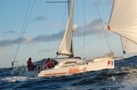
With his Beneteau Figaro 2 Imtech in the UK, Greenwood won Petit Bateau’s singlehanded round the island race and competed in the RORC’s Myth of Malham race down to the Eddystone. In addition to this he has had to compete in two races over in France in order to qualify for the Solitaire. Aside from the Solo les Sables, he sailed the Transmanche from L’Aber Wrac’h to Plymouth and back singlehanded.
In terms of budget, Greenwood says that this season is costing around £40,000. The majority of this was the charter fee which he managed to negotiate down to £18,000. The second biggest cost was new sails. The boat came with a three year old suit and he has had to purchase a new main, genoa and big spinnaker. He says that typically he has been quick downwind but struggled upwind. In addition to this there are entry fees, travel, insurance, etc. He has managed to get some equipment supplied such as running rigging which was provided free of charge by the Rig Shop in Southampton. He also managed to get a heavily discounted mooring in Port Hamble off a friend making it more viable to keep the boat in the UK.
Typically a vital component of a Figaro campaign, particularly on the Solent is having some talented shore crew who a skipper can effectively pass the boat over to make ready once they’ve docked. For the Solitaire Greenwood is relying on family, his wife and her father helping out in La Rochelle the week prior to the start and then his parents driving the van down to the first stopover in Vigo and then back up to the second stopover in Cherbourg. “So a bit of a family shore support operation,” he says. “If you can afford it, it is definitely worth working into the budget to have a proper preparateur.”
Another significant component absent from Greenwood’s first year in the Figaro has been training. “Training - that is the one thing lacking. That is what I would build into it for next year. Time-wise it hasn’t been viable for me this year unfortunately.”
We have written a great deal about the famous local government-funded Pole France school in Port la Foret, which started out as a training base for the Figaro class, but has since been used to train competitors in all walks of French offshore racing from the Vendee Globe and ORMA 60 tris down. Since then other training bases, some specialising in specific classes, have started up in La Rochelle, St Nazaire, Lorient, etc. Prior to his Figaro campaign last year for example Nigel King trained out of La Rochelle.
According to Greenwood it is most obvious the skippers who have been training when it comes to boat-on-boating. “Their manoeuvres are second nature. Close quarters stuff, they have their head out of the boat and can concentrate on the tactical side. I have my hands full just getting the boat around the course. That is probably the most difficult part of it all. That comes with time on the boat.”
But obviously on a long event like the Solitaire, this represents a much smaller component of the race. “Once you settle down into the legs it is much more about trying to keep your concentration going,” states Greenwood. In his preparations he spent a lot of time working with his autopilot, an NKE, trying to figure out how much it could handle and in what conditions and on what points of sail it could do at least as good a job as he could on the helm. In the Figaro he recognises that a lot of the secret to success is down to managing himself, particularly his sleep. He looks at the conditions ahead and when it is okay for the pilot to take over he will aim to sleep in those periods. “But if it is a breezy 36 hours, you are pretty much committed to just getting through it, catnapping when you can. In the more moderate stuff you can plan ahead to grab an hours worth of catnapping without too much performance loss. So I’ve focussed on that quite a lot. And just managing myself. Tactically, you have to go the right way, but the next biggest thing down from that is how you manage your sleep on board the boat, so you can perform at the maximum.”
The tactics in the Figaro fleet are reasonably unique given the nature of the course. Legs in the past have tended to be three or four days long, although this year they are the longest on record and for this period it is possible generally to get a reasonably accurate forecast for a whole leg in advance. Aside from that there are weather updates transmitted to the fleet by VHF from the Race Committee boat following the fleet and competitors can also receive GRIB files but from a highly restricted number of sources.
While some of the Figaro courses are along the coast, they are mostly in open water and there is the potential for some major corner banging, but typically the most diligent competitors play the fleet hoping that consistent results throughout the Solitaire’s four (or this year three) legs will earn them a top result.
Greenwood’s expectations for his first year in the Figaro are realistic. Even seasoned top professional sailors such as Italian Pietro d’Ali, who raced in the America’s Cup with Prada, have never managed to walk straight into the Figaro class and get top results. For this reason the Figaro’s ‘Classement Bénéteau des bizuths’ for the Solitaire’s first timers is significant. In terms of overall results in a fleet of 50 boats, Greenwood would be happy to be in the top 40 and top 30 would be “very good”. Of the 11 ‘bizuths’ he says three or four are well funded, including stars from the Mini such as Adrian Hardy and Isabelle Joschke, but he would hope to be among the top five.
“The boat is extremely well prepared. I am pretty happy. What I was quite keen to try and do was to get to the start line with a boat that was on equal terms to everyone else, so it would be a fair reflection of my own personal talent. It is the way it is supposed to be.”
We wish Greenwood every success with his Figaro campaign and hope it will provide inspiration for others from this side of La Manche to follow in his footsteps.
Most Read
Most Commented
Comments
Businesses
Pro businesses
Editor's choice
Member blogs
-
 Ned Collier Wakefield: MOD70 round BarbadosWell that was intense. 12 hard fought for seconds for the win. In idyllic conditions, Tony Lawsons MOD ...
 -
 Mini Transat leg 2 reportThe second leg of the Mini Transat started on 31st October, just over a month after ...
 -
Leg 1 reportI’ve been working towards the Mini Transat now for three years. In 2013 I was part ...
Business blogs
-
 The Island Sailing Club in Cowes, Isle of Wight, is delighted that Prince Michael of Kent ...
 -
Peta Stuart-Hunt chats with the 25 year-old British solo sailor Lizzy Foreman before she sets sail ...
-
The 2015 Student Yachting World Cup (SYWoC), an ISAF-recognised event hosted and run by students for ...
Editor's Choice
All time favourites...
-
 Three legs down into Ian Walker’s
 -
 Winning all but two races at
 -
 For the first time in its
Latest Comments
Add a comment - Members log in