
The hard road
Wednesday December 3rd 2008, Author: James Boyd, Location: United Kingdom
While one might get the impression from our coverage of the Vendee Globe that it is all about boats with 5 million Euro budgets - and indeed this is the case for the majority, or more in some instancs - there are still a number of skippers competing who have done it the hard way, without the considerable benefit of major corporate backing.
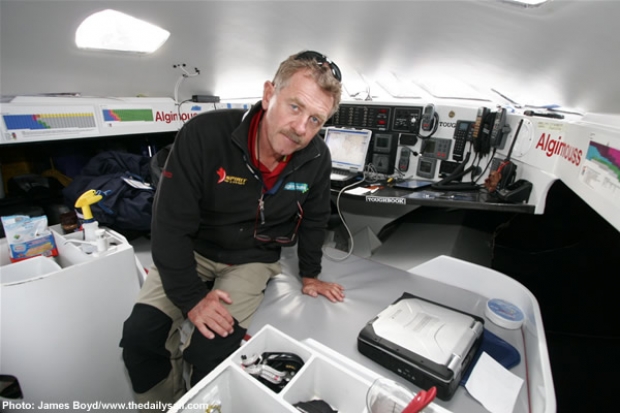
Few had to struggle harder to make it to the start line of the singlehanded non-stop round the world than Canadian former Mountie, Derek Hatfield.
Hatfield, readers may remember from the Around Alone (now the Velux 5 Oceans) when he sailed singlehanded round the world aboard his Open 40 Spirit of Canada. During this race Hatfield’s rounding of Cape Horn coincided with storm force conditions during which Spirit of Canada was rolled, losing her rig in the process (read about this here). Thankfully he was okay and with the help of the Around Alone community was able to get his boat rerigged to complete the race.
Glutton for further punishment, Hatfield soon after Around Alone was completed announced he was building a new, larger Spirit of Canada, this time an Open 60…
Originally the goal was to compete in the Velux 5 Oceans but due to financial issues, this was delayed. “A couple of times we had to slow down and dig deep and find more money. These projects are just bottomless pits for money. I can’t complain. We’re here,” says Hatfield who reckons he’s into 3.5 million Can$ (roughly 2.5 million Euros) for his campaign, having done a very “frugal job”.

And so the objective became the Vendee Globe. Unable to lure a major sponsor (and bear in mind Canada has strong ties with France), Hatfield and his partner Patianne Verburgh had to look at other means. They followed the same route as Bertrand de Broc’s Votre Nom Autor du Monde campaign from 1996 and later Pete Goss’ Team Philips with a ‘names program’ - a scheme whereby members of the public can pay money and get their name written on the side of the boat (Kito de Pavant’s Groupe Bel had a variation of this - the fingerprints of all of Groupe Bel’s employees are emblazoned on his mast, or were until the mast fell down).
“We never planned for it to be this way, but once the big sponsors didn’t materialise, we just kept plugging away with the names program,” says Hatfield. “We have almost 6,000 names, averaging around 200 Can$ each.” To put their name on the side of Spirit of Canada individuals paid anything from 100 to 100,000 Can$. “It is amazing how it adds up. These 6000 names has made over $2 million. It is as simple as that - just a lot of hard work.”

And hard work it has been. Most has been generated from Hatfield’s intense lecture program. “For the last five years all I have done is commute back and forth across Canada doing talks. We’ve talked to over 300,000 people and I’ve done 620 presentations and each presentation is 45 minutes long, about the last race and different things. Then at the end Patianne asks people if they want to get involved and put their name on the hull and 20% of the room will stand up and put their name on the hull. It is amazing.”
Finally in 2005 they started the build, from an Owen-Clarke design closely related to Mike Golding’s previous Ecover 2. “It took 14 months to build, from start to launch,” recounts Hatfield. “That was a little longer than normal, but that was money driven. Then once we launched it, it didn’t do a lot. We didn’t have the wherewithal to campaign it, we just had a long range, long drawn out process to qualify. We launched it in September 2006. So it has been sailing for two years, but being in Canada, it is so far to commute to the races and all our sponsors are in Canada. That’s why I went back to Canada this summer. We put 500 people through the boat, going sailing and believe it or not, that names program and our sailing program is what has got us here.” In addition to the ‘names program’ Hatfield was also selling days out on the boat to fund the campaign.
They put their own build team together to create the new Spirit of Canada and while it strongly resembles Ecover 2, Hatfield is the first to admit that it lacks some of the Gucci detailing of Golding’s steed. “It is a bare bones kind of thing because of the budget. All the nice details are expensive. We have done a basic boat. It is budget driven as well, but I always think that simple is easy on the brain when you are sailing offshore by yourself, so I try and keep it simple and my theory is that if you keep it simple you can raise your performance because if it is really complicated you are only sailing at 70% all the time.”
For example Spirit of Canada only has three pairs of water ballast tanks, compared to the new generation Owen Clarkes, such as Ecover 3 and Aviva, that have five. “It was a step up from Ecover 2 because they discovered that if you split the back tank differently, you end up with an aft tank and a middle tank. So we have gone into a little bit of complexity there, but I am still tweaking it and finding the sweet spots in the trimming.”
Also while both Ecover 2 and Ecover 3 have state of the art small section rotating wingmasts with one or two diamonds, on Spirit of Canada it is a fixed rig, albeit a carbon one. “We had an option to buy Mike’s spare rig, but when he dismasted on the Velux 5 Oceans we lost that option,” admits Hatfield. “So we went for a fixed rig and again, budget-driven we went for a rig out of the US and so far it has been good. It is probably a little bit too heavy, but it is close.”
Aside from money woes, getting to the start line also involved qualifying and while Hatfield did not compete in last year’s Transat Jacques Vabre, he did sail in the return race back, the Ecover Transat B2B, thereby securing his spot on the Les Sables d’Olonne start line.
“I’ve got four transatlantics on the boat now and I am getting to know it well. The disappointment is that we haven’t had the boat up and running enough and enough money to campaign it properly. In the Transat B2B I struggled miserably with pilot failures which resulted in some sail damage. But I got through it - the goal was to qualify, which we did - but it was a bit of a shocker getting through it.”
Thankfully on his arrival in France, Hatfield managed to secure some backing from Algimouss, a Vendee-based company that makes products for the construction industry for cleaning, degreasing, antifoaming, anti-saltpeter, fungicide, waterproofing, etc. They had previously backed Raphael Dinelli in the 1996 race when his life was saved famously by Pete Goss.
So was Algimouss a life saver? “It was and it wasn’t. It enabled us to pay some bills and bring in people to do some work for us and install some things that we wouldn’t have had, like a third autopilot and fine tune the boat a little bit and buy some little things and pay down some debt.”
Once in Les Sables d’Olonne prior to the start Hatfield, like all the skippers was being inundated with demands on his time, when he would have preferred to have been working on the boat. However this didn’t come as a huge shock having attended the starts of the 1996 and 2004 races. “The reception is overwhelming in terms of the demands on your time,” he said at the time. “It is very difficult to work on the boat. Any time between 10 and 7 you can’t do anything. So none of the skippers are here to work on their boats. I find that quite stressful, but it is all good. We have a stand here and I go up there everyday at 4.30 to do autographs.”
A few of the keenest supporters had made the long trip from Canada via Paris to Les Sables d'Olonne to see him off, but pre-start he had a core group helping him, including local Class 40 sailor David LeFevre.

As to his expectations, Hatfield is realistic. “I’d like to end up in the top 15 with all the attrition that is predicted, and get around safely, then I’d be happy.” We point out that with a typical 50% attrition rate in a 30 boat fleet, this is not a particularly stressful goal! “I have no delusions, seeing the preparation of the newer generation boats, that we are going to be able to pick any of those off. That’s just not going to happen.”
Even if he doesn’t win the race, Hatfield is still doing a good job on the communications side back in Canada. “I have regular updates with the CBC and CTV, the Discovery Channel are following us and a number of newspapers are following us with regular updates and parts of their websites connected to us. So we are getting good exposure, because of the last race with Cape Horn. We did a survey two years ago and discovered that about 8 million of the 35 million Canadians had heard of Spirit of Canada and this whole thing at Cape Horn. People were so into following it - it was predicted that if it was covered in the media about 19 million would follow it. That was a survey done by a bona fide survey company in order to attract sponsors.”
As to his plans after the Vendee Globe, Hatfield says he would on the one hand like to keep the boat, but on the other realises he may have to sell it to pay of the 1 million Can$ still owing in debt. If he does keep the boat he is unsure of whether he will skipper it or find some young Canadian blade to take over from him. To date he hasn’t found anyone.
“I am 56. It is tough, especially having to raise the money and to do it the way we’ve done it, is not the way to do. It is a lot of stress and hard work. I have a small family. I would have to be really enticed to continue and do more. I like it though. If I could continue doing it and organise it for someone else, and keep the team going then I think I would. But that is every skippers wish to keep their hand and it is very difficult to do. The skipper has to drive it. I will take some time with family.”
Hatfield this morning lies in 23rd place, his Vendee Globe having suffered a setback when soon after the start he was forced to return with electrical problems. The shorecrew from Bahrain Team Pindar rallied to help him, but on his arrival problems were compounded when it was discovered that Spirit of Canada's main track had broken - as the sail wouldn’t come down. As a result it wasn’t until 2am on the Friday following the previous Sunday’s start that Spirit of Canada was able to get away again.
But with the Vendee Globe's 23,600 mile long race track, there is a lot of opportunity to play catch up.
More photos of Spirit of Canada on the following pages...

Most Read
Most Commented
Comments
Businesses

Pro businesses
-
-
-
United Kingdom
-
Netherlands
Editor's choice
Member blogs
-
 Ned Collier Wakefield: MOD70 round BarbadosWell that was intense. 12 hard fought for seconds for the win. In idyllic conditions, Tony Lawsons MOD ...
 -
 Mini Transat leg 2 reportThe second leg of the Mini Transat started on 31st October, just over a month after ...
 -
Leg 1 reportI’ve been working towards the Mini Transat now for three years. In 2013 I was part ...
Business blogs
-
 The Island Sailing Club in Cowes, Isle of Wight, is delighted that Prince Michael of Kent ...
 -
Peta Stuart-Hunt chats with the 25 year-old British solo sailor Lizzy Foreman before she sets sail ...
-
The 2015 Student Yachting World Cup (SYWoC), an ISAF-recognised event hosted and run by students for ...
Editor's Choice
All time favourites...
-
 Three legs down into Ian Walker’s
 -
 Winning all but two races at
 -
 For the first time in its
Latest Comments
Add a comment - Members log in