
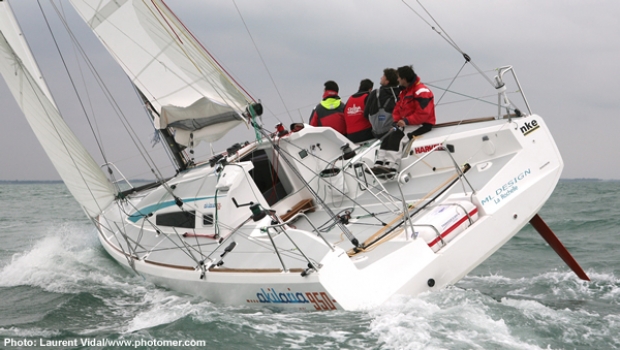
Akilaria 9.50 at pace...
The next big thing offshore?
Tuesday April 1st 2008, Author: James Boyd, Location: United Kingdom
While the sailing world needs another race boat class like it needs a hole in the head, given the record numbers attempting to make it to the start line of the Mini Transat, the dramatic rise from nowhere of the Class 40 and the advent even of 20 new multi-million Euro IMOCA Open 60s for this winter’s Vendee Globe, it seems there is considerable demand from sailors wanting to race offshore shorthanded.
Into this mix comes a new class that intends to bridge the gap between the Mini and the Class 40? “Wouldn’t this be the Figaro?” I hear you ask. Well, the Class 9.50 is in many ways aimed at being the anti-thesis of the Figaro – while the boats are similar in size, the Class 9.50 is a box rule (like the Class 40) and not a one design, but importantly is aimed at Corinthian sailors, whereas the Figaro is more for the pros.
The rule was created in late 2006 by solo race veteran Jean-Marie Vidal, best known for finishing third in the 1972 OSTAR aboard his trimaran Cap 33 and who in the intervening years has saied in the Mini and Figaro circuits as a keen, highly experienced, but ultimately Corinthian competitor.
Vidal worked with leading French designers such as Marc Lombard and Pierre Rolland in coming up with the right parameters for the new rule. This is closely based on the Class 40 rule, with some parts taken from the Series class within the 6.50m Mini fleet.
The basic dimensions for the Class 9.50 are:
LOA (max): 9.50m
Beam (max): 3.70m
Draft (max): 2.40m
Average freeboard (min): 1.00m
Displacement (min): 2,700kg
Water ballast: 450kg/side (more on this below)
Mast height from WL (max): 16.5m
Bowsprit/spi pole overhang (max): 2m
Main and genoa combined (max): 80sqm
Philosophically the rule is very similar to that of the Class 40 in that
- Appendages are limited to a fixed keel (without trim tab) and twin rudders.
- Canting and pivoting masts along with deck spreaders are prohibited.
- Sails are limited to eight in total including a staysail, storm jib and trisail and all must be made in polyester while spinnakers are in nylon.
- Bowsprits cannot be fixed and must retract within or pivot around into the footprint of the boat.
- to measure stability boats are inclined by 90deg and those with maximum height masts must show 130-170kg of positive righting moment at the masthead (less for shorter rigs)
- in terms of materials, for the hull, carbon, aramid and exotic glasses are banned as are Nomex core materials. For foils aramid is allowed, while for the mast, boom and bowsprit carbon fibre with a modulus lower than 245Gpa is permitted.
However over and above the Class 40 rule the 9.50’s has several additional features:
- While the maximum water ballast is 450kg/side (or 900 total), this is dependent upon beam, the calculation being (900/Bmax) x 3.7 (thus a 3.50 wide boat can carry 952kg of water total (or 476kg/side))
- To limit the relative proportions of the fore and aft sails there is a maximum average height of the main , jib and spinnaker (above the waterline) of 15.5m
- The boat is designed to have more of a cruising interior and the rule states that it must include four bunks and a chart table, all permanently fixed, and also a cabin top area providing 1.8m headroom below over a 2sqm area.
- oddly the rules specify that a collision bulkhead must be fitted, but no other bulkheads throughout the boat are stipulated
According to designer Charles Bertrand, who was one of the first to get involved with the new rule, the maximum beam limitation as well as the stability requirements changed between early drafts of the rule. The minimum displacement also rose. “They wanted production boats to be able to win races,” he explains. While at present custom builders of Class 40s have been struggling to get their boats down to minimum weight, this is not the case with the 9.50 and Bertrand says that with his Fox 9.50 design, currently in build in northern Sweden, they will have to include some correctors. Increasing displacement obviously allows safety factors to be increased but also, to some extent, helps limit cost.


The Charles Bertrand-designed Fox 9.50
As with the Class 40, a mix of prototype Class 9.50s and series production boats are anticipated. At present only three designs are believed to be under construction: the Fox (hull no1 due for launch in May for a German client), a Francois Lucas-designed hard chine wooden boat (currently under construction in the south of France), plus the Akilaria 9.50, a design from Marc Lombard, who penned the Tunisian boatbuilder’s Class 40 too. At present the only Class 9.50 to be launched and sailing is the Akilaria, the first boat being Marc Lombard’s own. Many other designers have 9.50s on the drawing board and it must only be a matter of time before Finot and Structures come up with a Pogo 9.50 fitting the new rule.
In conjuring up the 9.50, Jean-Marie Vidal was keen to promote variation between designs (hence the slightly more complex rules for the sail heights and water ballast) and it will be interesting to see in due course whether any designers attempt to go for anything less than ‘most powerful’ in terms of beams, sail area, mast height, ballast, etc.
Bertrand says that with the Fox they have a more balanced sail plan, whereas on the Akilaria the mainsail is substantially larger than the headsails. Also they haven’t gone for maximum beam on the basis that they are looking for the widest marketplace for the boat and this is does not solely include those looking to race the boat. However it is expected that most designers inevitably will end up at the most powerful end of the rule with the boats looking very similar to scaled down Class 40s but with a bigger cabintop.
A rule common to the Mini and Class 40, and also to the 9.50, is that in the interests of safety, boats cannot charge around pre-start areas of shorthanded event with bowsprits extended (like a jousting tournament). So, as is the case with the Class 40, it seems likely that there will be variations between boats when it comes to their bowsprit arrangements.
The Fox for example has a retractible bowsprit, whereas others may go for a Mini-style ‘MichDes’ bowsprit that articulates around a fitting on the bow, the sprit swinging back within the perimeter of the deck for pre-starts. Some, as is the case in the Class 40, may also take a conventional spinnaker pole in order to fly symmetric kites. Bertrand reckons this will depend upon the course.
In comparison the new Akilaria has no bowsprit at present, but Lombard reckons they will probably fit a fold-out ‘Mich Des’ style one next year. “I think it is a very powerful boat and personally I don’t feel the need to have a rotating bowsprit,” Lombard admits. “Jean-Marie Vidal who came up with the rule was very much into having a very long bowsprit but he sailed with us and it was very windy and I think he changed his mind! I prefer to have a normal fixed bowsprit and a normal pole for a symmetric spinnaker, like on a Figaro. I think it is better to have both, because you have the security, and if you have the rotating thing break because you do something wrong, then you have no downwind sails anymore. My opinion as a sailor is that I prefer to have both systems.”
As is the case with all of the latest generation ‘Open’ boats, we can expect to see chines in the hulls, particularly on the max power 9.50s. Both the Fox and Akilaria feature these.
Like the Class 40s, designers also have the choice of where to position the water ballast and in particular whether to have one or two ballast tanks each side. Both the Fox and the Akilaria have twin tanks (on the former the front tank on each side can take 260kg, the rear tank 200kg).
Price-wise a new production Class 9.50 costs much the same as a full-on proto Mini or a Figaro. Both the Fox and Akilaria come in at around 160,000 Euros ready to race in France, but Bertrand says that the price can be as low as 82,000 Euros without transportation from northern Sweden, a standard alloy mast, etc and with all manner of permutations available.
It will be interesting to see who takes up the Class 9.50. Will it solely be Corinthian sailors (as Vidal and his co-architects of the rule hope) or will aspirant pro sailors use the class as an alternative to the Figaro as a stepping stone between the Mini and the Class 40s? We suspect that like the Class 40 it will see a mix of both camps only that with the substantially reduced price tag, it will be even more popular.
“The boat is supposed to fit in the gap between the Mini Transat and the Class 40,” says Lombard. “Knowing that with the Class 40, the budget for a boat is 350-600,000 Euros for the prototypes, ready to sail, basically the gap [with the 9.50] is to make a boat that is half the price of that, that can interest many people and with more possibility of clients, because it is cheaper and it is not so extreme.”
While it is not so extreme, a fully tricked up 9.50 will still be handful to sail and will be one of the most powerful boats for its size. Lombard says that it is also extremely stable. “It is a very beamy boat - 3.70m, almost 50cm more than a Figaro - so it is a lot more powerful. Also it has 450kg of water ballast, whereas the Figaro has 220kg, so more than double. Basically the boat is really kind of a super Figaro - more powerful, more stable, faster, lighter. Its potential is quite enormous.” During a recent sail trial in around 18 knots of wind, the Akilaria agent in France was attempting to get the boat to broach, but failed to, recounts Lombard.
While the boats are around the same price as a new Proto Mini (despite being 10ft longer) Lombard says that the added size and the accommodation within the 9.50s should make them more comfortable and thus suitable for less nimble sailors. “For an old guy like me, you step on a Mini and you get hurt on the back and everywhere! The interior of the 9.50 is nice. The first one has a mix between a racing and a cruising interior and they made me a very nice double oven cooker which I think will stay in the office for most of the time! It has a fridge too! The boat has two double berths aft in that version and all the cruising kit. It is a very roomy boat.”
One possible limitation of the Class 9.50 are the races it can sail in. While an attraction fo the Class 40 is that it gets starts in events like the Route du Rhum, Transat Jacques Vabre and the Artemis Transat, providing a budget way into these major races, this will not be the case for the 9.50. It seems like that the success of the class with therefore be determined by the quality of the racing the class itself can organise. “The aim is to be have the same spirit as the Series class in the Mini,” says Bertrand. “Amateur sailors, good atmosphere, nice races.”
The UK-run Petit Bateau is an ideal vehicle for the new class. Lombard is still deliberating about whether he wants to race this 1000 miler so early in his new boat’s career. Bertrand points out that both RORC and its French equivalent, the UNCL are starting to run doublehanded classes in many of their main events. The UNCL offers an annual doublehanded trophy. There are additional events in the south of France and the Mediterranean such as Tour de Corse (Corsica) which can be sailed doublehanded. The first Fox is set to sail in the Baltic Spring Cup in July and will have an active schedule this summer up in the Baltic. Being Category A for two people, the boats can be sailed across the Atlantic, so one imagines it is only a matter of time before a transat for the class is organised.
Obviously the Class 9.50s are designed primarily for shorthanding but equally both the Fox and the Akilaria are set up to be sailed by a full crew of around five.
At present there are two orders for Fox 9.50s and three orders for Akilarias, with another 10 under negotiation, according to Lombard. Given that the class only went public a year ago this is perhaps to be expected but we suspect that it is only a matter of time before the 9.50 class goes supernova just the same way as the Mini and the Class 40 have done.
Full class rules:

More photos on the following pages...

Most Read
Most Commented
Comments
Businesses

Pro businesses
-
-
France
-
United Kingdom
-
Italy
Editor's choice
Member blogs
-
 Ned Collier Wakefield: MOD70 round BarbadosWell that was intense. 12 hard fought for seconds for the win. In idyllic conditions, Tony Lawsons MOD ...
 -
 Mini Transat leg 2 reportThe second leg of the Mini Transat started on 31st October, just over a month after ...
 -
Leg 1 reportI’ve been working towards the Mini Transat now for three years. In 2013 I was part ...
Business blogs
-
 The Island Sailing Club in Cowes, Isle of Wight, is delighted that Prince Michael of Kent ...
 -
Peta Stuart-Hunt chats with the 25 year-old British solo sailor Lizzy Foreman before she sets sail ...
-
The 2015 Student Yachting World Cup (SYWoC), an ISAF-recognised event hosted and run by students for ...
Editor's Choice
All time favourites...
-
 Three legs down into Ian Walker’s
 -
 Winning all but two races at
 -
 For the first time in its
Latest Comments
Add a comment - Members log in