
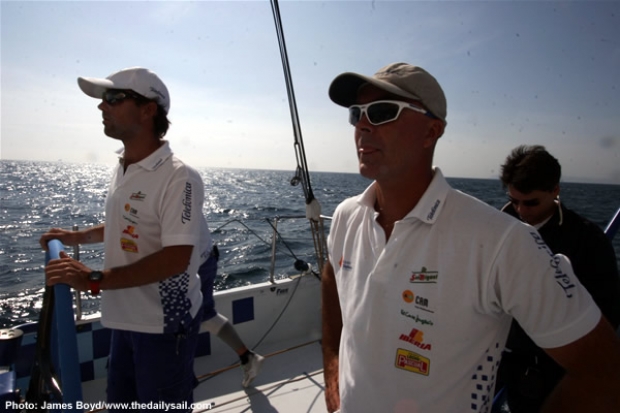
On board Telefonica Blue
Thursday October 2nd 2008, Author: James Boyd, Location: United Kingdom
While we had not expected to see the boats in the Volvo Ocean Race line-up en masse before the In-Port race on Saturday off Alicante, today a dry-run took place for all the boats with the exception of
Delta Lloyd. This was as much an opportunity for the new boats to check in with one another (although some sporadic boat on boating has taken place over the last weeks since the Volvo teams arrived here), as it was for giving the race officials a trial for what they can expect on Saturday.
I was fortunate enough to have blagged a ride on board Telefonica Blue where Dutch sailing legend Bouwe Bekking was running the show with 49er Athens Gold medallist Iker Martinez freshly returned from taking the silver medal in controversial circumstances in Qingdao. While Martinez helmed, his 49er crew Xabi Fernandez sweated around the front of Telefonica Blue’s giant cockpit. Obviously Martinez has been busy over these last weeks with his 49er campaign and so on board there was still a slight sense of him learning the ropes, despite having sailed with Bekking three years ago on board movistar.
The hierarchy within the Telefonica team is slightly unusual. The team is masterminded by Pedro Campos, who was today on board Telefonica Black. Meanwhile Bekking is ‘team skipper’ and is skipper of Telefonica Blue , Tornado ace Fernando Echavarri skippers Telefonica Black.
On board were a number of other familiar faces - calling the shots with Bekking was navigator Simon Fisher, who was on board ABN AMRO Two in the last race (and oddly is one of the few crew from the 'white boat' to be racing in the Volvo Ocean Race again this time). Leading bowman Pepe Ribes is back having sailed round the world with Bekking in the last two races (first on board Amer Sport One) and South African Jono Swain is another movistar crewman to return. While Swain was trimming the headsail upwind, the team have been lucky to get Barcelona 470 Gold medallist Jordi Calafat on loan from Alinghi, who today was on mainsheet. As we were preparing for Saturday’s In Port race the boat was in ‘inshore’ mode with two extra beefcake grinders on board.
As is typical with practice races of this type there were two starts before the third occasion when we all continued up the course. With a 12 knot southwesterly building to 15 knots and brilliant sunshine, we could not have asked for better conditions, sadly which the forecast indicates may be lacking come Saturday.
Despite a short start line there was not too much in the way of shenanigans for the starts where on all three occasions we lined up at the boat end. Come the third start Ken Read and all rock-star crew on Puma nailed the line the best in the middle of the pack while we were the first to peel off on to port. As we hit the right our team mates on Telefonica Black, on which round the world legend Roger Nilson is navigator, hung out on the left (offshore) side where conditions seemed to pay a little better.
So what did we learn today? That all the new boats are much more similar in their pace than the equivalent fleet was three years ago – not surprising since the VO70 box rule has been further tightened in its latest iteration. Volvo Open 70s behave a little like multihulls when tacking - there is a load to do, in addition to getting the main across, timing the runners right as normal, today we had the massive J1 genoa with its considerable acreage to thread around the front of the boat. Then there is the keel to be canted (a choice of three big buttons to jab in front of each helm position) and the twin daggerboards to hoist and lower. As on multihulls this all requires meticulous timing from helm, trimmer and in fact all the crew otherwise the boat loses all speed. Typically Iker would bear away a bit after coming through the tack to help build speed back up. In the conditions we were generally sailing at 11.5-12.5 knots upwind that would increase to around 15 downwind.
If upwind, like good comedy, it was all about timing, downwind it was about sheer grunt. Hoisting the giant spinnaker was a big grind for those on the three pedestals and during gybes it was most evident how understaffed the VO70s are even with two extra on board. Typically a boat of this size racing inshore would be manned by 20-25. Round the cans VO70s have 12… And this is not helped by the in port race course having a gate in the middle of it – so there are effectively four downwind legs. Also this time around there may not be one, but two In Port races on Saturday, although this may prove not to be the case if the sea breeze doesn’t kick in.
Interesting while some boats such as Puma have been using take down lines for their kites in practice, on Telefonica Blue we were not as Bouwe Bekking reckons that it is illegal: there is a rule for the race that you have to be able to shut your hatches within a certain (short) time period and having a take-down line disappearing down below with a large billowing sail behind it would prevent this from happening. We’ll watch out for this on Saturday!
And who won? While we finished a lacklustre fifth, partly through opting for the less favoured side up the first beat and then losing further ground during the drop at the leeward gate, the good news was that our team mates on Telefonica Black won the race 56 seconds ahead of Puma. If Telefonica Black and Ericsson 3 are considered B boats, which really isn’t the case this time - the Telefonica boats are virtually identical apart from their paint, while equal resource has also been ploughed into the Ericsson boats - then today was the day of the B-boats, Ericsson with Anders Lewander’s Nordic team having been second at the start of the final run. In fact ultimately Torben Grael and his race veterans on the newer Ericsson 4 claimed third ahead of Ian Walker and his Green Dragons with Ericsson 3 sixth and Team Russia bringing up the rear.
Make of this what you will. None of the boats seemed to be lacking for speed and on the inshore courses much much more was to be gained and lost through slick or poor manoeuvring and sail handling, generally a superhuman feat on these powerful boats, than sheer boat speed. It is also worth remembering that the VO70s are also in ‘inshore’ mode at present with a slightly different sail wardrobe and less gear on board. Offshore in the Volvo Ocean Race proper it could well be a very different story. Remember last time? ABN AMRO One had a rotten first In Port race in next to no wind off Sansenxo, but then showed the rest of the fleet a clean pair of heels for the remainder of the round the world race course. This time we doubt there is an ABN AMRO One equivalent. We will have a genuine yacht race on our hands.
Many more photos on the following pages...
A full technical article about the Telefonica boats follows next week....

Most Read
Most Commented
Comments
Businesses
Pro businesses
-
Italy
-
Italy
-
United Kingdom
-
Editor's choice
Member blogs
-
 Ned Collier Wakefield: MOD70 round BarbadosWell that was intense. 12 hard fought for seconds for the win. In idyllic conditions, Tony Lawsons MOD ...
 -
 Mini Transat leg 2 reportThe second leg of the Mini Transat started on 31st October, just over a month after ...
 -
Leg 1 reportI’ve been working towards the Mini Transat now for three years. In 2013 I was part ...
Business blogs
-
 The Island Sailing Club in Cowes, Isle of Wight, is delighted that Prince Michael of Kent ...
 -
Peta Stuart-Hunt chats with the 25 year-old British solo sailor Lizzy Foreman before she sets sail ...
-
The 2015 Student Yachting World Cup (SYWoC), an ISAF-recognised event hosted and run by students for ...
Editor's Choice
All time favourites...
-
 Three legs down into Ian Walker’s
 -
 Winning all but two races at
 -
 For the first time in its
Latest Comments
Add a comment - Members log in