
An incredible voyage
Tuesday February 12th 2008, Author: James Boyd, Location: none selected
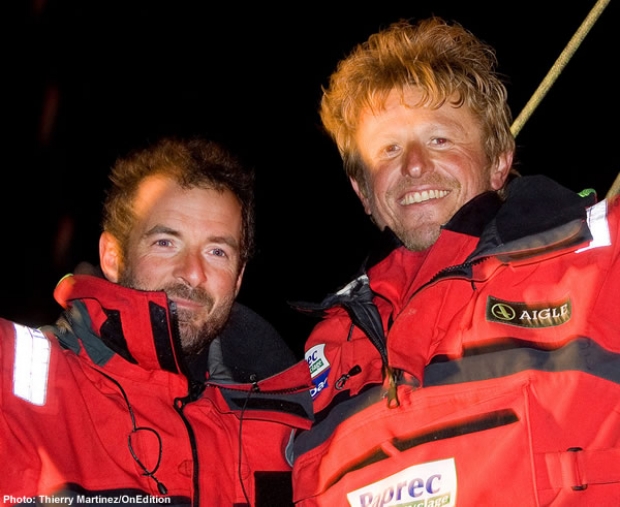
One happy Irishman arrived in Barcelona last night. Damian Foxall sailed with Jean-Pierre Dick on board their Farr-designed Open 60
Paprec-Virbac 2 to take line honours in the augural Barcelona World Race. This marked the end of Foxall's fifth circumnavigation after two Volvo Ocean Races, with
Tyco and then
Ericsson, a non-stop round the world record with Steve Fossett on
Cheyenne and winning the Oryx Quest with Brian Thompson. For Foxall the Barcelona World Race being doublehanded in Open 60s represented a whole new challenge.

Volvo v Vendee v Barcelona
So how has the experience of the Barcelona World Race - 90+ days of non-stop racing with only one other person on board - likely to have scarred him psychologically, compared to the Volvo? "With the Volvo, on the one hand you have a great group of guys behind you, but you are pushing the boat maybe a little bit harder. You certainly feel with a full group of guys on board you can deal with pretty much anything that comes up. Here it is a 60ft boat and you are singlehanded with one other person on board - just in terms of risk analysis and looking after delicate situations. Certainly it wouldn’t take much for it all to turn pear-shaped. The whole way around I felt this knot in my stomach...
"On the one hand you have got competition and you have to go as fast as possible in one direction, but on the other hand you don’t want to break anything. The smallest breakage on one of these boats can cost a lot because doublehanded you have less energy and less capability to do something about it.
"And it’s non-stop. I feel like I have been running on adrenalin and stress for three months non-stop and I don’t think the day after the arrival that I’m going to realise just how tired I probably am. Probably something weird will happen to me in 2-3 weeks time! I certainly feel we have achieved something. It has been the result of everything I have done up to date and a year’s work with Jean-Pierre getting the boat ready. I certainly feel drained.
With this new format of racing, comparisons with the solo Vendee Globe and with the fully crewed Volvo Ocean Race are inevitable. "With two people we can push the boat almost to the extent of what you can do fully crewed, because you can have someone helming. To go downwind fast you have just got to get the sail area up and a spinnaker is much more efficient than a genniker. So a lot of the time we weren’t using the PRB-type option, where you have the genniker up and a couple of reefs and have the autopilot on. You’ve got the small spinnaker up, with however much main you need, and then you have got to be sitting at the helm. It is a totally different way of running the boat and demands a lot more from those on board. And then you are certainly in a situation where things could go pear-shaped quite quickly and you are aware of that the whole time. That is the main difference between this event and maybe the Volvo Ocean Race where you can push the boat to 110% all the time, but then you have all the guys on board to deal with that."
While in the Volvo Ocean Race there was much talk by the teams of 'breaking guys' this is certainly no less true sailing an overpowered Open 60 non-stop around the world doublehanded. Foxall agrees: "We are doing exactly the same stuff we do in the Volvo with this race. When you are reaching, you put up your reacher and you put two reefs in the main and there’s 35 knots of wind and off you go - blasting down the waves and you are doing 25-30 knots. It’s exactly what we do in the Volvo."
Foxall maintains that most of the time they are sailing to the max, only in some situations, such as VMG sailing, would having a full crew on board be better. But obviously it is in manoeuvres and sail handling that they suffered most doublehanded. On Open 60s more use is made of furlers and snuffers, but most boats are now using hook systems for their halyards, although on Paprec-Virbac 2, they only have them for the headsails (some boats such as Gitana 80 are also using them on their mains too).
He admits that they would change sails earlier than they might fully crewed, but not nearly to the same degree as a skipper would singlehanded. Again this all works fine, provided there are no mistakes. Generally they would look ahead weather-wise and plan their sail changes one, two days or occasionally a week in advance. In their planning occasionally if there was a major change ahead they would miss out a gear they might not have fully crewed. "'Let’s skip the small spinnaker and we’ll go straight to the big genniker' for instance, which will do the job of all those three sails we could have put up. So there were a lot of times where you are in a compromise situation."
So was there any sail combinations they were using that J-P wouldn't be using singlehanded? Foxall says he will still be carrying kites in snuffers in the Vendee Globe, only he is likely to be using them less. During the Barcelona World Race they used their small kite extensively. "We were running down the Cape Verdes with the full kite and full main in 30 knots of wind for a day. When we messed up strategically - we didn’t get out far enough out west - so we just dug in and kept the sail up and at one stage it was ‘okay, we’d better get the reef in', but we managed to soak down on PRB and limit the damage we’d created.
"In the Indian Ocean we sailed for more than a week with the small kite, and full main, one or two reefs. And that’s the type of stuff that J-P wouldn’t do in the Vendee, but you would do in the Volvo. So that is why this is a fantastic formula: For me, this race is probably the most compete and hardest challenge that there is, because you can push the boat further than you could singlehanded and you are not fully crewed and it’s non-stop. It is the perfect match of physical and mental and challenge in terms of endurance."
During the race they initially carried out all sail manoeuvres doublehanded but Foxall says that increasingly during the race if it was something simple like throwing out or taking in a reef or changing headsails (furling one in, furling out another) they might do it singlehanded. "Anything that was top of the range or where the autopilot couldn't be left to look after itself required two people," he says.

Road to victory - a well matched pair
In our opinion one of the reasons for their success was that Foxall and Dick knew each other well from when Foxall had navigated for Dick during a Tour de France a la Voile. With the present campaign they had begun preparing for the Barcelona World Race a year in advance. They also had the same competitive outlook, never satisfied with the trim of the boat, always looking for more speed.
In terms of their routine on board Foxall says they initially set out with a formalised routine with a three hour watch system, changing watches to coincide with the latest polling and/or the arrival of new weather info.
"In reality it changed along the way and got more flexible. There were times when we were happy to have six hours down below and stay nice and dry rather than having to get into your dry suit. That was in a situation when you are just going along for days and days on end, when nothing’s happening other than driving the boat fast. Then there are other moments when its changing a lot and you are doing sail changes every hour or hour and a half and then we are in a much more intensive watch system of shorter watches of three hours. And then there were times when it was flexi-time. It evolved around the race. I think that worked out really well for us. We’ve both done a lot of singlehanded racing and crewed racing and we realised it was important to change that depending upon what mode we were in."
In terms of any major decisions that needed making they would discuss it, but there was also a split of responsibilities, as Foxall explains: "I was more responsible for keeping the boat together technically. Anything that needed repair or analysis or checking stuff. J-P looked after the electronics, the engine and information side. Weather analysis and routing, we shared it."
Pilots
While the Barcelona World Race was doublehanded and there was much big talk prior to the start of having someone helm all the time, even from the outset this was all baloney. Foxall says they used their B&G pilots a huge amount. "An autopilot is worth at least two or three crew. If you go off singlehanded with an autopilot in some ways you have already got three people on the boat, at least, because the autopilot drives. So if you don’t take an autopilot you are going with less people than if you are singlehanded! It is critical to have a really good autopilot that works in as many conditions as possible and a lot of the time it drives faster than we do, especially when you are tired.
"Managing that became an issue when we thought we were going to run out of diesel, and there are situation when you have to drive - you are faster driving downwind with the kite. And there are other times when the autopilot does a fantastic job. Any time you want to do a manoeuvre and it requires two people, on she goes and it is pretty nice to know when you are on the foredeck pulling down the small spinnaker in 35 knots that your autopilot is keeping the boat pointed downwind. The spinnaker is socked and at some stage you have got the spi socked and you have two guys on the foredeck and it would only take the autopilot to luff up and the whole thing could go pear-shaped quite quickly. We never had one of those situations."
While modern autopilots have essentially three settings - being able to steer to compass course, apparent wind angle, and the most tricky of the lot, true wind angle - Foxall says they used all three of these regularly. "There’s not one single way of using the pilot. Each situation requires a different usage according to wind stability, point of sail, whether you want to go straight at the mark or whether you just want to go fast, whether it is important to trim the sails or just have them twisted a little bit."
When it came to food, this being a French boat they celebrated each day with some Serrano ham at midday. Otherwise it was freeze dried mainly from Mountain House and Back Country. Of course there were some meals that were not favourite and for Foxall mushroom soup was one. However since the Barcelona World Race took very much longer to complete than was expected (prior to their departure there was talk of seeing them return in 80 days...in the end it was 92, and that was for the winner...) they did begin to run low on food and so the mushroom soup was consumed. Foxall says it wasn't that bad. They had to watch their diesel and by the time they arrived they were onto their last gas bottle.
Things that go bump in the night
As ever with voyages such as this there were moments when they nearly came acropper. Foxall recalls two incidents in particular - one when the furling drum for their Solent jib (the only fixed forestay Open 60s have) sheared in half (hear him describe this here) and another occasion when he has chosen to carry out a rig check and sailed into an ice field while tethered to the top of the mast... (listen to his animated account of this here).

In terms of other breakage there is a large patch on the port side of their cabintop where a solar panel came off. And they also were forced to make some running repairs to their kick-up rudders. "We kicked them up a few times coming down the Atlantic - it works really well," says Foxall. "It has a fuse system so you just replace the fuse. But we also had to redo the skin and I had to reinforce the rudder casing system as there was quite a bit of play there."
In addition to this as they were approaching the Cook Strait they managed to pull the fractional halyard lock out of the mast. This meant that they could no longer use their smaller downwind headsails, until Foxall felt brave enough to go aloft to attempt a fix. "It wasn’t clear how to do it - but we managed to put in a classic halyard rather than a lock, but it did mean a little bit of laminating up there so we could have got a halyard in there."
Another problem was that one of the water ballast intakes got jammed out forcing them to heel the boat over with the keel as Jean-Pierre Dick (the taller of the duo) was dangled over the side in an attempt to coax it back in.
New technology
One of the most innovative features of Paprec-Virbac 2 is her planing wedge, the drop down lateral trim tab affair running across the underside of her hull immediately forward of the transom. Despite this nearly coming off on their delivery trip to Barcelona prior to the start, during the race it worked well.
Foxall eloquently explains its advantages: "It allows you to have a boat that has more rocker and when you want a boat with a longer, faster waterline length, you just drop it down. [In Volvo terms] If you bring the trim tab up you have got ABN AMRO and if you let it down you have a Farr boat. The negative side is that you have a little extra weight. It is fantastic to have ABN when it blowing and you are going downwind. You bring it up then to increase the rocker. In light airs or upwind you’d have it down for a longer waterline length and increased stability. In very very light airs you bring it up. When you are moving along and looking for waterline length, down she goes. When you are looking for stability down she goes and when you want to get the bow out, up she comes."
Another unique feature to Paprec-Virbac 2 and her sistership, Loick Peyron's Gitana 80 is that they have a massive sliding cabintop protecting the aft half of the working cockpit area. While Dick says they are going to modify this (he is tall and under the sliding cabintop headroom is decidedly limited) Foxall says he welcomed the added protection on the Open 60, compared to the highly exposed VO70 cockpits. In this respect he admits he has become a convert. "There is no point standing out there just getting nailed the whole time. That’s not fast."
Bang bang bang
Foxall comments on how essentially they were upwind for the last 6,000 miles of the race, ever since they rounded Cape Horn. However he says he is mightily impressed by how well their Open 60 sails to weather (traditionally Open 60s have always been downwind reaching machines).
"The central water ballast system works really well and you sail with a lot of weight in the bow with the boat nose down and it becomes a displacement boat as opposed to an Open 60 type of skiff. And that is where it is really good that this boat is strong and there is more an accent on reliability and longer haul than maybe some of the lighter options that some of the other teams have gone for. That’s when you are happy just to power on through the waves and you feel like the boat is just happy. It goes really well upwind. It has longer boards than the last version and that makes a huge difference."
For this is one of the signficant ways an Open 60 differs from a Volvo 70. While the latter weighs 13.5 tonnes, typically Open 60s are substantially lighter for their length, most weighing in at around 8-9 tonnes. Thus VO70s spend much more of their time as displacement boats and with less water ballast to play with they have many less modes.
"You can change them to do anything," says Foxall of the boats. "You can go from more skiff-type mode to displacement mode, and the boats launch off pretty well when you have got breeze. You can feel quite light with these boats when it is downwind and there is not a lot of breeze - you feel like you are sliding along quite nicely. They are only 60ft long but they have a lot of power. I think generally the VO70 is quicker but there will be ponts of sail where these would match them."
No backing off
While the competition was dropping out (only half the fleet look likely to finish the Barcelona World Race) and Paprec Virbac 2 developed a significant lead over second placed Hugo Boss, Foxall says that they didn't back off.
"We discussed it [backing off] and decided to drop it fairly quickly. The fat lady is never there until the finish line. 500 miles can get washed away quite quickly, either through natural compression or by having to take a completely different route because you are so far in the lead and the guy coming from behind can go straight. We had one of those situations at the Australian ice gate and another off Brazil.
"There was a constant discussion about how hard to push. The objective was to move forwards at race pace and there were very few times we throttled back. Even coming through the Strait [Gibraltar] we were still racing. Only on the last day we might have kept the small jib up a little bit longer. So we sailed at race pace the whole way, but without taking unnecessary risks. Sometimes you can go just as fast with a smaller sail..."
The future for our Damian
In terms of what lies next for Foxall, being Ireland's most capped offshore racer and one of the few with experience of the race, his destiny must surely lie with the Irish Volvo Ocean Race team. He is enthusiastic about this but hasn't furthered this discussions yet and significantly he also has a young family.
"It would be fantastic if Ireland can get a good Volvo entry. Hopefully they have everything they need in place to make it work. I would be delighted to be involved, but I have to see how it works with my family life. I have done two Volvos and it is going to be hard to beat this. To go around again - I don’t need to go around just to go around, but I’d be very very happy to sail for the Irish Volvo team and we’ll just see - I need to sit back for a few weeks and think about it."
Most Read
Most Commented
Comments
Businesses

Pro businesses
-
France
-
-
United Kingdom
-
Editor's choice
Member blogs
-
 Ned Collier Wakefield: MOD70 round BarbadosWell that was intense. 12 hard fought for seconds for the win. In idyllic conditions, Tony Lawsons MOD ...
 -
 Mini Transat leg 2 reportThe second leg of the Mini Transat started on 31st October, just over a month after ...
 -
Leg 1 reportI’ve been working towards the Mini Transat now for three years. In 2013 I was part ...
Business blogs
-
 The Island Sailing Club in Cowes, Isle of Wight, is delighted that Prince Michael of Kent ...
 -
Peta Stuart-Hunt chats with the 25 year-old British solo sailor Lizzy Foreman before she sets sail ...
-
The 2015 Student Yachting World Cup (SYWoC), an ISAF-recognised event hosted and run by students for ...
Editor's Choice
All time favourites...
-
 Three legs down into Ian Walker’s
 -
 Winning all but two races at
 -
 For the first time in its
Latest Comments
Add a comment - Members log in