
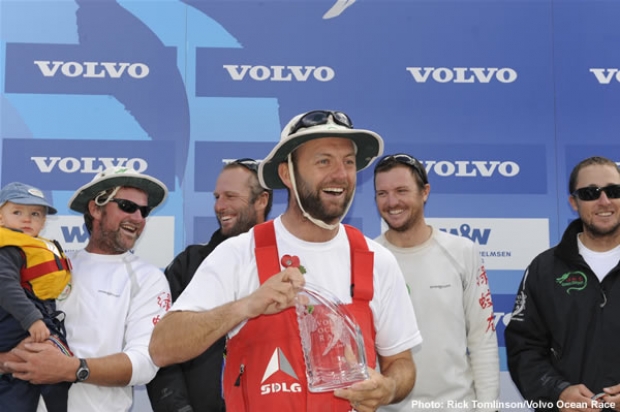
Once more into the fray
Friday November 14th 2008, Author: James Boyd, Location: United Kingdom
All the Volvo Ocean Race teams have been frantically busy these last days with a fantastically cutdown stopover in Cape Town - less than two weeks compared to the best part of a month three years ago. Ian Walker’s Green Dragon team have been out of the water fixing their keel fin that was damaged in a collision and were one of the first to get back in the water.
Unfortunately getting some time on the water before tomorrow’s start of leg two to Cochin, India was cut short yesterday when the J4 lock strop again broke (as it did on start day in Alicante) neatly wiping out one of their spreaders.
“We have got a spare spreader which we are waiting to arrive,” Walker told thedailysail this morning. “It was the same problem we had in Alicante with the J4 strop breaking - that is the biggest concern, not the spreader. The spreader we can fix. Apart from that we are in good shape.”
So why is it happening? “We certainly know what would have contributed to it,” he says cryptically. “We thought we’d solved the problem we had in Alicante. But I don’t think we are as close to finding a solution but having said that we have got some ideas. I will be a bit nervous when we go upwind with the 4 on this leg.”
On the first leg Green Dragon exceeded everyone’s expectations when, as one of the single boat mid-fleet campaigns, she led into the Doldrums and was only overhauled by the powerful Puma and Ericsson 4 off Rio. She eventually finished fourth into Cape Town behind the two Ericssons and Puma.
“I think we can sail better, especially in heavy air," continues Walker. "But looking at it globally we have got to be very happy with the result and reasonably happy with the performance. We need to spend more time sailing closer to other boats before we can have any confident in our boat speed over others.”
When we put it to Walker that Green Dragon’s performance on the first leg was down to tactics more than boat speed, he agrees with us, but points out that you still have to be in the ball park speed-wise otherwise even if you go the right way you still don’t gain.
As to his assessment of the competition after leg one, Walker’s views are based on what he has seen on scheds. “I think you will find that Telefonica are very good in the light. Puma looked good downwind until it got very windy. Ericsson seems powerful upwind and reaching and obviously were a class apart in strong breeze. They were in easier conditions, but 600 miles is still a long way in 24 hours.”
And Green Dragon’s strengths? “We seem okay in the light downwind. We did pretty well getting out of the Med when we were near other boats quite a lot so we are pretty competitive in that stuff. We haven’t done much reaching yet, so that has yet to be seen and I think we will be good in a breeze. We were going quite well in a breeze only we dropped the front earlier than Puma and Ericsson. Our runs were pretty good generally.”
One of Walker’s criteria for choosing the crew for the Green Dragon was that it had to be people he didn’t mind spending a lot of time with and one gets the impression this is one of the most well gelled crews in the race. “I think we are good,” he says about this. “We had a very positive debrief. Some of the guys said it was the most enjoyable leg of the Volvo they’d ever done which was very pleasing to hear. We had no issues at all on board, in fact quite the reverse we had a good time. But it is always easy to have a good time when things are going well. It is only when things go badly that you really get tested.”
As a result there will be no changes to Green Dragon on this next leg, but Irish race veteran Damian Foxall is known to have pre-planned standing down for the third leg, to Singapore, some while before the race started.
As to this next leg across the Indian Ocean and up to Cochin, Walker agrees that it is going to be a tactical ‘challenge’. “We have been looking at it all morning. You are going to have to go south to get some breeze early on. Yesterday the forecast looked really quite windy for the first week with a succession of lows. That probably will still happen. So I think we will have some quite big breeze, but at some stage we are going to have to go north. You are not going to want to go north because the moment you go north you are going to slow down. So it will be different to the Brazil situation where we keep going south in the knowledge that it is going to get easier and easier to get east. This will be hard, because going east isn’t necessarily going to help you get north as you might end up having the big high pressure separating you from where you want to go. So it is quite tricky.”

For watchers of the race he warns that for most of the leg not much should be read into DTF or who is leading as groups of boats are likely to be in very different weather conditions or be playing out the same circuitous tactics as they had to in the South Atlantic en route to Cape Town.
A particular issue this leg is the scoring gate - anywhere along the line of longitude 58degE south of 20degS. Getting to this first will certainly require the boats to dive south out of Cape Town and on to the Southern Ocean expressway, only this might not be the fastest route to Cochin, warns Walker. “It might be diametrically opposed to what you need to do to get to India first, unlike the first leg where everyone had to go around Fernando. So I could see a situation where people at the back decided not to worry about the scoring gate and head north towards Cochin and end up hundreds of miles ahead of the guys who are just going east to get the points at the scoring gate, for instance. Or the weather might pan out that actually going east to the scoring gate is the best way of getting to Cochin in which case you have a win-win. So strategically it is going to be quite hard, plus, of course, we have to get out of here first which is going to be a nightmare - and cross a high pressure ridge to get south. Then we have got the easy bit, which is getting east and then we have to cross the high pressure to get into the trades and then we have two bands of Doldrums and then it is probably going to get light on the way into India. So there is plenty of scope to get it wrong…or right.”
Perhaps you don’t want to be leading? “One of the hardest things is going to be working out who is leading! I’m not sure distance to Cochin is going to have much to do with anything. It will be quite interesting if someone comes out of here, turns left and goes upwind.”
So possible ‘sleath mode’ could come into play more on this leg? “I think we used it quite well on the last leg - we used it to cover up our mistakes! We’re probably going to need a few more of them! I think 12 hours isn’t a long time. When someone is going along and they play their stealth card, it probably means they have gybed off. I think people off the boats are making more of it than people on the boats. Having said that, when maybe it goes light towards the end, it could be quite nice to switch the lights off.”
Obviously in Cape Town the teams have been busy at work on their boats – there’s been a keel change on Ericsson 3 for example - but Walker doesn’t feel this is going to make much difference to their performance from what we have already seen. “ Ericsson 3 - they were pretty fast before and I’m sure they will still be very fast. There is not much you can do within the rules to substantially change things. Probably sails are the greatest thing. I know Telefonica have been focussing hard on their sails, as we have. We have run out of time here because of the weather. We have recut one of our spinnakers, but we haven’t had time to check it. So we will be more conservative than we were intending to for this leg.”
One gets the impression that the crews would much rather be heading out of Cape Town on to the Southern Ocean expressway, logging high speeds and notching up more 600 mile days. However what the new second leg of the Volvo Ocean lacks in pace, it will certainly make up for as a highly challenging – and new – game of water born snakes and ladders.
More photos on page 2...

Most Read
Most Commented
Comments
Businesses

Pro businesses
Editor's choice
Member blogs
-
 Ned Collier Wakefield: MOD70 round BarbadosWell that was intense. 12 hard fought for seconds for the win. In idyllic conditions, Tony Lawsons MOD ...
 -
 Mini Transat leg 2 reportThe second leg of the Mini Transat started on 31st October, just over a month after ...
 -
Leg 1 reportI’ve been working towards the Mini Transat now for three years. In 2013 I was part ...
Business blogs
-
 The Island Sailing Club in Cowes, Isle of Wight, is delighted that Prince Michael of Kent ...
 -
Peta Stuart-Hunt chats with the 25 year-old British solo sailor Lizzy Foreman before she sets sail ...
-
The 2015 Student Yachting World Cup (SYWoC), an ISAF-recognised event hosted and run by students for ...
Editor's Choice
All time favourites...
-
 Three legs down into Ian Walker’s
 -
 Winning all but two races at
 -
 For the first time in its
Latest Comments
Add a comment - Members log in