
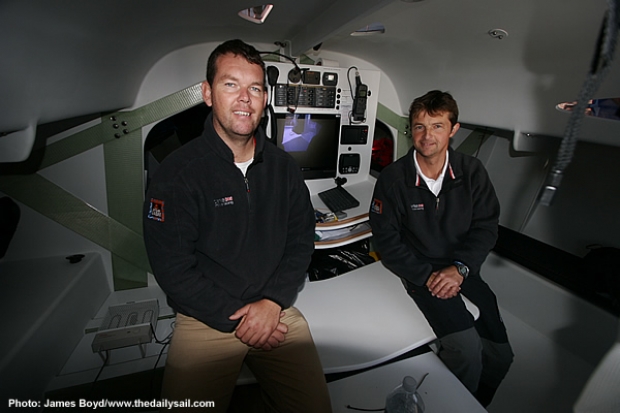
Shorthanded debut
Saturday November 24th 2007, Author: James Boyd, Location: Transoceanic
A long term member of the crewed keel boat racing fraternity, Simon Clarke has been a key part of many of the leading UK big keelboat campaigns, from Nick Lykiardopulo's Aera to Nick Hewson's Team Tonic to Chris Little's Bounder. Clarke was introduced to the world of short handed offshore racing when he ran the shoreside of Alex Thomson's Hugo Boss Open 60 campaign and it doesn't take a leap of imagination to see that at some point during the proceedings the ' I could do that' cogs began to turn.
"I always fancied the TJV," admitted Clarke to us before the start of the Transat Jacques Vabre. Currently his Class 40 is mid-fleet as her skipper sees whether he enjoys shorthanding. "I thought I’d give it a go two handed to see what happens. You end up sailing the boat at times if you were on your own, so it will be interesting to see what I think of it. It is a trial for myself. And it is much easier to do a trial doublehanded than singlehanded. The 60s, everyone would love to have one, but they are so expensive and I don’t want to be uncompetitive in an old boat. That doesn’t do it for me. So there was this opportunity with this boat, a 2.5/3rd generation one."
Clarke says he first saw the drawings for the 40 he and co-skipper David Lindsay are currently sailing to Brazil when he dropped into designer Simon Rogers' office in Lymington to discuss Hugo Boss' keel having fallen off. "Then when I left Alex, I bumped into Simon and he said 'you should see our new 40', so I dropped in and looked at them, and he said ‘hull no.2 - the guy is up for chartering it’. So I went away and thought about it and wondered how much it was and it went from there."
The boat is owned by Mark Wynne-Smith, European CEO of Jones Lang LaSalle, one of the leading real estate services and money management firms. Wynne-Smith is also a co-owner of the Dubois 40 Azure. It is unclear as yet what Wynne-Smith's plans are for the boat beyond the TJV, but there is a chance that it may compete in next year's fully crewed Quebec-St Malo race. Prior to this there is The Transat singlehanded race, which could of course be a convenient delivery.
Despite tremendous experience working with yachts Clarke says that pretty much everything that could have gone wrong, did go wrong in their build-up to the TJV.
Among the mindblowingly long list of set backs has been 'losing' the mast in France somewhere on the back of a truck as France went 'en vacances' in August. Fortunately this didn't matter so much at the time - because the boat had been lost too... "It was supposed to be in Felixstowe and somehow it got put on a barge and taken to Thamesport, but no one knew why. So the lorry was waiting in Felixstowe for a boat that wasn’t there," says Clarke, wincing at the memory.
The forestay arrived 50cm too short, despite email evidence specifying the correct length and the mainsail was too long in the foot - by 20cm!
More fun and games were to come. "We noticed there was a bit of water in the boat and so Pom Green [the builder] came down and he started messing around with the keel bolts….and then suddenly there was a lot of water in the boat and it was emergency, rig out, keel off. We put it all back in the water and two hours later ‘is there meant to be water back in there again ?’" Eventually the leak was located in the engine drive leg that was somehow feeding water up the longitudinals towards the keel bolts. "All credit to Pom, he stuck his hand up," says Clarke.
And then just as the duo were about to set off to France, there was an issue with the keel foil, that hadn't been built to the drawings supplied. So it was keel off again and off on a lorry down to be fixed by master keel builder Henry Irons down in the Cornwall.
"We are record breakers at getting the rig off," says Clarke, looking on the bright side. "Yes, every three times we go sailing we end up taking up the keel off!" adds his co-skipper.
Given this background it was perhaps amazing that the duo managed to complete their qualifier and are now at the closing stage of their first shorthanded transatlantic race. While it gave them more time to prepare the boat on land, there were understandably substantial downsides. Clarke chartered the boat personnally and was hoping to find sponsorship - but with the boat out of the water constantly this proved impossible (the original plan was to have the boat sailing at Cowes Week at the beginning of August - in the end it became a mad scramble in October). Aside from their qualifier they also had a distinct lack of sailing time in the boat prior to the TJV start.
Originally Clarke's former Team Tonic skipper Jeremy Robinson was to have competed with him but Robinson suffered to a serious hand injury prior to the race and Lindsay, a Kiwi sailor with a similar racing background to Clarke, stepped into the breach.
Sailing doublehanded the duo haven't had to endure the massive sleep deprivation singlehanders do. Prior to the start Clarke joked about it being 'just a fleet race' only 4,300 or so miles to Brazil. In fact this is exactly what it has proved to be.
To plug some holes in his knowledge he took some meteorological tuition from Chris Tibbs prior to the start. During the race they get fleet scheds four times a day and pick up fresh GRIBs from MaxSea Chopper and Steve Hayles and Marcel van Triest's excellent UGRIB service. Among the Class 40s there seems to be some debate about what you are and aren't allowed to get off the internet and while boats in the TJV are obliged to carry Iridium satphones, in the build up it was noticable the large number of Fleet 33 satcom sets (with faster download speeds) being fitted to some boats. But not Clarke's.
The boat
Clarke and Lindsay's steed was the second of the three Rogers boats competing in the TJV to be built at Composite Marine International in Thailand. The first was Novedia Set Environnement, belonging to Tanguy de LaMotte, a former Mini sailor and himself a designer who had a major say in the deck layout for all the boats (see photos on the following pages). The third was the prologue winner, Vecteur Plus of Figaro sailor Bruno Jourdren and multihull sailor Nicolas Pichelin.
The hull is beamy compared to the older boats and has the inevitable hard chine aft (as the photo above shows). The twin rudders are mounted on the transom attached to a single central tiller.
On Clarke's boat they have made a few changes to the standard layout. In order to make trimming easier, they have an 8:1 traveller purchase system and don't have so many diverter blocks for the sheeting in order to reduce friction
The cockpit is open ended save for a beam on which the full width mainsheet track is mounted. All the lines from the mast foot run back through an aperture in the top of the cabintop to a central bank of clutches and the pit winches, an arrangement similar to the first Virbac Open 60. This has made it necessary to fit twin companionways and there is a protected area beneath the cabintop either side of the pit area where the crew can shelter. There is no seat here, the crew prefering a bean bag instead.
They also have furling headsails instead of a conventional headfoil. "I think we’ll make the changes more often because it is easier to do," Clarke told us before the start. "When it is windier we’ll hold it for longer than if we had to go up there and physically wrestle the sail down."
On the foredeck they have a system borrowed from ABN AMRO and some of the Open 60s for tensioning the staysail luff involving a line running aft to a cockpit winch that is cranked up and then locked off by a jammer mounted just forward of the mast (where you'd be taking the kites down).
There is considerable variation among the Class 40s to spinnaker handling, as like the Minis the class has a rule about bringing bowsprits within the footprint of the boat to prevent the potential for terrible jousting during pre-starts. Thus boats have bowsprits retracting into the hull, along the deck (as Giovanni Soldini's race leader Telecom Italia has) and rotating back in beneath the lifelines (as they do on Minis). Some have conventional spinnaker poles and some have the fitting for the aft end of these mounted half way up the foredeck.On the Rogers boats the bowsprit is simply hinged on deck and flips up, released by a halyard-lock type mechanism. They have a spinnaker pole but ended up not taking it on the race, preferring instead to use A sails.
Down below the boat is mini-Open 60 with the nav area, with a V-eed seat and chart table, dominating the saloon area. This is similar on all three boats. The main bulkhead has some very apparent structural bands of unis stuck to it. Forward there is the normal sail stowage and - quite a relief - as Class 40s are prohibited from fitting canting keels, access to this area is very straightforward.
Aft, running either side of the cockpit indentation, there are some slightly small bunks with the water ballast tanks on the outside, with large diameter plumbing running between them for rapid ballast transfer.
Despite the incredible list of teething problems Clarke says he is pleased with the boat. "It seems like a nice boat. It is a beautiful boat to steer downwind - light, responsive..."
On the race course
After a promising start when they were lying in second place, the valiant crew have discovered a distinct Achilles heel in their boat's performance.
"We’ve suffered massively in the light: Since our parking lot off the Canaries, we have been pretty much dead downwind in around 10 knots of breeze and funnily enough having a powerful, light boat, it doesn’t like doing that," Clarke admitted to us when we spoke to him on Friday. "On our first evening after the start when we had all the boats around us, the breeze started to clock round, we put up our biggest jib and they started pulling out A0s and stuff and Kiwi and I we looked at each other and said 'I think we might be needing one of those shortly'. All those boats right out in front they have got the gear - their kites are massive in comparison to ours. So they can always sail inside us and you really pay the penalty for that. We are hoping that this last 1000 miles, is what we’ve got this boat for - it going to be 15 knots minimum, jib reaching where we can use our beam and power. That’s what we’re praying for."
Coming out into the Atlantic the duo were one of only a few boat to brave the Chenal du Four between Ushant and mainland France putting them into fourth place across the Bay of Biscay. At Cape Finisterre they had pulled up to third, but chose an easterly heading to sail down the Portugese coast where the boats offshore to the west won out. They correctly took a hit and crossed the race track pulling them up to seventh again and passed Madeira in sixth place, the most westerly of the lead boats. However they sailed too close to the high and in the park up off the Canaries they dropped to 18th place as the left side of the race track began to pay again. This set of circumstances has dictated their race even since.
They tackled the Doldrums in the middle of the race track on a similar path to the leader and while boats to the east had a relatively easy crossing, for them the Doldrums threw up its normal curved balls.
"It was very active," recounts Clarke. "The cloud activity was unbelievable. Through the day the clouds seemed to behave themselves, but as evening came it was clouds everywhere. You'd have 10 knots of breeze and then you’d have all these clouds around you and then you’d have 3 knots. And at the same time you are trying to avoid some of the big black ones which are particularly nasty.
"If you can get on the right side of these clouds you can get pressure, but you can’t get to all of them. And some clouds suck the air out for about two hours and you are just left reeling in its path. So had one when we had the masthead chute up, and found ourselves travelling in a northeasterly direction at about 18 knots of boat speed in just under 30 knots of breeze! But there’s nothing you can do! You can’t risk taking it down. If you flog that much kite in that much breeze it is not going to survive. So it is just hang on basically."
When we spoke to Clarke on Friday they were attempting to reach the southeasterly trades, post Doldrums. "We are still unbelievably in the transition period - we’ve been in it for 24 hours now! Traditionally you come out of the Doldrums and you go on the wind for eight hours and you sail hard on the wind as you can just to get out, but unfortunately you’d like to sail south but we can’t because the wind has been from the south. It is slowly starting to shift now to the gradient position, but it has been a struggle. We thought it had gone a couple of times during the night, but it never did."
Generally Clarke says he has been enjoying the TJV experience, except on the occasions they have found themselves undercanvassed.
"We were a bit naïve powering after Soldini, but conditions were right and we were able to hang onto him. He wasn’t that far ahead of us when we parked up [off the Canaries]. Of course we were not properly downwind, it was a bit of reaching and all that and then the boat is fast. We realised from early on that Soldini is the class act. ATAO and Chocolats Monbana - they are good guys too, but we’ve sailed past Chocolats Monbana on the first full day out and the size of their kite compared to ours… And that is a quick boat downwind - it is quite narrow on the waterline, with massive sail area.
"So, yes I am enjoying bits of it. And provided we get the conditions down here and we are able to claw back some places, then I guess I will enjoy it a whole lot when I am sitting in a bar in Salvador."
Thankfully since getting out of the Doldrums they have pulled up from 19th place to 16th as they finally feel the benefits of their powerful hull and sail plan kick in. At the time of writing they had four boats ahead of them all within 30 miles and this could conceivably leave them in 12th.
As to the future, Clarke says he would definitely like to continue Class 40 sailing, but obviously needs to find some sort of sponsorship in order to back him. Now he has this race under his belt he has a long list of things he admits they could have done better. As a sponsor prospect we reckon he'd be a good bet as apart from being a highly experienced yachter, one thing he is very accomplished at is spinning a yarn...
To listen to Clarke recount the most hair-raising part of his TJV so far - open this file...

Detail pics of the boat on the following pages....


Most Read
Most Commented
Comments
Businesses


Pro businesses
-
-
Netherlands
-
-
United Kingdom
Editor's choice
Member blogs
-
 Ned Collier Wakefield: MOD70 round BarbadosWell that was intense. 12 hard fought for seconds for the win. In idyllic conditions, Tony Lawsons MOD ...
 -
 Mini Transat leg 2 reportThe second leg of the Mini Transat started on 31st October, just over a month after ...
 -
Leg 1 reportI’ve been working towards the Mini Transat now for three years. In 2013 I was part ...
Business blogs
-
 The Island Sailing Club in Cowes, Isle of Wight, is delighted that Prince Michael of Kent ...
 -
Peta Stuart-Hunt chats with the 25 year-old British solo sailor Lizzy Foreman before she sets sail ...
-
The 2015 Student Yachting World Cup (SYWoC), an ISAF-recognised event hosted and run by students for ...
Editor's Choice
All time favourites...
-
 Three legs down into Ian Walker’s
 -
 Winning all but two races at
 -
 For the first time in its
Latest Comments
Add a comment - Members log in