
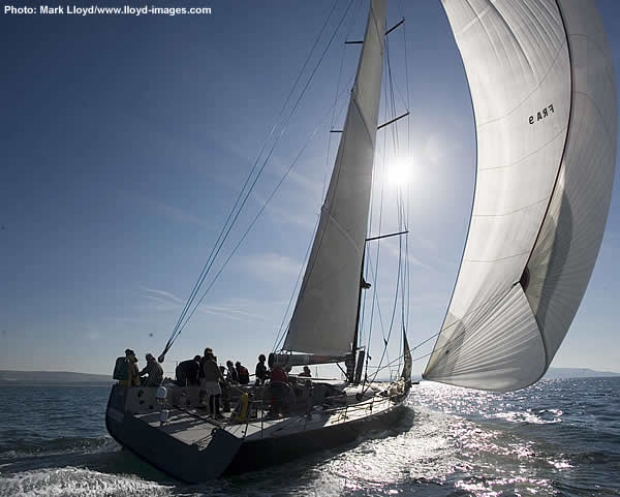
Walking the second half of the course
Wednesday June 20th 2007, Author: Pete Selby, Location: United Kingdom
In this second part (see part one
here
) of Pete Selby's Pace Notes for the JPMorgan Asset Management Round the Island Race he describes the route from St Catherines to the finish line in Cow
es. The weather situation remains unpredicable says Selby: "A
very mobile low pressure is making that extremely hard at the moment. Every time I look the forecast has changed, so lets assume that we will see anything from 0 to 20Kts and a deluge to a drought."
St Catherine's point to Bembridge
This leg breaks down into two sections: The first is St Cats to Bonchurch the second Bonchurch to Bembridge.
This year, most boats will have fair current on this leg. The current is East going until 1800, staying closer to shore will not be essential this year giving some separation from the rocks and ledges, a straight course is the fastest.
If you end up close to shore the charts show most of the really big stuff, but miss out on some smaller rocks, especially if you have a deep draft. If I end up close to this shore I make sure that someone on the foredeck is solely looking out for submerged items. I also make sure that I constantly have a good view of our course, even if it means that I end up to leeward.
If winds are still light keep an eye further offshore, by now it is probably midday or later and the land will hopefully be heating up and a sea breeze may be developing. This generally comes from the seaward side of the course first so being further offshore may be advantageous. As ever, observation will give you the clues of where the wind will come from (if at all) so make sure you place your boat in the best position for what is to come.
As you get to the end of this section, you will come to Bonchurch. This is where the Island rolls northwards into Sandown bay. If inshore be very careful not to change course too soon, as Church rocks and Monks Bay will make a mess of any boat. If you decide to go into the bay, expect less help form the current but this may pay off if you can see better breeze in the bay.
From here to Bembridge is fairly easy. Watch that the tide doesn't push you off course, but basically straight line it in anything except very light conditions. If you end up in the bay pay close attention on the way out to Bembridge ledge. West Princessa marks an old wreck and bigger boats will still find it a little shallow if they stay close to shore. Long ledge just after Culver cliff can dry to over 2m.

Bembridge to the Finish
As you get to Bembridge you need to pay close attention to the tide. This is the area where the Channel tide and Solent tide meet, often going in very different directions.
About 1600 the tide in the Eastern Solent begins to flow to the West, so anyone rounding Bembridge before then will be fighting the tide unless they are well inshore.
The tide goes in a circle here, going SE off shore and NW inshore between Bembridge Ledge and No Mans Land Fort.
The advantage is therefore to head back towards the Island and look for the favourable tide. The problem as ever is water, or rather a lack of it. The sea bed is gently sloping in this area so good use can be made of the echo sounder. The other problem is that this takes you off the rhumb line and adds distance to the leg, so generally a compromise is the best answer. This can of course be greatly altered by having other boats around, so be prepared to change your plan dependant on traffic.

Historically the first big obstacle and gain point has been No Mans Land Fort. This is a still a real chokepoint for the earlier boats, as this is where they hit the full foul stream from the Solent. The best route is to head to the west of the Fort and seek protection from the tide. Whilst there are no obstructions between the Fort and the shore there is not a lot of water. A shallow spit extends towards the Fort, flattening out to 2m above datum so at low water (1130) there should only be 3.7m but by high water (1828) there should be 6m.
If you decide to do this, keep a good eye on the echo sounder at all times. If you decide to shoot the fort and pass as closely as possible remember that the fort sits on a pile of rock and concrete that spreads out from the sides effecting depth accordingly.
If it is a slow race later boats should have fair current past the fort, in which case the shortest route with the best winds is the preferred course. If you arrive with foul current then the normal rules apply. Stay inshore as long as possible and only go out to the fort if you have to, shooting the fort can really pay or kill you dead. There is always a big wind shadow around the fort, and if you arrive in a group, generally only one of you will gain and the rest will lose. It is well worth considering standing off the fort to maintain better wind but endure the stronger tide. If there is a big parkup going on, standing off can really pay.
If you are a smaller boat or just fancy a gamble, going inside the Fort is an option. Tidally this option is a must for boats that are fighting current and can do it, allowing them to miss the deep water outside the Fort and sheltering behind Ryde sands from the foul current for as long as possible. Remember to keep an eye on the poles as they still mark the really shallow water.
From the Fort the next stop is the finish, so can you still gain? There are a couple of potential areas for gain on this final section.
The first is to stay close to the Ryde sands if you are fighting the tide. There is little room for error here so close attention is really important.
For the later boats with fair tide (after 1630) the important thing is to stay in the maximum tide whilst making the best route for Cowes.
There is however the option to hit the mainland shore, and if this is the chosen option it will greatly affect your route through the Forts. This option does not normally pay, but in vary light conditions the wind can fill in first on the mainland shore and you can sail around all the boats becalmed under the Island and approach the finish from the shelter of the Brambles. This is a big decision not to be taken lightly but the rewards can be overwhelming as shown by several boats in last year’s race.
Assuming you stay on the Island side, boats fighting the tide can gain by being in the shallowest water. There are no really nasty surprises on this shore, but watch the echo sounder and remember to look ahead to make sure that you are not sailing into a depth trap. Boats with fair tide should stay in the main channel and to the South of Ryde Middle bank for the best help.
The last major obstacle can be Old Castle point. The wind, if from the West can do two things here. There can be a much lighter area of wind nearer the shore and the wind can bend around the point giving a big gain to those on the inside. The important thing here is to balance the lighter winds against the gain from the bend, all the time considering the tide. I would suggest that pushing hard for the shore here is generally the wrong thing to do and standing off for better wind will generally pay. If you are close to the shore, watch the depth as there are still a few rocks and shallows that could ruin your day at this point.
So, final corner turned and on to the finish, but which finish! Make sure that you know where YOUR finish is and go there.
Remember that all course records go from The RYS start line to the RYS finish line, so if you think you have a record, make sure to go through your finish line and then on to the RYS.
This is a big race which can give you a great reward, but it is only a race, so remember that personal and boat safety are the paramount aims for the day and sail accordingly!
Enjoy your day I know I will.
Most Read
Most Commented
Comments
Businesses


Pro businesses
-
France
-
United Kingdom
-
France
-
United Kingdom
Editor's choice
Member blogs
-
 Ned Collier Wakefield: MOD70 round BarbadosWell that was intense. 12 hard fought for seconds for the win. In idyllic conditions, Tony Lawsons MOD ...
 -
 Mini Transat leg 2 reportThe second leg of the Mini Transat started on 31st October, just over a month after ...
 -
Leg 1 reportI’ve been working towards the Mini Transat now for three years. In 2013 I was part ...
Business blogs
-
 The Island Sailing Club in Cowes, Isle of Wight, is delighted that Prince Michael of Kent ...
 -
Peta Stuart-Hunt chats with the 25 year-old British solo sailor Lizzy Foreman before she sets sail ...
-
The 2015 Student Yachting World Cup (SYWoC), an ISAF-recognised event hosted and run by students for ...
Editor's Choice
All time favourites...
-
 Three legs down into Ian Walker’s
 -
 Winning all but two races at
 -
 For the first time in its
Latest Comments
Add a comment - Members log in