
Walking the course
Tuesday June 19th 2007, Author: Pete Selby, Location: United Kingdom
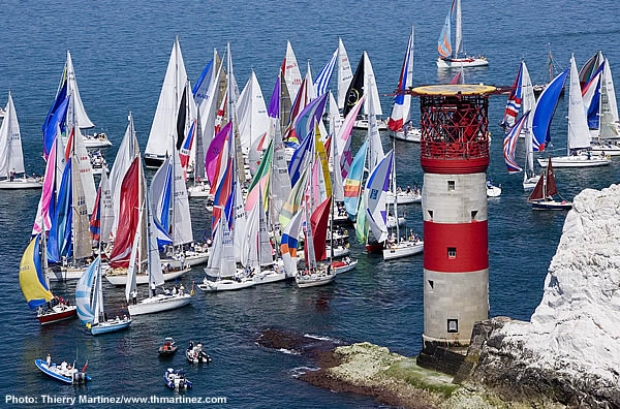
The 2007 JPMorgan Asset Management Round the Island Race starts early on Saturday morning and is one of the biggest features of the British sailing calendar – with 1,780 boats entered sofar. All eyes (blink and you’ll miss it) will be on the new
Icap Leopard
– Mike Slade’s new 30m Farr designed canting keeler, which if one forecast is correct should obliterate his existing race record of 4 hours, 5 minutes and 40 seconds set in 2001 on Skandia Life Leopard.
The jury is still out with regard to the weather for Saturday. There is a low pressure to the west of Ireland that is forecast to move very slowly east and dissipate. Depending on the timing and accuracy of this it could be a 20 knot south westerly through to a 5 knot north westerly with a bit of rain.
Ace navigator Pete Selby (remember they named the GPS system after him – the G standing for Great) updates his annual navigator’s guide to the race on TheDailySail. Selby is this year racing on Fortis Excel a Farr 45. In addition to his sailing achievements Selby’s company Soluxion , which he runs with business partner Peter Jones, is IT advisor to Origin, the British America’s Cup team.
The Round the Island race, a big start line and now only three marks, how hard can it be? The question perhaps should be how hard do you want to make it! There are big gains to be made by the use of navigation and exploiting areas that your opponents ignore. There are of course, like most things in life, big risks attached to the big gains.
Basic Planning
In planning for the RTI one of the first questions should be, what are our aims? And what are we prepared to do to achieve them? If all you want is to take part and enjoy the day, then planning can be fairly general. If however you want to win, then a little more detail will be required.
A few basic items are required for planning, and top of my list are 'Solent Hazards' and 'Wight Hazards' by Peter Bruce. These books give detailed descriptions and warnings of the many obstacles, which will be encountered by most competitors for the first and only time of the year.
A Tidal atlas that covers the Solent and the back of the Island is essential. Once again I rely on Peter Bruce and his 'Solent Tides' backed up with the Admiralty Tidal atlas for The Solent and Adjacent waters (NP337).
A GPS will always be handy & a chart plotter (that you trust) can make the workload a lot easier. You also need to have faith in your echo sounder and know how it has been calibrated – depth to waterline, depth to bottom of keel, or something more dubious. Lastly but by no means least are decent charts that cover the whole area. The scale of the charts should be the smallest you can get (especially for the first corner).
Crew Dynamics
If you decide to push hard and make the most of opportunities, one important aspect of crew work is to decide (beforehand) who has control in tight situations. Normally the tactician will call for a change in direction, but if you are close to rocks or shallows, then the navigator must know that they have the final word. This can lead to some grey areas of command and responsibility, and everyone must be happy with where they sit.
Some decisions are gambles and need everyone to buy in to the risk; some decisions are not up for discussion and must be acted on at once.
So now that you have made your game plan, where can you gain? Where do you have to be on top of your game? And where can you enjoy the great view (a bit)?
The Details
The race breaks up conveniently into four basic parts:
- Start to the Needles
- Needles to St Catherine's Point
- St Cats to Bembridge
- Bembridge to the finish.
Start to the Needles
HW Portsmouth is 0547 BST and 1828 BST
Tide height is 3.80 m nearing neaps
The first start is at 0500 and the last 0640
The long range forecast for Saturday suggests that this could be the most exciting race for several years – but all will depend on what that low pressure really does.
This year everyone should have plenty of fair current to get to the Needles.
A good start will make the first leg a lot easier and reduce the amount of traffic that you have to beat through. Full concentration is required for this leg.
If conditions are brisk this year, be prepared to help other boats if they require assistance and keep channel 16 clear for those that need it.
The tide will be west going for all boats. The earlier start (tidally) means that the dash to the Green for the early current is not a huge issue this year but it will give an early advantage to those that can get there. Look down the course and at the boats starting with you, plan for the leg not just the first few minutes.
If the breeze is from the south west you will start on the wind and the later boats will see a wall of boats upwind of them. Trying to keep clear air will be very difficult but is as ever essential.
If there is more wind this year them expect a few more incidents as boats will be moving faster and some may struggle with the potentially fresh conditions. Keep a good lookout, especially on the way to the Needles, as nearly 1800 boats take up a lot of space whilst zig zagging in the confined channel.
Whilst trying to be in the best wind don’t forget to stay in the best current. The stronger current is in the deeper water, if you have a GPS watch your SOG to see if and when you are running in and out of the best current.

The places for potential current gains are, Gurnard Ledge, Salt Mead & Hamstead Ledge. The tide tends to rip around the edge of these rocky outcrops and you can pick up and extra 0.3 Kts on a good day. Because the tide is still high there is little risk of trouble here, especially as the gain is at the end of, not on or over the ledges.
The best current swings in towards Yarmouth but stay out of the moorings and make sure to miss Black Rock. Sconce is the target as we get to the end of the western Solent. Once again the tide rips around the end of this bay and there are gains to be had. However, there is no need to push hard as again there is no extra gain in going too far.
If the wind is in the 20 knot range then expect rough water going through Hurst. Strong winds over strong tides can lead to exceptional waves here, with boats having to be craned off other boats in the most extreme circumstances.
Out through Hurst and onto the Needles, the best current is down the Southern edge of the Shingles. The best route is from Sconce to NE Shingles and then down the bank. Big gains are to be made here but there are big risks. This is one of those times when you must be sure of where you are and where you are going. The current will try to push you over the bank, two problems there, less current and a lot less water!
The edge of the bank is fairly steep and you can get in very close. So close that you can hear the shingle moving under your keel but by then your echo sounder has probably given up in the turbulent water and you have no idea how safe you are.
Next up is the first bend. Like Formula 1 there are often a few spills and thrills at this point and likewise gains and losses to be made. For earlier boats the tide will still be going Westerly at this stage, and will not begin to turn to the East until 1100. Later boats will have to watch they are not swept onto the Needles by the current which will then whip them on the way to St Catherines Point.
There are three ways around the Needles, the good, the bad and the ugly. The size of your boat will limit your options. Tactically the sooner you turn, the bigger the gain (and the risk). Inside the Varvassi wreck is good and outside is bad. This year there will be less than 2m above chart datum by 0700, just about when the early starters get there. This will mean less than 5m inside the wreck, and falling fast, a tough choice and very dependant on prevailing conditions. By 1100 there is only 1.4m above datum so the later boats will always have less to play with.
These are predictions and may vary with conditions. Remember to take sea state into account when deciding your route; a 1m swell will make a big difference.
The inside route is well documented in books and articles and in the smallest boats the only restriction is not scratching the paintwork on the lighthouse. The outside route however is a bit vaguer. Sure there are sightings and bearings that guarantee a safe passage but hey, we're racing! The pressure to make the turn as early as possible comes from all sides, the smaller boats can turn inside and make an immediate gain, and others watch the bigger, faster boats and use them as their own guide.
The big danger of relying on others is that, if they miss the rocks and the wreck, will you! Be sure you know where it is or it may get ugly.
Plan ahead for this rounding as it could change from on the wind to a fresh and exciting reach. Plan your sail changes and strategy well in advance as the conditions will make life difficult with potentially choppy seas.
Heading SE away from the Needles the tidal gain for the early boats is to the shore. There are numerous rocks and outcrops to avoid but all being equal (as if) the inshore boats will make gains.
The tide will start heading SE around 1100.
Needles to St Catherine's Point
This is an easier leg as the fleet is now spreading out and the direct course is well away from danger until the end. If conditions are rough I would give this entire shore a wide berth but in lighter winds you can push deeply to the shore whilst fighting the current.
With the current not becoming East going until around 1130, early boats could face foul current all the way to St Cats and beyond. Later boats will fair better but if it is a quick race even they may have to fight their way around the point.
If you cannot lay St Cats in one, or the winds are light, then gains for the early boats are to be made by heading in to Freshwater Bay. This is particularly true for the slower boats. There are numerous rocks until in the bay proper, but once in, the echo sounder can be relied on to give enough warning of danger. Just past Freshwater is Compton Bay and at the end are Brook Ledges.
Like most of the hazards around the Island, these are hard rock and very unforgiving. These obstacles are easily missed but if pushed hard can give some extra gain. The important thing to remember as you push into the shore is how you will get out again. There is no point pushing too far in, only to find you have to backtrack to get out.
I can attest that the charts of Brook ledges are pretty accurate; I have pushed a bit hard in the past and hit exactly where the chart said I would (It comes up pretty quickly). Always remember to think ahead to the next manoeuvre.

Moving down the coast you come to Atherfield Ledges. The strategy here is the same as for Brook Ledges. Even if you are following the rhumb line from the Needles to St Cats I suspect that Atherfield Ledges will be an issue. The shallower water extends out quite a way and in a bigger sea it can be surprisingly rough here.
Having relaxed a bit on this leg (not if it is a tight reach), it is now time to pay full attention again, as on the approach to St Cats you can make a big gain.
Being close in to Chale Bay hides you from the worst of the foul tide around the point until the last minute. At certain states of the tide there is even a back eddy that will take you around the point. A quick look at the chart will show you the problem of this inside route - shallow water and a few rocks to bounce off.
This year most boats will not have an Easterly going current at this point so staying inshore should pay.
Remember that the chart shows overfalls at the point and for a good reason. The sea state here can be quite incredible to behold, with a big swell and breaking waves, and you will probably be trying to gybe in all of this. Calmer water is found close inshore or well offshore (about 1 mile off), once again prepare your manoeuvre in advance and keep it safe.
This is traditionally the half way point of the race, but there are still many hazards to avoid and opportunities to exploit which I will be detailing in Part Two.
Most Read
Most Commented
Comments
Businesses


Pro businesses
-
United Kingdom
-
Italy
-
-
Editor's choice
Member blogs
-
 Ned Collier Wakefield: MOD70 round BarbadosWell that was intense. 12 hard fought for seconds for the win. In idyllic conditions, Tony Lawsons MOD ...
 -
 Mini Transat leg 2 reportThe second leg of the Mini Transat started on 31st October, just over a month after ...
 -
Leg 1 reportI’ve been working towards the Mini Transat now for three years. In 2013 I was part ...
Business blogs
-
 The Island Sailing Club in Cowes, Isle of Wight, is delighted that Prince Michael of Kent ...
 -
Peta Stuart-Hunt chats with the 25 year-old British solo sailor Lizzy Foreman before she sets sail ...
-
The 2015 Student Yachting World Cup (SYWoC), an ISAF-recognised event hosted and run by students for ...
Editor's Choice
All time favourites...
-
 Three legs down into Ian Walker’s
 -
 Winning all but two races at
 -
 For the first time in its
Latest Comments
Add a comment - Members log in