
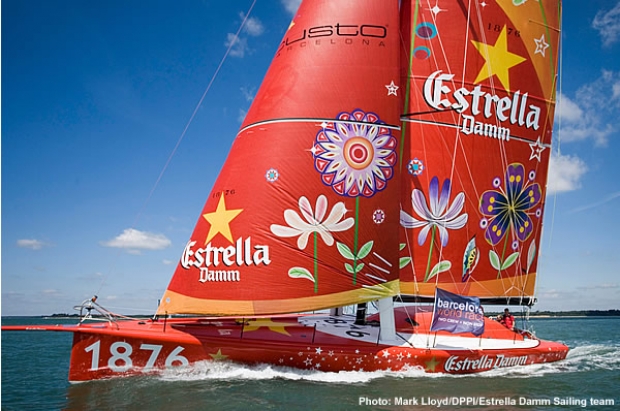
The new big red
Friday August 31st 2007, Author: James Boyd, Location: United Kingdom
Following on from their first Open 60 design,
Virbac-Paprec for
Jean-Pierre Dick, so Farr Yacht Design will have the lion's share of the 17 new generation Open 60s taking the start line of next year's Vendee Globe.
Delta Dore and Vincent Riou's new
PRB were launched in time for last year's Route du Rhum (although both retired,
PRB dismasting) and since then J-P Dick's new
Virbac-Paprec has been launched followed by Loick Peyron's new
Gitana out of the same moulds at Southern Ocean Marine. The fifth is of course the new vessel for the Offshore Challenge Sailing Team that will be crewed by Spain's Guillermo Altadill and American Olympic medallist, Mini sailor and OneWorld/Luna Rossa main sheet man Jonathan McKee in the forthcoming Barcelona World Race.
The first most noticable design aspect of the new Estrella Damm, apart from her flowery red mainsail, is her humungous cabintop. There is a trend among the latest generation of Open 60s to have more protection in the cockpit and Estrella Damm's cabintop extends way aft from the cockpit bulkhead, although not as far aft as the sliding hatch arrangement on J-P Dick's new Virbac-Paprec. Aside from cockpit protection the cabintop also serves to help make the boat unstable should she ever become fully inverted and we understand the keel only had to be moved by around 10° when she was put through her inversion test.
In addition to the mighty Farr office, some brainpower has gone into the new boat on this side of the Atlantic. Calling the shots from Cowes was OC's former Technical Director Neal Graham who has since retired and been replaced by the equally capable Neal McDonald. The creation of the boat was slightly unusual in that Paul Quinn's boatbuildling team started work on her before a skipper was decided. Only some while after leaving Artemis in January was Brian Thompson announced and since then family commitments have seen Thompson pull out of the Barcelona World Race to be replaced by McKee. However Thompson is as well versed as any in Open 60s having sailed extensively on Ellen McArthur's original Kingfisher and with Mike Golding on Ecover. It is the tall lanky one who gives us the guided tour of the latest OC steed.
Of the five new Farr boats there appear to be some variation in Beammax with PRB and Foncia at 6m and Delta Dore and the new Estrella Damm at 5.8, all with a similar chine extending half the length of the topsides (on the Finot boats the chine goes most of the way to the bow). While PRB and Foncia were 'exclusive' designs Delta Dore and Estrella Damm are believed to have been exclusive in some of their detail.
Perhaps due to not having a skipper in place from the outset, the new Estrella Damm is possibly more conservative than some of the other new generation Open 60s. For example she has a conventional fixed mast set-up - the tube built by Marstrom in Sweden and engineered by Herve Devaux - rather than a rotating wing, and a steel foil for her keel rather than a carbon one. However there are many innovative features to the new boat in her detailing.
While the mast is fixed, the spreaders hinge, rather like they did on the old PRB and VMI Open 60s. According to Thompson: "That helps downwind reefing, so you have a bit more sweep back with the spreaders. I think they are a little more swept back than most, but when the main hits it, it will swing away a little bit, so it is a bit more forgiving, like a shock absorber system. The mast is very light - definitely a lighter solution than a wingmast - and it is something you don’t have to worry about. With a wingmast you have to tune it as you reef."
Compared to the other Farr boats we have seen the daggerboards seem a similar size (ie way longer than the Finot boats) but on Estrella Damm they are slightly raked aft and appear slightly more toed out (generally Farr boats appear to have them almost straight up and down). "When we swing the keel fully and have the windward daggerboard down, there is an inch gap between the fin and the board," says Thompson. "Hopefully the keel will be arcing down slightly..."
Twin rudders are fitted and, as we have seen on the other Farr boats, these are capable of kicking up in the event of a collision, or otherwise the weather rudder can be be deliberately hoisted to reduce drag. While the Finot boats have the rudders transom-hung on the Farr boats they are neatly recessed into the transom, thereby preventing the ventilation that can occur on transom-hung rudders. The rudders kick up by about 100° rather than going fully vertical.
Estrella Damm also has the 'MichDes' curved track that doubles for the mainsheet and the vang. This is also seen on PRB, the new Britair, Generali and of course MichDes' new Foncia. The 'mainsheet' comprises a strop with two Karver blocks on each end, running through a hole in the end of the boom. Through each Karver block runs a loop of mainsheet down to the track. The 'vang' comprises a cascade of yet more Karver blocks running between the track and the another track running along the underside of the boom. There is no traveller as such. According to Thompson with this set-up the roles of the mainsheet, traveller and vang become slightly blurred. "The mainsheet - you could call that the traveller because that only pulls it down when it is right in the middle of the boat. It seems to work pretty well. The only bad thing about it is that in very light airs you can’t put it in the centre without putting a lot of leech tension on. So we’ll have to get a little line to pull the traveller to windward."
The only significant difference with the system on Estrella Damm compared to PRB and Generali is the way the main sheet runs straight to a jammer in the cockpit. According to Thompson this was a Neal Graham idea for freeing up the back, weather side of the cockpit for stacking.
On Estrella Damm the sizable dome hiding the Fleet 77 gyro-antenna is mounted in the cockpit (on others such as Hugo Boss it is mounted on the foredeck) and just forward of this is the tiller. While there has been a trend to go for wheel steering on recent Open 60s, ( Generali and Hugo Boss for example have twin wheels), all the new Farr boats have tillers, although very different arrangements. Virbac and Foncia's are Y-shaped, while Estrella Damm's is a monster-sized conventional tiller, PRB's is smaller and has transmission allowing it to be centred in the middle of the cockpit (ie further forward) and Delta Dore has a reasonably complex arrangement that folds over to port and starboard.
Thompson says he is pleased with the cockpit protection. While this may look ungainly off the boat within the cockpit it makes perfect sense. "The shelter is fantastic. You feel like you’d need an ejector seat to fall out of the cockpit. On quite a few boats when you are winching you feel like you could fall off the leeward side."
Up at the pointy end and Estrella Damm is fitted with a bowsprit as all the other boats have, but has two martingales attaching to the stem, preventing the bowsprit from snapping upwards. They will fly an A2 or an A3 (also called a Code 5 -big Cuben sail) from the end of the sprit and they also have a fractional chute. Just forward of the pulpit is where the tack of the Code Zero flies from, as Thompson says this is where it seems to balance best.
The sails have been made by a combined of North France and North UK but designed by Henrik Soderlund in Denmark, who was behind the acclaimed ABN AMRO One wardrobe. Typically Estrella Damm will carry 12 or 13 sails while racing. Thompson says this hasn't gone up from what many of the bigger players carried in the last Vendee Globe, however while many of them may have taken spares, their 12 or 13 sails are all different. "So if we break a sail we can use one that is slightly different, so if we break an A3 we can use a Code 0, etc," he says.
Just inside the pulpit is another removable stay for a big genoa and, surprisingly, the downhaul for this stay is attached to the only hydraulic ram used in the rig. Further back down the deck is the only fixed stay - as required by the IMOCA Open 60 class rules - for the furling Solent. "Everyone has gone for this one being fixed so that they can have removal big genoas that they can take down," says Thompson. "This is what other people would use as a staysail for the spinnaker and an upwind sail in under 12 knots of wind and their reaching sailing in strong air. So it would probably get more use than any other sail, although you do worry you might get a situation like they had in the Velux 5 Oceans where you have 70 knots and it unfurls." On Estrella Damm the Solent furls using a Karver drum and a Future Fibres anti-torsion PBO rod (all the standing rigging is Future Fibres PBO).
Further back along the foredeck is another removable stay for the staysail, and this is also the same space where a storm jib can be flown. All the headsails are run off Karver halyard locks, while the mainsail has what Thompson refers to as a 'halyard lock-lite' - a carbon Spinlock jammer at the masthead, controllable from on deck, an arrangement Vincent Riou used on PRB in the last Vendee Globe.
Running the length of the foredeck are two coamings covering all the lines running aft to the cockpit, and these double as a foothold for crew going forwards when then boat is heeled. "The only sails with a snuffer are the A2 and A6. The rest you can do from the cockpit," says Thompson.
Down the sidedecks, just aft of the large daggerboards are the headsail sheet tracks that are athwartships, used to control the position of a suspended ring through which the sheet passes. "Athwartship tracks are far better than fore and aft," says Thompson. "But it is on a 2:1 so as you slide it in you don’t alter the height of the ring. These are nice fittings where the 2:1 is on the outside of the ring. Again that is made by Hercules."
Around the foot of the mast is an impressive bank of custom turning blocks also made by Hercules (Roger Scammell - who also fitted a lot of the gear for Neal Graham at Assa Abloy ). As ever on the Farr boats, there is a tunnel through the cabintop leading the lines directly back to the 'pit' on a central island between the two companionway hatches leading down below. A difference between the first Virbac and the new generation Farrs is that this tunnel no longer slopes upwards first.
The mainsail has three fixed reefs and a vestigal fourth and the reefing pennants all pass through carbon Spinlock jammers housed internally in the aft end of the boom, but which again can be operated from the pit area.
Harken winches are used with a five winch set-up including the pit winch. The primaries are Harken 880s and according to Thompson this is indicative of how the loads in the modern generation boats has increased: "The righting moment is 30% more, so the loads are 30% more. So the skipper will have to spend 30% more time in the gym lifting 30% heavier weights! I don’t think you have to be Francis Joyon to sail these, although it always helps being big and strong..." While there is only one pit winch all manner of cross sheeting is possible using the weather primary and the redundant runner winch.
As ever there is a coffee grinder operating three of the winches (not the runner winches) and these can be operated individually or simultaneously (or, impressively, simultaneously in different gears...)
Down below when we were on board the interior was still being put together.
The galley is fitted on the forward side of the cockpit bulkhead as it is on Delta Dore. Forward the chart table rotates around a vertical pole allowing whoever is navigating or burning up the dollars on the satcoms, to sit to weather. According to Charles Darbyshire who has masterminded the electronics installation, whoever is at the chart table will probably sit on a bean bag, while there will also be a small seat on top of the engine/generator box in the middle of the central cabin space that can be used when the boat is level.
The chart table is mounted just aft of one of the two full bulkheads encasing the canting keel area. Estrella Damm is fitted with a single hydraulic ram mounted on the starboard side (an arrangement we would imagine is similar on all the new Farr 60s). The rams and the all-important keel control mechanism has been manufactured and fitted by Greg Waters from Central Coast Hydraulics in Sydney (who also supplied this gear to Leopard, the Reichel-Pugh supermaxis and the movistar VO70). While VO70s must be fitted with twin rams, on Open 60s this is not the case. "I think the safety margins are quite high," says Thompson dryly of the single ram set-up.
Aside from the canting keel, the other main feature of the accommodation is the amount taken up by tankage. While the tunnel reduces headroom aloft, the three sets of tanks in the stern, middle and forward in the boat restrict it still further from below. Due to the water plane of the boat moving so substantially as it heels (thanks to its huge beam) particularly further aft, so this dictates the positioning of the water tanks. While the forward pair are reasonably narrow, the central tanks span most of the width of the usuable floor and the aft tanks are actually divided with a tunnel between them allowing access to the hatch in the transom (through which the crew can escape in the event of a full inversion).
To give some idea of the size of the tankage Thompson reckons that if you filled all six ballast tanks simultaneous you would more or less double the displacement of the boat. However the reality is that you would never fill the leeward tanks and you would never fill more than two of the windward ones at any one time. In total you are only ever likely to increase the displacement by around a quarter. In fact given the amount of tankage, if all were empty then the boat would be virtually unsinkable...
Water is fed into the tanks as normal by a scoop, and the waterworks are operated by some very smart gate valve, again custom built by Roger Scammell's troupe in Devon. "This stays in a line so you can’t break it off by pulling it," says Thompson pointing at the smart black valve. "There is no 'sticky plunger'. We are also going to set up a system where we are going to have an Etchells-style box where you pull some strings and open up the gate valve."
In terms of displacement Thompson reckons that all the Farr boats are in the 8-9 tonnes range. He is intrigued by the new Guillaume Verdier/VPLP Open 60s such as Safran and Groupe Bel that might have taken the multihull approach to minimalism, drastically reducing their weight.
Generally the quality of the build appears excellent. Estrella Damm was put together at the GBR Challenge shed up the Medina River in Cowes by a team led by New Zealander Paul Quinn who has previously built the Amer Sports VO60s, Club Med, the Desafio Espanol Cup boats, to name but a few. Construction was impressively fast - just seven months.
But will Estrella Damm cut the mustard against the 16 other new Open 60s? While she may lack the radical features of some of her competitors, she appears to lack none of the finesse in her detailing, but we suspect what it may come down to is how much time her crew have to refine her and whether they have the shorthanded sailing experience to get as much out of her as some of the crews more familiar with this form of sailing.
More photos on the following pages...
Most Read
Most Commented
Comments
Businesses


Pro businesses
-
United Kingdom
-
United Kingdom
-
Italy
-
Editor's choice
Member blogs
-
 Ned Collier Wakefield: MOD70 round BarbadosWell that was intense. 12 hard fought for seconds for the win. In idyllic conditions, Tony Lawsons MOD ...
 -
 Mini Transat leg 2 reportThe second leg of the Mini Transat started on 31st October, just over a month after ...
 -
Leg 1 reportI’ve been working towards the Mini Transat now for three years. In 2013 I was part ...
Business blogs
-
 The Island Sailing Club in Cowes, Isle of Wight, is delighted that Prince Michael of Kent ...
 -
Peta Stuart-Hunt chats with the 25 year-old British solo sailor Lizzy Foreman before she sets sail ...
-
The 2015 Student Yachting World Cup (SYWoC), an ISAF-recognised event hosted and run by students for ...
Editor's Choice
All time favourites...
-
 Three legs down into Ian Walker’s
 -
 Winning all but two races at
 -
 For the first time in its
Latest Comments
Add a comment - Members log in