
Volvo Ocean Race update
Wednesday December 19th 2007, Author: James Boyd, Location: United Kingdom
While the next Volvo Ocean Race represents a significant break with tradition when it comes to the route, many are coming round to the idea of a new-look race with most of the Southern Ocean component removed in favour of a massive detour up through the Middle East, India and the Far East.
While we still believe that taking the Volvo Ocean Race out of the Southern Ocean removes part of the heart and soul of the event, there is no doubt looking at the course that Volvo have set themselves and the race teams an ambitious course. For starters it will be far in away the longest ever round the world race - potentially more than 40,000 miles of racing for the crews. Plus this time there are substantially faster turn-around times in port. One hopes these two factors has instilled in teams the understanding that the latest race will be a whole lot more demanding than previous races and it is therefore imperative that their race boats are robust enough to make it around the course in one piece.
For the staff at Volvo Ocean Race HQ in Whiteley on the south coast of the UK, getting the race to visit all the new ports has created many logistical headaches. Not only has the race come forward by a year giving them less time to prepare, but it now goes to new countries such as India, China and Russia, where they have had to identify feasible ports the boats could physically visit (adequate draft and dockage, etc) and wooing local authorities with, in many cases, no previous experience of any form of yachting, let alone a major Grand Prix event.
As a result on this occasion members of Andy Hindley and Glenn Bourke's team have divided up the stopover negotiations between them. Race Director Andy Hindley himself has been dealing with two of the hardest - India and Russia - where there has been no previous experience of holding events of this kind.
Walking the course
The start port for the next race has been moved from Vigo on Spain's Atlantic coast to Alicante in the Mediterranean. Alicante was the first port signed up and was announced soon after the end of the last event. Here there will be an in-port race.
From Alicante the race goes on an otherwise traditional leg south down the Atlantic to Cape Town (originally this wasn't in the plan, but was added to avoid having an epic first leg direct to the Middle East).
However on this occasion the stopover in Cape Town has been reduced from 30 days as it was last time, to just 12 days, the organisers hoping - perhaps ambitiously - that leg one won't see the same degree of carnage that took place on this leg in the last race.
"By setting the deadlines early enough in the route people have realised that robustness in the structure of your boat is paramount," explains Andy Hindley hopefully. "There is not enough time in many of these places to be fixing boats. And we have tweaked the rule to try and push them in that direction too. We would hope the boats are more robust. We have spoken to people about the minimum time requirement to get a boat out, take it apart and put it back together again and it is anywhere between 8 and 10 days. If we have had a reasonably long leg that could potentially have bad weather we’d generally give people enough time for people to take the boat out, strip it, rebuild it and put it back together."
While leg two was originally destined for the Middle East instead the next stop after Cape Town is Kochi in the Kerala region of southwest India. Hindley is clearly taken with this location: "It’s beautiful. It is the biggest tourist destination in India both internally and internationally. Everyone thinks of Goa... It is in the Conde Nast Travellers guide as one of the most beautiful places in the world to visit."

The reason the race will visit Kochi before the Middle East is because of dates. In the original schedule the Kochi stopover would have coincided with Christmas and there simply wouldn't have been enough hotel rooms available. "That is one of the infrasturcture requirements that people often forget," says Hindley.
While Mumbai might have been the more obvious choice of stopover port in India, Hindley points out that up until around 6-8 months ago there were no commercial marinas in India at all, despite the country having around 7,600km of coastline. A marina is now being built in Goa, but doesn't have a adequate draft to take VO70s. "Kochi is a working port and a naval base. They have a fantastic pontoon, which is a ship pontoon admittedly, but it is a concrete structure that is 23m wide and is 250m long and has a loading capacity of 25 tonnes/sqm, That’s plenty of space. And its deep water. And there is a huge area on shore from there."
Hindley anticipates the stopover in India being around 8-9 days. From there he hopes to take the race to the Middle East, most probably Abu Dhabi or Qatar, although as you may gather of all the stops this is the one least progressed. A decision about this is imminent. If it goes ahead then the Middle Eastern stopover will be 6-7 days long.
From the Middle East the course on leg four doubles back towards India and then rounds Sri Lanka for what could be one of the more frustrating legs from a weather perspective as the 1000 mile passage around Sri Lanka to the northern end of Sumatra is basically straight along the doldrums. At the end of this, the boats then go down the eastern side of Sumatra through the Malacca Strait, one of the world's most notorious spots for piracy. One suspects this could be an added incentive to get the boats sailing fast...
Thankfully the Singapore stopover looks set to be in the height of luxury at the One°15 luxury waterfront development on Sentosa Island off the south side of Singapore which comes complete with infrastructure for hosting events. This will also be the first full-on stopover since leaving Alicante with the boats scheduled to stay in port for 15-18 days complete with the first in-port race since Alicante.
While on the last Volvo there was only one in-port race, this time around there will be an in-port race followed by a mandatory pro-am race the following day. "It is incentivised for the teams to go out and participate," explains Hindley. "You don’t score points but you are deducted three points if you don’t turn up. You score zero if you win or lose."

From Singapore leg five takes the boats into equally uncharted territory north past Vietnam and up the Chinese coast, past Shanghai and on to the Olympic sailing centre at Qingdao. The schedule here is for a 15 day stopover and while there was previously talk of having two stops in China, this is now the only one. Once again there will be an in-port race in this stopover.
Another interesting feature of the new Volvo Ocean Race format is leg six - the biggie - from Qingdao down to the Southern Ocean, round Cape Horn and up to Rio. Hindley says their estimates for the duration of this 12,300 mile leg is for it to take 34-35 days.
"There are no restrictions on the route," says Hindley. "People said you should take it through Cook Strait. We looked at how many days that added to the trip - and the result was an extra five days. That would be a huge ask on a leg already 34-35 days long."

In their study for this leg Hindley says they looked back at the last 12 years of weather information and the routing to Cape Horn given their start date and 14 days either side of this. The permutations were incredible with the extreme routes 2,500-3,000 miles apart, some only dipping down into the Southern Ocean approaching the Chilean coast. In fact to make it tactically more interesting Hindley says they are likely to introduce a scoring gate along a line of latitude, to the east of New Zealand so crews will have an incentive to head south as quickly as possible.
Scoring gates will feature in the Volvo Ocean Race after being seen as a success following their introduction in the last race. For this long leg to Rio there will be two gates so potentially as many points to gain from being first to the gates as there is from winning the leg.
From Cape Horn north the route is familiar - to Rio and then on to Boston. While Boston is further up the eastern seaboard of the States, Hindley points out that it is actually a shorter course from Rio to here, rather than to the Chesapeake due to the curvature of the earth and the way the US coastline 'leans over'.

Leg 8 will be the blast across the Atlantic, that proved to be the windiest on the last race, but on this occasion concludes in Galway on the west coast of Ireland where we understand all the stops are being pulled out to host the race. The boats will remain there for 14 days and the stopover will include an in-port race. The race will then head around the top of the British Isles to the a short pitstop at Volvo's international HQ in Gothenberg before moving on to Ericsson's principle base for a full stopover in Stockholm.
Finally the race concludes with the 400 miles leg east up the Baltic to St Petersberg. "The infrastructure in St Petersberg is good," says Hindley. "I have been there twice. We’ve organised with the Lenta team that the race village will either be at the Exhibition Centre or we are still looking to secure the site at the St Peter and Paul Fortress which is up the river right in the heart of the city. There are bridges in the way which we need to co-ordinate the opening of."


Course summary
Leg 1: Alicante-Cape Town (6,990 miles)
Leg 2: Cape Town-Kochi (4,390 miles)
Leg 3 - Kochi-Middle East (1,660 miles)
Leg 4 - Middle East to Singapore (3,530 miles)
Leg 5 - Singapore to Qingdao (2,450 miles)
Leg 6 - Qingdao to Rio de Janiero (12,100 miles)
Leg 7 - Rio de Janiero-Boston (4,750 miles)
Leg 8 - Boston-Galway (2,630 miles)
Leg 9 - Galway to Gothenberg (980 miles)
Leg 10 - Gothenberg to Stockholm (500 miles)
Leg 11 - Stockholm-St Petersburg (380 miles)
Teams
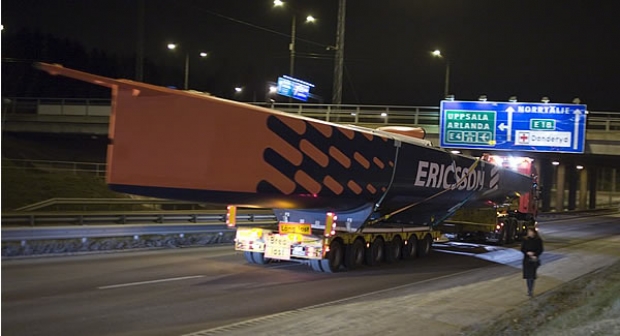
At present seven boats are in-build including the first Ericsson boat which last week emerged from her build shed in Stockholm ready to be shipped to the team's training base in Lanzarote. Ericsson have a second boat currently in build. One imagines that as was the case with ABN AMRO in the last race, that Ericsson's Scandinavian team will end up with the first boat, while Torben Grael's hotshots (who must be thanking their lucky stars they chose Volvo not the America's Cup) will race the second of their Juan Kouyoumdjian designs.
Details are still sketchy of the Spanish team currently backed by Alicante. Will movistar come out of the woodwork as a backer again? Like Ericsson this is a two boat team and once again the team led by Bouwe Bekking has opted for Farr Yacht Design, but on this occasion under an exclusive agreement. Their first boat is being built by King Marine in Spain, while the second is under construction at Southern Ocean Shipyard in New Zealand.
The Irish revealed themselves last week with Ian Walker skippering the Volvo Ocean Race's first Reichel-Pugh offering in Team Green. This is being built by McConaghys in China. Read more about this here.
Meanwhile Ken Read's Puma team from the US have spent the year training on the former ABN AMRO Two and on George David's Rambler, including a record breaking voyage in the Rolex Middle Sea Race. Their boat, a Botin & Carkeek, design is under construction at Goetz.
Oleg Zherebtsov's Lenta team, led by Andreas Hanakamp, have their Rob Humphreys design in construction at Green Marine in Lymington.
In terms of their progress Ericsson's first boat is on a ship to the Canaries, while their second boat is in construction. Puma is fractionally ahead of Team Green in that moulds are built for both boats and work on the hull is now being carried out on both boats, but Puma's deck is already complete. Lenta's moulds are complete and they are starting construction. It is unclear how far progressed the Spanish are.
While seven teams are actively in the fray, there are a few other prospects says Hindley. With the America's Cup in a complete hiatus, so a couple of America's Cup teams have been looking at projects to keep their personnel occupied. With Team New Zealand being run by former Volvo Ocean Race winner Grant Dalton it wouldn't take a huge leap of imagaination to think they would be one. Volvo are also talking to another team with a familiar sponsor about fielding a mixed crew that would compete on board the old Pirates of the Caribbean.
So what can Hindley tell us about the new boats? "I know exactly what they will look like - they will be like ABN AMRO One on steroids. So the biggest questions are – coming from the bow to the stern how quickly can you get to maximum beam and where do you put your keel and your daggerboards. I think the rest of the questions are pretty much answered..."
But surely with less Southern Ocean sailing, the average wind speeds for the course are generally lighter? "We don’t go off average winds because it is very misleading," states Hindley. "There will be a lot more lighter air sailing, but we have given the boats an extra masthead spinnaker that they didn’t have before, so you have arguably compensated for that lack of light air performance. If you gave the big masthead chute to Pirates last time it would have been faster than ABN AMRO in super light airs. So now they just want power, super wide. It is all twin rudders... In the light airs they’ll just have to get the big sails up and work it hard."
So expect massive chines extending much further forward than they did on the ABN AMRO boats. While maximum beam is restricted and waterline beam isn't, Hindley reckons that the waterline beam on most of the boats will also be large.
Obviously one advantage of canting keel boats is that in light conditions the keel can be used to incline the hull and the boat stacked to minimise wetted surface.
Media person
Another new feature of this Volvo Ocean Race is that the boats will have to take along a dedicated media person. So far the names we have heard about for people taking these slots tend to be sailors who are media inclined. Former Chessie Racing bowman and cameraman, Rick Deppe, for example, has the media spot on board Puma.
The question is - what exactly is the media person allowed to do on board other than be a passenger who writes, photographs and takes video? Hindley says he has been discussing this role with all the teams and believes that the best way to define this is to write a list of things the media person can do.
The list proposed at present is:
1. All media duties
2. All environmental duties
3. Cooking (meals, drinks and refreshments)
4. Washing up
5. Emptying bilges (sponging out, bailing)
6. Placement of body weight as required
Nice work if you can get it...
So the prospect of getting a reserve navigator, meteorlogist or someone who can at least deal with the restacking down below seem to be no longer possibilities. "There were people saying they should be there to be the medic or the diesel mechanic," says Hindley. "But no, I want that filmed. That’s part of the story of life on board."
Quite how the departure of CEO Glenn Bourke from the race will effect it remains to be seen. Bourke was instrumental in initiating the changes to the race but now perhaps sees his work as being done. We wait with interest to see who his replacement will be.
What's your view on how the Volvo Ocean Race is shaping up? Email us here
Most Read
Most Commented
Comments
Businesses


Pro businesses
Editor's choice
Member blogs
-
 Ned Collier Wakefield: MOD70 round BarbadosWell that was intense. 12 hard fought for seconds for the win. In idyllic conditions, Tony Lawsons MOD ...
 -
 Mini Transat leg 2 reportThe second leg of the Mini Transat started on 31st October, just over a month after ...
 -
Leg 1 reportI’ve been working towards the Mini Transat now for three years. In 2013 I was part ...
Business blogs
-
 The Island Sailing Club in Cowes, Isle of Wight, is delighted that Prince Michael of Kent ...
 -
Peta Stuart-Hunt chats with the 25 year-old British solo sailor Lizzy Foreman before she sets sail ...
-
The 2015 Student Yachting World Cup (SYWoC), an ISAF-recognised event hosted and run by students for ...
Editor's Choice
All time favourites...
-
 Three legs down into Ian Walker’s
 -
 Winning all but two races at
 -
 For the first time in its
Latest Comments
Add a comment - Members log in