

Save the 60ft trimarans
Tuesday March 13th 2007, Author: James Boyd, Location: France
What on earth is going on in France? Just over four years ago 18 ORMA 60 trimarans lined up on the start line of the
Route du Rhum. This year just four of the world's most exciting boats will be competing on what is perhaps the least ambitious ORMA program we have seen.
The 2007 program is as follows:
13 May - AS Lease Challenge Lorient - Corogne - Fastnet - Lorient, crewed
19-20 May - Trophée des Multicoques, Lorient, crewed
24 June - Trophée SNSM- Saint Nazaire/St Malo with crew
13-15 July - Défi de Douarnenez, crewed
12 August - Rolex Fastnet Race, Cowes - Fastnet - Plymouth, crewed
4 November Transat Jacques Vabre, Le Havre-Salvador de Bahia, doublehanded
This circuit will be raced by the three 'big' campaigns - Groupama, Banque Populaire and Gitana - plus young skipper Antoine Koch at the helm of Sopra Group.
So why are there so few boats? We felt that former Fujicolor and Fujifilm skipper, two time OSTAR winner and ORMA champion Loick Peyron, now General Manager of Baron Benjamin Rothschild's Gitana team. was the right man to ask.
"For many reasons," says Peyron of why the rot has set in. "Quite a lot of sponsors and skippers are going to do the Vendee Globe. There is less difficulty to find partners to do that than a multihull." Multihull skippers competing in the Vendee Globe include ex- Biscuits la Trinitaine skipper Marc Guillemot and former Geant skipper Michel Desjoyeaux, who is backed by Foncia, originally Alain Gautier's trimaran sponsor.
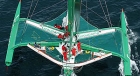
Peyron continues: "And Groupama II is the green god which is frightening everybody, because, in Grand Prix especially, there is not much chance to beat them, so the motivation is not very high." When it comes to Grand Prix Franck Cammas' trimaran, the only new ORMA trimaran to have been built since the 2002 Route du Rhum, has been all but invincible.
 "And the offshore races, such as the Route du Rhum as it has been for 30 years, has been a success for everyone - but not the other races. The big mistake all the people involved in this for many years have made, is not to lock the class - there is too much difference between the boats, mind you that is the same even in the Cup or one designs sometimes, but it is especially true in this game. So there are many reasons."
Of course other reasons that the ORMA circuit is in such steep decline is down to money and the return on investment for sponsors. In years gone by 60ft trimaran budgets have been surprisingly small, affordable for small regional French companies - the bakers and pizza makers, as Peyron describes them - but as is the way in so many development classes the smaller players have now been priced out of the game. ORMA 60 budgets have risen thanks to inflation, the price of carbon fibre, more and more complex and therefore expensive boats and the Grand Prix program where boats are sailed by around 12 crew.
Peyron's view is that 60ft trimaran budgets are now too large for most French companies so it must go one way or the other. Costs must either be reigned in, returning it to a state similar to what we saw in the 1990s, or alternatively budgets must go up with the backing of larger companies who have business interests internationally and who are want to take the circuit to countries outside of France.
"That is the paradox - the only way to continue is to have big sponsors with some foreign interest and it is no longer just a French speciality - or perhaps a Breton one between La Foret Fouesnant and La Trinite [ie a 30 mile stretch of coastline] that is not a big enough market to succeed in..."


Another rather serious problem with the ORMA circuit is that there seems to be no one in charge. "Who is in charge?" we ask Peyron. "Nobody. The pope maybe! That is the question I am asking all the time, but I don’t know who I have to ask this question to." At present the class appears to be being run by a committee including sponsors, skippers and key players such as Groupama's Vincent Borde, organiser of the first event of the season. Because there has been no clear leadership while at the same time there also being such diverse opinion about 'what to do with the class', the class has splintered with the likes of Thomas Coville and Yvan Bourgnon using their boats to attempt singlehanded records for example.
Peyron cites Bourgnon's Brossard campaign: "He doesn't want to do the races because he wants to attempt the Atlantic record alone which is less expensive and if he succeeds is a bit more efficient. That has been a major problem for many years. Everyone wants to do their own thing, only thinking about their own progress, but not for all the family."
For 2007, the committee has finally recognised that something must be done to attract more boats back to the class. Around fifteen ORMA 60s capable of winning offshore races are gathering seagull guano in boatyards around France, but Peyron points out that only one or two are capable of winning Grand Prix. So the idea is to have less Grand Prix and to reduce running costs, although quite how this is being done remains a little vague. Limiting Grand Prix crew numbers down to say six from the present 12 might be a start, but Peyron reckons that even this might prove to be a false economy.
"It is quite dangerous. I sailed on the Nokia Oops Cup two years ago and we were six or seven [on board] and it was very hard to manage the boats, because we know how to sail the boats with 12. 'The problem is money' was the criticism, but if we decide to sail with only six instead of 12 the six guys will be big heavy guys and will have to be recruited in Valencia in July and these guys are a lot more expensive than a skinny guy like me! And in terms of the show, having only six on board is not enough to make nice manoeuvres."
All this comes at a time when Russell Coutts and Paul Cayard have announced their World Sailing League circuit for one design 70ft catamarans.
Ironically Peyron has been touting a one design catamaran as a solution to the ORMA crisis for some years but to date this has fallen on deaf ears in France. "I talked quite a few times with Russell in Switzerland while we were sailing the D35s. The last time was in June last year at the end of the Bol d’Or and at that time I had been working on a one design catamaran for many years so I was happy to see their drawings on the web, looking like exactly what I was thinking for many years! But it is good," he says without too much bitterness.
Peyron says that the big difference between what he was envisaging and the World Sailing League is that the latter is a 'champion of champions' concept similar, but bigger than, the popular annual French event the Clairefontaine Trophy. "It is very interesting - that is a good way to do it. I really trust this idea."
This might work internationally but would something like the World Sailing League work in France? Peyron is sceptical. "I think people in France don’t care about sports stories, sailing sport is not popular. The only stories which are very popular in France are adventures and I am not sure the way they are doing it is going to be very interesting to the French market." The French public seem to be only interested in offshore racing, and this won't feature in the World Sailing League.
However Peyron reckons that those who have been involved in the ORMA circuit - the sailors in particular - will be invaluable to the new circuit. "All the French guys knowing multihulls, I hope they will be like the Kiwis are on monohulls. I’m quite sure the French crew, the skippers and yards are going to be very very good consultants and players in this game."

Peyron maintains that the general public and media in France are only interested in adventure and that is a uniquely French problem, while Anglo-Saxons are more interested in the 'sport' of yacht racing. "The French public are interested in the Route du Rhum or Maud Fontenay who lost her mast in the Indian Ocean. I remember Dennis Conner saying a few years ago that sailing in France was a case of ‘where is Isabelle?’ That was when Isabelle [Autissier] was being rescued by Giovanni Soldini, the French press and officiandos of sailing, just want to know where the last adventure was, but not the result."
Because of this Peyron maintains there is a difference between the type of racing the French public and sponsors want and what international competitors might want. In French they want more offshore, more shorthanded and the occasional Grand Prix for corporate entertainment purposes, whereas competitors from overseas would want more fully crewed, inshore type Grand Prix, like the World Sailing League are offering.
In fact the divide is not nearly as clear. While Anglo-Saxon sailors are more familiar with fully crewed inshore racing, there is no queston that the general public internationally find adventure more appealing, just as they do in France. Thus Ellen has been front page news following her Vendee Globe and singlehanded round the world in a trimaran exploits, Dee Caffari was too when she became the first woman to sail non-stop westabout singlehanded around the world, whereas mere race stories rarely succeed in leaving the sports pages. The classic example of a story being more important than the result is the outcome of the 2000-1 Vendee Globe, which a majority of people believe was won by Ellen MacArthur and not the less media-attractive Michel Desjoyeaux and this was as true in France as it was abroad.
While adventure being more generally appealing than sport might be true internationally, the sports side cannot be discounted from the ORMA circuit. Witnessing a trimaran grand prix sailed in anything more than 15 knots is THE MOST visually exciting racing in our sport bar none. Seeing twelve 60ft long by 60ft wide trimarans piling into the weather mark at 18 knots to the soundtrack of much Gallic swearing and gesticulating or seeing the boats approach 40 knots on the reach to the spreader mark are among the most dramatic moments available to us in sailing. The problem is one of communication. Precious few sailors or public outside of France have ever witnessed this amazing spectacle and in France great TV programs have in the past been made by Philippe Facque's Royale Productions but they have failed to be broadcast, even in France.
If the ORMA class had shown more solidarity and strong leadership and a major central sponsor had been found four years ago, who could have forced this sport on to TVs in France and ideally abroad, then the rot may not have set in to anything like the same degree.


Given that the rot has now firmly taken root, and that boats and sponsors must be attracted back - surely the blindingly obvious solution to the ORMA circuit's crisis is to focus on offshore and/or shorthanded races? This is a view people such as trimaran designer Nigel Irens have been trying to promote for years. If you look solely at the major shorthanded offshore events, there doesn't appear to be a problem. A highly respectible 12 boats showed up on the starting line of last year's Route du Rhum and 10 are likely to compete in this autumn's Transat Jacques Vabre despite only four regularly competing on the circuit.
The ORMA class has reacted - for this season there are less Grand Prix but what has replaced it represents another of the problems with the circuit - with the exception of the two handed Transat Jacques Vabre in November, the events this year are boring and unimaginative. This combined with there being only four boats will do nothing to stop the rot. What is needed is some fresh thought about the type of racing trimarans should be doing - there should definitely be more offshore events, fully crewed or shorthanded, and more shorter distance shorthanded events like the Figaro class offers. 60ft trimarans are blistering fast so why not hold more speed trials or a race on a record course with a start delayed until such time as conditions are right? A program including more events like this will help save our favourite circuit.
There was talk, even a press release issued last year about the ORMA circuit in France going to play with the Nokia Oops Cup trimaran circuit in Scandinavia. Unfortunately this hasn't come to pass. "We tried that," says Peyron. "We said 'we are going to organise a race in your country and the big sponsors here, they were saying 'we’d like to play with you, but try to come [to France] one time and play with us'. And nobody answered. They would like to, but they have no money to do that. In the planning study we included quite a lot of events in the north [Scandinavia]. Even though Groupama and Banque Populaire weren’t interested in that market, they were ready to play the game. But in return we needed to be sure that some of these boats in the north will play with us in the south, but they have no interest or no money to do that".
Aside from the Nokia Oops Cup boats tending to be a generation or two older than the ORMA fleet, the reason for the reluctance is exactly the same as they are in France. Essentially French sponsors are only interested in the French domestic market and in the exact same way the Scandinavia companies supporting boats in the Nokia Oops Cup are only interested in their markets and have no reason to go abroad. "So the only way to have something attractive for a bigger market is to have bigger more international sponsors and that is why Russell and Paul are doing something interesting, to use only the elite is interesting because they are the only people who can attract elite sponsors in different markets. But back to the French market, the major event is the Route du Rhum race and for that there is only French skippers. I don’t know any other countries who have a skipper who could win the Route du Rhum."
Another option being considered as the ORMA 60 solution is one design. Peyron has been touting a catamaran, with all the inherent advantages of narrower beam, reduced construction costs, the spectacle of flying a hull, etc. This he maintains, like Coutts and Cayard, is the better option for inshore racing, but probably not for shorthanded offshore racing. He points out that a majority of the younger sailors on the ORMA circuit are more used to racing trimarans and have no experience of crossing oceans shorthanded on two hulls. So surely the solution is to take Groupama II's moulds and use these for a one design hull, limit the tweaky bits like the trim tabs on the foils and the fore and aft rig canting and ultra-expensive materials like high modulus carbon and titanium where appropriate. Restricting classes is not rocket science and has been achieved in every other development class from dinghies upwards.

Gitana 13
Meanwhile Peyron is gearing up for his 41st crossing of the Atlantic. Last year the Gitana team acquired the 105ft long Gilles Ollier maxi-catmaran that Peyron sailed in The Race as Innovation Explorer and which subsequently went on set a Jules Verne Trophy record time as Orange 1 in brother Bruno's capable hands. It was then sold to Offshore Challenges and an unsuccessful Jules Verne attempt was made in her as Kingfisher 2.
Since it was delivered last May Gitana 13 has been back at its builder, Chantier Multiplast in Vannes where the major structural work has been in raising the forward beam by just over one foot to reduce wave impact. Other than that the boat has been completely refitted and a new mast built. In fact this was based on a tube that Offshore Challenge had already had moulded by JMV Industries in Cherbourg. This spar was substantially taller than the original rig, to the extent that the Gitana team have had to have it shortened so that it is now only 2m taller... The new wingmast also has a hook system on all halyards with the exception of the small jib. "There is a lot of sail area now. The gap with these boats was in medium to light air downwind. The problem with a taller mast is that it is heavier, so that means there is not too much problem reaching, but upwind these boats were really ugly and this one especially! They are not very efficient upwind, but they are not made for it. But sometimes it happens and you need to carry your plastic bag!"
While Gitana 13 is unlikely to be faster than Orange II or Franck Cammas' new Groupama III maxi-trimaran, there are some conditions in which she will be competitive maintains Peyron.
The record program for Gitana 13 starts with the Route of Discovery record from Cadiz to San Salvador in the Bahamas and the big cat is due to set sail from her berth in La Trinite-sur-Mer this Thursday night with a view to going on stand by from Monday. Following this they may possibly make an attempt on the west to east transatlantic record, currently held by Loick's big brother, but this will be immensely hard to beat.
"Now if you want to beat a record the only way is to have perfect conditions and that means no gybes, no tacks, no manoeuvres and lots of good steerers. So you need the easiest conditions as possible. And that won’t be the case with Cadiz-San Salvador."
For Gitana's patron, Baron Benjamin de Rothschild, sailing Gitana 13 will be his first experience on the G-Class maxi multihulls. A special cabin has been built for him in the port hull. Who knows - maybe after this he will follow his other rivals on the ORMA circuit, Groupama and Banque Populaire, and build a new one? Time will tell. "I’m not sure he is really interested only in records. He likes to race against other boats, which is why he likes the 60s," says Peyron.
Crewing on board Gitana 13 will be a lot of old hands. Originally Peyron was rumoured to be skipper of the big cat, but since his incredible victory in the Route du Rhum Lionel Lemonchois will be taking the reins with Peyron as navigator along with Dominique Vittet. Other crew include Loic Galleon, formerly boat captain of Ellen's B&Q trimaran, multihull veteran Daniel Souben and Incidence sail maker Jean-Baptiste Levaillon. Gitana 13 will be sailed by 13 crew and we hope they're not superstitious.
More photos on the following pages...

Most Read
Most Commented
Comments
Businesses

Pro businesses
-
Italy
-
United Kingdom
-
Netherlands
-
Editor's choice
Member blogs
-
 Ned Collier Wakefield: MOD70 round BarbadosWell that was intense. 12 hard fought for seconds for the win. In idyllic conditions, Tony Lawsons MOD ...
 -
 Mini Transat leg 2 reportThe second leg of the Mini Transat started on 31st October, just over a month after ...
 -
Leg 1 reportI’ve been working towards the Mini Transat now for three years. In 2013 I was part ...
Business blogs
-
 The Island Sailing Club in Cowes, Isle of Wight, is delighted that Prince Michael of Kent ...
 -
Peta Stuart-Hunt chats with the 25 year-old British solo sailor Lizzy Foreman before she sets sail ...
-
The 2015 Student Yachting World Cup (SYWoC), an ISAF-recognised event hosted and run by students for ...
Editor's Choice
All time favourites...
-
 Three legs down into Ian Walker’s
 -
 Winning all but two races at
 -
 For the first time in its
Latest Comments
Add a comment - Members log in