
The most competitive Transat ever
Monday November 5th 2007, Author: James Boyd, Location: Transoceanic
This Mini Transat completely lived up to the expectations. It was viciously hard race, ultra-competitive, with amazing pace, but due to its nature despite immaculate preparation of the top boats, still completely unpredictable. We saw obvious favorites fail and some other less expected sailors putting in an amazing performance, all playing the old game of 'the first to the finish is the winner...'
For Andraz and me this was our second consecutive Mini Transat. With already one (and for me a very painfull) Transat experience under our belts, we did not want to just compete but were aiming for the top, which is easier said than done. This Mini Transat proved to be the most competitive race ever. Normally you have one or two competitors sticking out as clear favorite, but this time you had about 10 guys (and a girl!) that could win the race, all having new or heavily upgraded boats and all having finished at least one Mini Transat previously, while Sam Manuard, Yves Le Blevec and Alex Pella were going for the third time. With ten competitors capable of making the top five, the stage was set for a great show.
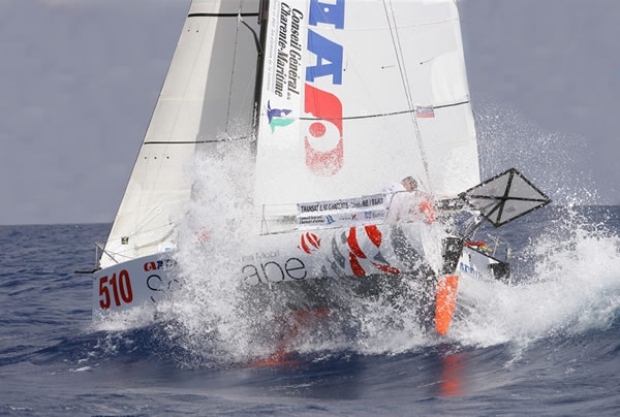
The start was the usual mayhem with 89 boats on the line, but almost everyone took great care in avoiding each other. A group of press boats got a bit too curious wandering really close to the first turning mark, with several of the competitors (me included) nearly missing them, passing to left or right of them. Andraz and his SLO 510 were less lucky - when he rounded the buoy; he switched on the pilot as he hoisted his Code 5 only realising that there is a big press boat right in front of him. Too late to do anything about it, he crashed right into the boat, puncturing the outer carbon skin of his bow, damaging the starboard centerboard and ripping the Code 5 - not a great start to a 4300 nm long race. After a brief inspection and a forecast promising a downwind first leg, he decided to continue the race.
Over the next two days the frontrunners were flying like bats out of hell, while I had problems keeping up with their pace, despite training and good preparation. One of the reasons was surely that I did not do any long races this season, due to an injury I suffered over the winter. This ice skating incident resulted in a complicated fracture of my leg, followed by surgery and about six months of rehabilitation and still being on crutches three months before the start of the Mini Transat.
Anyway, it took me until we got to Finistere, or a good two days, to get into the racing mind, and by this time Isabelle [Joschke] was the leader already 50 miles ahead. Andraz on the other hand found some inner strength or maybe just through berserk rage, darting through the fleet climbing all the way up to the fifth place.
The weather situation after the Cape Finisterre was an interesting one, with a strong acceleration zone close to the Spanish/Portugese coast with the Azores high pushing in from the west. Jure Jerman, our weather router suggested that it would pay diving south right after the Finisterre, entering the acceleration zone causing us to be slingshot towards Madeira at high speed but making our route about 70 miles longer. Having absolute faith in the decision we both dove down and enjoyed two days of the wildest downwind runs in wind gusting to 35 knots. Andraz managed to get the most out of it and in the process notched up the class's largest daily run - an impressive 294 miles…
Meanwhile the top trio were following the shorter route in less wind, but with a hotter wind angle, still managed to keep the distance over us, especially since they managed to squeeze past the expanding high. Peter Laureyssens, second on the Finisterre headed too far west, got stuck in light winds and lost 12 places in one day. The rest of the first leg then turned into simple straight lining, gybing on shifts.
Our eastern position paid off a bit on the approach to Madeira with Andraz finishing a creditable fifth. On the other hand my luck ran out on the morning of the third day when the wind started to drop and I decided to change to the big kite. During the hoist the boat hit a bad wave and while rushing water pulled the tack in the water, the boat ran over it, the spinnaker did a cobra on me and in the blink of an eye it was over. After pulling the rags out of the water it became obvious that only a sailmaker could repair it. Sailing with the medium kite for three days in light conditions resulted in some very hard moments mentally, finishing a rather disappointing 18th approximately 16 hours behind the leader.
The stopover in Madeira was nice, but the long leg ahead kept me from relaxing too much. We took great care in double checking everything, going through the offshore mantra: rig, keel, rudders, pilot and electronics and then checking it again. Our sail maker flew in from France and did an awesome job on the spinnaker, completely repairing the rips and the torn out clew.
Weather at the start of leg two was again a bit unusual with a big depression to the north of Madeira, killing the trades and establishing a band of light winds to the south offering two options: going southeast, passing through the Canaries and using the acceleration zones between the island to sail fast or a southwestern track staying in less wind, a bit closer angle and shortest route.
The routing pre-start was indicating a faster route passing through the Canaries, but since the trades appeared to be unusually strong, Jure ran a high resolution model over the Canaries. The results were worrying - the acceleration zones would boost the trades to a sustained 35 knots of wind with gusts over 40 knots also meaning very big seas. The western option on the other hand promised much tamer conditions, with the wind not more than 25 knots and a good broad reaching angle all the way to the Cape Verdes. Together with a shorter route this was offering good alternative, especially since Minis will not sail much slower in 25 kts that in 45kts of wind due to the severe sea state, not mentioning the exposure of the boat to potential damage. So west we went.
The start was again a bit hectic - I narrowly avoided two port tackers by crash tacking despite having the starboard advantage. Andraz on other hand had a great start but his plans came to abrupt end when a missed port tacker T-boned him about 15 minutes into the race. The boat hit him just in front of the chainplate, leaving a gaping wound at the deck-hull joint. Unable to continue the race he returned to port, where with the help of the team managed to repair the hole. Twice in two starts would surely be a bad omen for a more superstitious sailor, but Andraz restarted about four hrs latter leaving about 20nm behind the leaders.

Meanwhile, while as most of the fleet dove southeast, I was following our plan to stay to west of the rhumb line. The wind was dropping slowly during the night until it disappeared completely leaving the boat rolling in the swell. With sails flapping wildly I got a bit careless, raised my head a bit too high and met the boom in full swing, rewarding me with a gaping wound on the temple. In no time I was covered in blood, not just my face, but the dripping blood everywhere… in the cockpit, on my boots, on the ropes, inside when I was looking for some bandage… A bit of gauze and duct tape did the trick but next morning it took me almost three hrs to clean the blood form the cockpit.
The whole of the next day I was still trying to get S-SW, until the wind filled from the N-NE late in the afternoon. I was still heading west trying to get enough leverage for a final descent to Cape Verdes. Maybe it was a mistake to push that far west, especially since Yves le Blevec did just fine in the centre of the route, but at that time I didn't have a better plan. After a gybe I set the boat up for some heavy downwind conditions.
The next four days were fast but uneventful, just keeping the boat moving as fast as possible, changing sails, taking care not to overload it, keeping my energy levels high by eating enough, drinking enough water and sleeping at least remotely enough - in Mini Transat terms of course.
Here I realised how much the winter modifications had changed the behavior of the boat. With a 50% lighter rig, lighter bulb and lithium batteries we had shed close to 100kg, leaving the boat in measurement condition at just 820kg. Together with a new generation of sails the boat was flying high above the water, with scarcely any water on deck, very stable, very easy on the helm - a pure joy to sail.
I passed the obligatory gate in the Cape Verdes on its western edge and dove south. With the Cape Verdes marking the limit of the pre-race weather forecast, we were now on our own, the only source of information being the daily meteo report from the organisers - that is of course if you could catch anything on the ancient technology of the SSB.
I was pushing very hard in the next two days, trying to get as close to the leaders before we enter the grand scale lottery of the Doldrums. The hard work paid off, when I heard my position report placing me on 5th position, but more importantly only 15 miles behind second placed Adrien Hardy and 45 miles behind the leader. With a bit of luck, interesting things could happen.

Compared to two years ago, the Doldrums were a place of big agony for all of us. The first day the wind was light easterly but with strong squalls, however it was next day that the real troubles began. The sky was overcast with low clouds; raining continuously, while strong squalls gusting to 35 knots passing regularly carrying walls of torrential rain. But at least we were moving, because on the next, third day, the wind died completely, dark clouds bringing strong showers that broke the routine of permanent drizzle from an overcast sky.
Wet, tired to the bones and completely miserable I made a costly mistake by falling asleep, leaving the boat on the autopilot set to apparent wind angle. Three hours later I wake up in shock, realising that the pilot had tracked the shift and taken me 7 miles west instead of my intended direction towards the exit in the south. With the wind below 1 knot it took me 12 hours to cover nine miles back south, with a very bad feeling about my current position. The daily report on Monaco Radio confirmed my fears - I lost three places, now eighth, but more terrifying was the thought of losing more than 100nm - now 120nm off second. Apparently the eastern route this time paid off better, as was obvious for Yves le Blevec and Hardy and Sineau who were already smoking miles in the southern trades.
Exiting the Doldrums was spectacular, leaving a wall of clouds behind, while enjoying a nice 10-12 knot southerly wind and flat sea with a clear sky. The last third of the route was promising to be a fast reach instead of a hard upwind slog like during the 2005 Transat. 15-22kts of wind and a 65° to 90° wind angle are the sweet spot conditions for our beamy Sam Manuard designs, promising some catch-up possibilities, so my spirit was high.
Fast on a Mini inevitably also means wet, with waves and spray covering the deck (and skipper) regularly, conditions that obliged us to constantly use our increasingly leaking oilies, no matter what brand you were using. Leaking oilies on a Mini also mark the beginning of some serious skin problems and no matter how good your nappy rash cream is one will sooner or latter result in “baboon´s butt syndrome”. Discussion among the skippers later revealed we all shared some very violent emotions on this topic during the race and it was good that Mr Musto or Mr Lloyd were out of reach at that time.
Passing the Brazilian coast was again uneventful with fast reaching and eating the lead of the leaders but their more easterly position paid off handsomely with me unable to reduce the distance enough until the finish.
Andraz made good progress after his restart in Madeira, passing through the fleet with his known determination, but then realising his accident left him with more mental burden than was obvious initially. With a clear image of winning the race and no back-up plan, he went through some very painful soul searching moments, finally getting back on his feet and finishing a creditable 10th on the second leg and 9th overall in the general classification culminating in our team success, having both boats in the top 10 on the most competitive Mini Transat ever.
The finish in Salvador was a mix of emotions for me. On one side you feel a great sense of relief, but on the other hand I felt a bit of remorse too, not due to my finishing eighth, but because this also marked the end of our four year long Mini Transat campaign.
Coming from a country with no offshore tradition and infrastructure, we overcome climb many obstacles. Having built and optimised two top level boats, creating a team of people that give us support, while all the time promoting solo sailing, a sport that is finally getting recognised with a spirit of adventure - not just a bunch of loonies trying to get killed. All this makes us immensely proud on our work. It would be a pity to stop just here, so I am sure we´ll think of some way of continuing.


Last but not at least; I can´t conclude this report without mentioning Adrien Hardy on Brossard. During the Doldrums when lying 2nd, his forestay chainplate failed causing his rig to fall over the side. Fortunately he was using a spreader less wingmast, held up by just three PBO shrouds that survived the fall intact. In an Yves Parlier style act of unparalleled determination he rebuilt the carbon chinplate, using his on-board repair kit, attempting to make the lamination despite the permanent drizzle and moisture. After the lamination cured, he rigged the bowsprit as a crane and managed to lift the 12m long, 50kg mast, somehow restepping it on its rotation ball. How he managed that in the permanent swell of the open ocean is a mystery, but with the mast back in place he then switched back to racing mode to finish a creditable sixth. His amazing feat definitely made him the moral winner of this race and an inspiration to all of us.
Thanks to Jure Jerman, our weather router, Ana Lukanc, communication and PR, Vid Jeranko, sailing coach and Nejc Sarabon, physical trainer (drill sargent) and nutricist, Leja Dolenc, sleep management and Matej Tusak who worked on our psychological preparation.
More photos on page 2....

Most Read
Most Commented
Comments
Businesses

Pro businesses
-
United Kingdom
-
France
-
-
Italy
Editor's choice
Member blogs
-
 Ned Collier Wakefield: MOD70 round BarbadosWell that was intense. 12 hard fought for seconds for the win. In idyllic conditions, Tony Lawsons MOD ...
 -
 Mini Transat leg 2 reportThe second leg of the Mini Transat started on 31st October, just over a month after ...
 -
Leg 1 reportI’ve been working towards the Mini Transat now for three years. In 2013 I was part ...
Business blogs
-
 The Island Sailing Club in Cowes, Isle of Wight, is delighted that Prince Michael of Kent ...
 -
Peta Stuart-Hunt chats with the 25 year-old British solo sailor Lizzy Foreman before she sets sail ...
-
The 2015 Student Yachting World Cup (SYWoC), an ISAF-recognised event hosted and run by students for ...
Editor's Choice
All time favourites...
-
 Three legs down into Ian Walker’s
 -
 Winning all but two races at
 -
 For the first time in its
Latest Comments
Add a comment - Members log in