
Four to go
Thursday October 25th 2007, Author: Key Partners, Location: Mediterranean
By the early hours of this morning, two more yachts had completed the 2007 Rolex Middle Sea Race bringing the number of finishers up to 13. Four yachts remain on the course.
Nord Star (RUS),
Windsong (GBR) and
Muzyka (ITA) are in a close bunch doing 8-9 knots halfway between Lampedusa and Malta. The last boat in the race, the German multihull
High Q1 is halfway between Pantelleria and Lampedusa. Currently sailing in light a southerly, the wind is expected to strengthen - a relative term - to a steady 10-15 knots as the evening progresses.
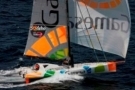
The two 'latest' finishers are Global Yacht Racing (GBR) at 7.40PM on Wednesday evening and Jonas Diamentino's Gasan Mamo Insurance Comanche Raider (MLT) at 1.52AM on Thursday morning. Both will have enjoyed some excellent sailing over the previous 24 hours but would be excused for feeling frustrated as the winds around Malta faded away for their arrival. Global Yacht Racing, in particular, endured a miserably slow crawl to the line, but greeted their arrival with a noise to match that coming from the ravelin in front of the Royal Malta Yacht Club as they eased across the line.
Basking today in sunshine unimaginable at the start of the race, Martin Scicluna the skipper of Air Malta Falcon one of the two Maltese boats to finish yesterday, happily described his race: "We knew about the weather we knew it was going to be tough. Before the race I had a briefing with the crew and told them the situation. I also told them that retirement is not in my vocabulary, so long as the boat is okay and nobody is hurt our intentions was to start the race and finish the race. I told them we would be careful and made sure we had the right sails and food onboard," commented Scicluna.
According to Scicluna, Air Malta Falcon encountered the weather it expected and for which it had prepared. Even with the presence of his 15 year-old son Matt on board he never felt threatened by the conditions nor considered the possibility of giving up. One of the weapons in his armoury of staying power was the presence of Arthur Podesta and Elusive Medbank: "Arthur is an experienced sailor and practically has done all the Middle Sea Races. So I felt that as long as he was racing I would continue. His presence spurred us on and it was good that we competed against each other."
Scicluna was surprised when he discovered so many boats retired on the first night with worse still to come. Falcon saw 50-55 knots from the east on Saturday night, but this was nothing compared to his experience on the second night, which he calmly described as the 'perfect storm'. In order to cope: "we dropped the main and hoisted the No 4 [headsail] which is a very flat sail and spills the wind, and, we kept like this even in the eye of the storm. We abandoned the original shift system and only kept a helmsman and a trimmer on deck with two on standby below. There was some sickness, but not too bad. We even managed to cook bacon and eggs!"
Scicluna has done the race five times since 2002 and has never seen anything like the conditions he witnessed this year. Thunder, lightning, hail all hit the boat. Apparently the storms would form as fast as they would dissipate and he had never experienced this. Watching the storms building was quite alarming and Scicluna finds it hard to imagine it could ever be worse. Even if it is expect Scicluna to be there, he clearly loves the challenge.
Another yacht seemingly surprised at the number of withdrawals while being utterly awestruck by the severity of the conditions and the speed at which the squalls would form, die away and return is Slingshot the British doublehander.
"It was always going to be challenging because of the weather forecast, so we had that in mind. The boat had been here a year and was well prepared in advance. When we arrived it was ready to race and we didn't actually go sailing beforehand," explained co-skipper Shaun Murphy. "Our idea was to race to the top of the Strait and then take a call on the weather. The run up was good. We had a bit of damage [to the main] when we were hit by 38 knots, so we brought the main down to do a bit of repair. We were under trysail for a while, so we were quite slow at that stage. There was certainly no rush because we knew the weather was up there. Getting [to Messina] any faster would not help us," he added.
After the Strait, Slingshot enjoyed a nice reach to Stromboli, but difficulties were not far away. "The black clouds started to appear just as we approached Stromboli. I can only describe it as a curtain of cloud heading towards us. Strong lightning strikes were hitting the water and we decided to run away from them trying to circumnavigate the thunderstorm. It was at least three to four hours before we could get past the volcano. We saw other boats turning around at this point and even though we knew we were going into heavier weather we decided to carry on. We had the experience and were confident in the boat," recounted Murphy.
The strongest winds they saw were in excess of 50-knots. Sailing under trysail for much of the second day Murphy and crew Roger Barber made every effort to conserve themselves, remain flexible with the watch system and keep the boat going. Talking through every procedure and manoeuvre before doing it they returned to the "ABC of sailing" according to Murphy, adding "we haven't got 20 people to come and help us out if the sail goes in the water. We're extra cautious and do our utmost to minimise mistakes to allow us to continue sailing fast and safe." The objective was always to get to the finish line even if that meant occasionally sailing in the wrong direction to escape thunder and lightning strikes.
Murphy has now completed the Rolex Middle Sea Race doublehanded on two occasions and is a great favourite at the Royal Malta Yacht Club. He is also a great enthusiast for the race and intends to do it again as often as possible.
Another group that have won many friends this year is the crew of Loki who returned to Malta late on Tuesday after it became clear the yacht was irrecoverable. Owner Stephen Ainsworth and skipper Cameron Miles are clearly affected by the loss of the yacht but are satisfied that there was nothing more they could have done to save Loki and that the decision to abandon was correct.
Miles described the situation faced by the crew in the final hours after the loss of the rudder: "we had four metre seas with breeze up to about 35 knots. Pretty bad and certainly bad enough to make it uncomfortable and to not give you many options. We were really trying to slow the boat's drift down as much as we could. The situation became worse when we realised that there wasn't any tow vessel available. Option B was to try to guide the boat to a marina that we had selected as the best possibility. As time wore on it became increasingly obvious that this would put too many people in danger. If we missed the breakwater we would end up in the water on a leeshore in four metre seas.
"Lying 4 to 5 miles offshore, Option C and the only other one was to ask for helicopter assistance and that is what we did. The crew throughout the whole ordeal were very professional, including the young guys onboard. It was really good to have undertaken training about how to get into a raft and being able to assist the helicopter guys by being proactive about getting away from the yacht."
Getting off was no quick process, according to Miles: "we sent two groups. The first group got off and probably spent an hour and a half in the raft. By the time they all got extracted and were in the helicopter it was another hour and a half before the second group got out."
Getting into the raft from a bucking yacht in wind and darkness is no fun, as Ainsworth explained: "No one willingly jumps into a liferaft in the middle of a heaving sea in the pitch black night. We did it because there was no other option and we had to think of the crew first. Full credit to the Italian Airforce about the way they got us out of the rafts and into the chopper. They had a struggle with the first raft in 35-40 knots, but fortunately for the second raft the wind had subsided slightly and it was much, much quicker."
Miles who was in the second group got into the helicopter quite quickly and then discovered that being in a chopper trying to hold station over a raft while being buffeted by the wind is as alarming as being in the raft waiting. The noise and motion is relentless. It was like moving from the proverbial frying pan to the fire. But as he is first to admit the end result was as good as it could be.
George David's Rambler is the Overall Winner of the Rolex Middle Sea Race 2007, she also set a new Course Record of 47 hours 55 minutes and 3 seconds.
The final prize giving will be held on Saturday 27th October.
Most Read
Most Commented
Comments
Businesses
Pro businesses
Editor's choice
Member blogs
-
 Ned Collier Wakefield: MOD70 round BarbadosWell that was intense. 12 hard fought for seconds for the win. In idyllic conditions, Tony Lawsons MOD ...
 -
 Mini Transat leg 2 reportThe second leg of the Mini Transat started on 31st October, just over a month after ...
 -
Leg 1 reportI’ve been working towards the Mini Transat now for three years. In 2013 I was part ...
Business blogs
-
 The Island Sailing Club in Cowes, Isle of Wight, is delighted that Prince Michael of Kent ...
 -
Peta Stuart-Hunt chats with the 25 year-old British solo sailor Lizzy Foreman before she sets sail ...
-
The 2015 Student Yachting World Cup (SYWoC), an ISAF-recognised event hosted and run by students for ...
Editor's Choice
All time favourites...
-
 Three legs down into Ian Walker’s
 -
 Winning all but two races at
 -
 For the first time in its
Latest Comments
Add a comment - Members log in