
Tough first year
Wednesday October 10th 2007, Author: James Boyd, Location: United Kingdom
As a professional sailor used to crewed racing, one of the hardest things to do is to leave the comfort zone and shared responsibility of regular well paid work with your mates, to go off and mount your own solo offshore racing campaign, be it in the Mini or the Figaro. This move is effectively like taking up sailing afresh, requiring a whole new set of skills and the prospect of, initially at least, scoring some not very good results. This year we have seen two sailors go through this harrowing process - Aussie Tom Braidwood, more familiar with the bow of Volvo 70s or running Neville Crichton's
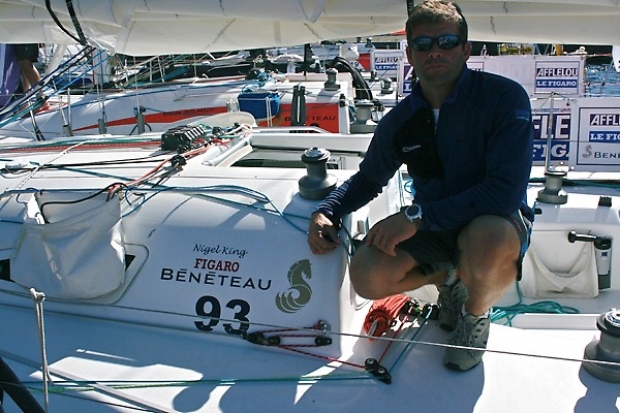
Alfa Romeo, has mounted a Mini campaign while another Volvo sailor Nigel King has been attempting his first season in what many view as the most competitive of all the solo offshore racing classes, the one design Figaro.
Neither King nor James Bird, the other British skipper competing on the Figaro circuit this year, will be particularly pleased with their results in the all-important Solitaire Afflelou le Figaro race, both having had to withdraw at various times from the four leg race that this year visited France, Ireland and Spain.
Bird was on the back foot from the outset when his yacht GFI Group suffered an unfortunate collision with an underwater object prior to the start of the first leg. He missed out on the first leg and was forced to pull out of the third leg too as was King. However it should be pointed out that this year's Solitaire was exceptional - around the time the Rolex Fastnet Race was postponed due to the bad forecast, the Figaros were out there in the Bay of Biscay (not a nice place at the best of times) and on two legs experienced winds up to 50 knots.
 When King pulled out en route to Spain from France he says it was blowing 45 knots and his boat was being battered by 5-7m breaking waves... when his all-important autopilot suddenly gave up the ghost. "The boat auto-tacked with full stack and ballast in and everything sheeted on," King recalls. "I was down below at the time so the first thing I did was come up on deck to shut the pilot off and to grab the helm and as I opened the hatch I took two breaking waves down below, which wasn’t the look I was going for.
"So I got the boat sailing again and then decided I’d better reduce sail to get some control. I went to put the storm jib up and I lashed the helm off so I could keep sailing while I was doing that and in the middle of that, the boat autotacked again - it lost its way with the waves and span round. So I was floundering around on the foredeck for a little bit under water with sails half up and half down which wasn’t ideal. I was pretty relaxed about it but I didn’t feel in control and I needed to be in control. You can’t carry on for too long like that before things start to go wrong.
"So I hove to for a while to try and sort out the problems and I was just getting dropped - the boat was going over the waves and was landing on its side. I took a couple of really big impacts and one shut down the boat’s computer and so I now had no nav stuff – again not the end of the world, but too many things going wrong at the same time... I thought 'if I continue to drop the boat on its hull to deck joint I am probably going to break it'. So I thought 'what are my options?' and I started to look at where I could run away to. Everything in Spain was upwind or no good for support and everything downwind - there was La Rochelle. I was closer to La Rochelle than I was to La Coruna, so I ran away to fight another day.
"And it was getting dark, I had another hour of light and I had no clue about what was wrong with the pilot. And later we discovered it was basically fried. Other boats I know had pilot issues but they lost functionality not the whole thing. And I felt there was no way I could go through the night, in 50 knots of breeze steering all night safely without running the risk of having to get on the phone and call someone up. I thought that was a bad position to put myself in and bad to ask someone else to come and get me if something did go wrong. Also I took the view that I couldn’t afford it to push it and destroy the boat because I own it and I haven’t got a sponsor and I want to come back next year in good shape. So I think if I was making the choice again tomorrow, I would make the same call."
As a result he was unable to compete in the fourth and final leg, another where boats regularly saw 40 knot winds.
In general King's first season in the Figaro has been a tough one as he has doggedly attempted his campaign without a sponsor. Having bought his own Figaro boat and setting up shop out of the training base in La Rochelle, he was regularly having to cut into his training time, particularly vital for the first year in the class, to go and get regular sailing jobs to stay alive. In particular much of the latter part of this year has been spent with Dee Caffarri who has invited him to compete in next month's Transat Jacques Vabre doublehanded on board her Open 60 Aviva.


Despite the hardship King says he has enjoyed his time so far in the Figaro: "It was probably one of the best years sailing I have ever done. I probably learned more in my 20th year than I did in my first year which feels really good. I didn’t quite get the result I wanted, but that is one of those things. The gear failure on the boat was disappointing, but I still look back on the race as a really positive experience. I learned so much. The fleet is fantastic. The support you get from the fleet and the guys and the shore crew and the organisers is great. The Solitaire is a well run, professionally run race."
While tough and left to his own devices on board, King reckons sailing the Figaro in some ways is less stressful than what he is used to. "I was the most relaxed I’ve ever been sailing, because its small boats and you are on your own. When you are on your own, there’s only you you worry about. If there was a crew there I probably would have been much more concerned about guys going to the foredeck. And small boats - if it had been a Volvo 70 it would have been really scary because we would have been launching at 12 or 14 knots not 6 knots. So small boats - I am pretty happy there."
King talks about his big learning curve this year as he has ventured into new territory. "I think it is about what I know and what I don’t know. When you sail with crew you only do a bit of the job. I am much more confident now with my tactical decision-making. All the way through the race when I look back I had the right tactical thoughts, just sometimes due to a lack of confidence I talked myself out of what was the right thing to do. So I have realised that I perhaps know more tactically than I perhaps gave myself credit for. And navigationally, never having had to do the full race nav, I learned loads about that, how to plan it and how to think about it and the weather situation."
During this year's Solitaire Afflelou le Figaro King won the rookie prize (awarded to first time Figaro sailors) in the prologue prior to the start of leg one, the prize for which is the opportunity to spend a day at the Meteo France centre in Toulouse (the French equivalent of the UK Met Office in Bracknell) where he will get some more weather training.
He continues: "And just generally getting more confidence in setting up a boat up and racing in a one design fleet. After the race I talked to Jeanne Gregoire and she had had a bad leg - I said 'I really struggled to manage my sleep'. And she said ‘well, why wouldn’t you? This was your first race. We all struggle with that in our first one. If you enjoyed it that is half the battle'."
While a mate came to his aid prior to the start for 10 days, another downside of being under-funded was that King was one of perhaps only three boats in the class not to have a regular shore crew (a 'preparateur' as it is known in France) - someone to take the lines and sort the boat out as the skipper steps ashore zombie-like. "It makes a huge difference. I originally said without a preparateur I wouldn’t do the race." Thankfully King has a highly capable sister in Helen, a veteran of Offshore Challenges and who has worked on campaigns for Ellen MacArthur and Nick Moloney. While King was racing his sister was driving the van between the stopover ports.
But the main hardship of the year for King has been trying to juggle being in France spending quality time with his boat, earning a living while also trying to find a sponsor that could solve all his problems, allowing him to focus solely on the Figaro. "Hopefully we’ll just keep working at it and hopefully we’ll get there. It seems to be a bit random," he says of his search for a sponsor. "But if you keep putting yourself in front of people you’ll find someone in the end."

However the sponsorship hunt will have to resume in the new year now as King has the TJV ahead of him and then goes to Australia to compete in the Sydney Hobart race once again with Chris Bull on Jazz. "Chris has been a massive supporter of the Figaro and without his support I wouldn’t have got anywhere. He is such an enthusiast for the sport, he just wants to see people do well," says King.
In addition to la Solitaire du Figaro, as the event is to become known once again now that it has a new sponsor in Suzuki, on the cards for next season in the Figaro is the Transat AG2R, doublehanded across the Atlantic from Lorient to St Barts, another race, like the Trophee BPE this year, that is a big event very early in the season. Generally the Figaro class are looking at rationalising their calendar as with the advent of new events such as the Cap Istanbul (from France all the way to Istanbul) the class is getting spread too thin between events.
"They are looking at getting a two year plan in place, a permanently fixed program which rolls through to give the championship a little more structure and allowing people to plan much further ahead," says King. "Fortunately the Figaro class is really well prepped. There are a couple of version of the calendar already. I was asked to fill in a 25 document on what I thought of the race [the Solitaire] asking us to comment on everything."
An exciting prospect for King, and perhaps one that will help his sponsorship hunt, is that the class are planning a stopover for la Solitaire once again in the UK, either in 2008 or 2009. "We have had a great response from a couple of councils," says King. "It has been an eye opener seeing how the French do it. In Caen for the start 200,000 people turned up at the race village." Without substantial promotion it is unlikely that the race would get similar attention in the UK, particularly arriving at one of the busiest times in the season, but it is still a step in the right direction.
One of the unusual aspects of the Figaro is that while boat on boat tactics are of paramount importance even offshore, this being a one design fleet, with boats hunting in packs, there regularly seem to be a handful of people always at the front. In this year's Solitaire Michel Desjoyeaux, a former winner of the Vendee Globe, the Route du Rhum and the Transat, as well as two previous Solitaires, provided a text book display of how to win the race.
"There were three guys who seemed much more comfortable with themselves," says King of the Figaro elite. "They were walking around looking like winners." When there was a substantial course change on the third leg, removing the Fastnet Rock for a mark further south down the French coast, to avoid the fleet experiencing 50 knot winds for three days solid, it was they who complained the lest.
"Mich has that air about him," King says of this year's winner. "He’s very calm, everything is very professional. There is no stress around him at all. He’s happy to talk to everyone. On the water he is really hot. He always seems to have that little edge. If you are into solo sailing, he is a perfect example. He’s challenged himself ten times to go back and do that race and he’s happy to put his reputation on the line. He doesn’t win a leg, he’s not upset, because he’s there learning. I can’t see any downside to doing it apart from some dents to your media image."
One of the hardest things to explain about the Figaro compared to other classes, is just why it is so hard to win. King reckons that for foreign sailors it is particularly tough due to the UK's lack of history in the class. "The young French guys who come in have already done a few years as a preparateur. They know the boat inside out and the rule inside out."
So are any more Brits planning on having a go? James Bird should be back and King says he has heard of a couple of other Brits sniffing around. But there is a giant step between sniffing around and making it to the start line.
While competing in the Figaro again next year is top of his list, King is also really keen on getting a group of young British sailors down to compete in the Figaro and to act as their coach. In France there are several schemes such as the one run by Credit Agricole, whereby young sailors who prove themselves get a grant and a boat to sail in the class for a season. Aside from sponsorship for himself, King hopes that one day such a scheme might run in the UK.
Most Read
Most Commented
Comments
Businesses

Pro businesses
-
Italy
-
-
Italy
-
France
Editor's choice
Member blogs
-
 Ned Collier Wakefield: MOD70 round BarbadosWell that was intense. 12 hard fought for seconds for the win. In idyllic conditions, Tony Lawsons MOD ...
 -
 Mini Transat leg 2 reportThe second leg of the Mini Transat started on 31st October, just over a month after ...
 -
Leg 1 reportI’ve been working towards the Mini Transat now for three years. In 2013 I was part ...
Business blogs
-
 The Island Sailing Club in Cowes, Isle of Wight, is delighted that Prince Michael of Kent ...
 -
Peta Stuart-Hunt chats with the 25 year-old British solo sailor Lizzy Foreman before she sets sail ...
-
The 2015 Student Yachting World Cup (SYWoC), an ISAF-recognised event hosted and run by students for ...
Editor's Choice
All time favourites...
-
 Three legs down into Ian Walker’s
 -
 Winning all but two races at
 -
 For the first time in its
Latest Comments
Add a comment - Members log in