
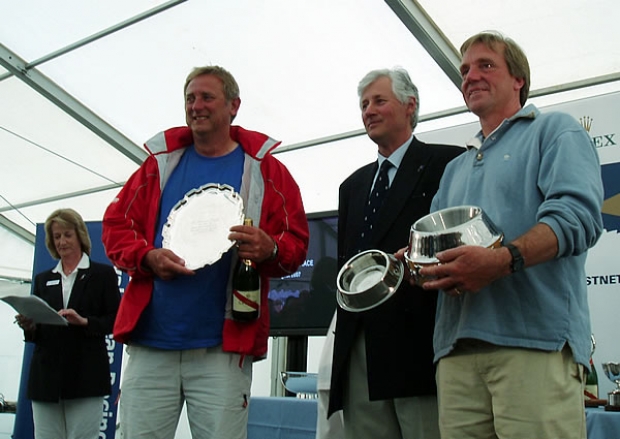
Paul Peggs (left) with Simon Curwen (right), RORC Commodore David Aisher presenting the silverware and Race Director Janet Grosvenor mistress of ceremonies at the Fastnet prize giving
Doublehanded victory
Wednesday August 22nd 2007, Author: James Boyd, Location: United Kingdom
While many competitors in last week's Rolex Fastnet Race got a caning from the conditions on the first night and then crossing to The Rock upwind in 30+ knots, some of the toughest times in the race were had by those who chose to race doublehanded (and we're not talking Open 60s here...)
The doublehanded class this year had 22 entries, a testament to this form of sailing gaining ever increased popularity in offshore racing, however not so good was that only two of these finished. Among them Simon Curwen and Paul Peggs, sailing the former's J/105 Voador, scored a resounding victory and at one stage were even on track to win the IRC 2B class on handicap ahead of the fully crewed boats. Even in fully crewed 2B there were only five finishers among 29 starters.
While the maxis and Open 60 race leaders saw winds touching 40 knots Paul Peggs says they had a pretty miserable time en route to Land's End. "Generally we saw 35 knots getting out of the Channel and didn’t see much more than that going across the Irish Sea but the sea state in the Channel was a bit horrible."
Of course 'a bit horrible' is a relative term. Both Curwen and Peggs are past Mini-Transat veterans, in fact Curwen is still the highest placed Brit in that biennial race, when he finished second in 2001 ahead of Anglo-Saxon 'names' such as Brian Thompson and Sam Davies. The duo regularly sail together in the Royal Southampton YC's various doublehanded races and competed in the Royal Western YC's two handed Round Britain and Ireland last year and in the French Transquadra race.
"In the middle of that night was when it was windiest," Peggs continues. They were generally sailing with two reefs in the main and for about an hour they rolled the headsail away sailing under main alone. They rigged up the inner forestay ready to go down to storm jib, but in the end they never used it. Having had a premonition about the expected conditions Peggs says: "We put the no4 up at the start - it was a brand new and was a really good sail for us. It was the only headsail we used all race..."
As a shake-down prior to the Rolex Fastnet Race, Peggs and Curwen had sailed in the RORC's breezy Channel Race during which they had experienced a number of 'technical problems' with Voadar - the boat giving them some warning that some boat prep was required. "The electrics had played up and we had no reefing lines in and we ended up flogged the mainsail to bits. And we didn’thave any gas. So it was a bit of a wake-up call," says Peggs of that race.

However back on the Fastnet, in the big conditions some unanticipated issues came to light. "We haven’t been out in big winds in the J/105 and we hadn’t realised that the cockpit speakers - they haven’t been used for ages - whenever we got a wave into the cockpit loads of water was getting down below." The 'waterproof' speakers were found to be less water resistant than advertised so they unscrewed the speakers and screwed them back in with a plastic bag behind them as a vague seal. Life down below was made no better when 6lts of diesel decided to add itself the deluge pouring into the bilge...
On their way down the Channel our dynamic duo clipped St Alban's Head, Portland and Start Point whereas most boats headed further offshore. Only ten boats in Class 2B made it past the Lizard and heading past Land's End Voadar was third on the water behind the Pronavia 38 Bongani and the mighty Trintella Antares. For Peggs and Curwen their killer move was to head east on their way out to The Rock across the Celtic Sea.
"When we went around Land’s End, we were fetching so we fetched off even more and as it was going around to the northwest," explains Peggs. "We fetched off most of the night and then the shift came around and we were able to tack over, so we only ended up with the last 20 miles being a one sided beat. That’s when we took out some time on Foggy Dew because they rhumblined it while we stayed high."
After a brief spell of tacking to get up to The Rock, they rounded it at around 1630 on Wednesday afternoon in first place not only in the doublehanded division but also ahead of all the fully crewed boats in Class 2B. "We weren’t expecting to do so well in Class 2 - to be up there in class 2 was a bit of a shock," Peggs admits.
Sadly the return journey down to Bishop Rock was not so flash. They wrapped the kite a couple of times and on one occasion it went trawling when the halyard broke. "We two sailed it through the middle of the night to try and recoup and that is where Foggy Dew got through us," says Peggs. Shortly after rounding Bishop Rock Noel Racine's JPK 9.6 was up with Voador on the water, but satisfyingly never quite made it past them.
"We had a pretty amazing boat on boat battle with Foggy Due - we were side by side for the last 40 miles," recalls Peggs. "By the time we got to Plymouth it was only 10 boat length between us and they suddenly caught us up so there was only two boat lengths between us on the line. We managed to keep ahead of them all the time, but they rated lower than us and beat us on handicap." At the wrap-up Foggy Due ended up beating them by around an hour and a half on corrected.
Being seasoned shorthanded sailors Peggs says they slept reasonably well during the race and didn't keep any sort of formalised watch system. "Most of the time we did a couple of hours and when it was windier we’d do an hour. With the kite up we don’t do more than an hour each," says Peggs.
In terms of steering, they generally left it to the autopilot upwind - Peggs reckons they steered for about 80% of the way up to the Rock - and in the more tricky downwind conditions on the way back steered all the time, particularly with Foggy Due nipping at their heels...
Aside from the leak and the sail handling issues, the only other damage was a small tear in the mainsail, although Peggs says that in the conditions they didn't even attempt to patch this.
Like many more experienced offshore sailors who took part in the Rolex Fastnet Race, Peggs was surprised at how many boats dropped out. "Delaying [the start] was a good idea as it gave people the option to go in. It was pretty horrible out there, but I was quite surprised that some of the bigger boats went in in 35 knots."
Of course with almost three quarters of the Rolex Fastnet Race fleet retiring, there is now the view expressed to us by several knarly old hands we spoke to at the finish, that offshore racing in this country is in a dismal state and we are all turning into a bunch of wimps. In our view the RORC did an admirable job in providing enough action for competitors and giving then adequate warning about the expected conditions and an easy get out into Plymouth, with the end result that no lives were lost. Just a notch or so further up the Beaufort Scale and it could have so easily have been so different.
Most Read
Most Commented
Comments
Businesses
Pro businesses
Editor's choice
Member blogs
-
 Ned Collier Wakefield: MOD70 round BarbadosWell that was intense. 12 hard fought for seconds for the win. In idyllic conditions, Tony Lawsons MOD ...
 -
 Mini Transat leg 2 reportThe second leg of the Mini Transat started on 31st October, just over a month after ...
 -
Leg 1 reportI’ve been working towards the Mini Transat now for three years. In 2013 I was part ...
Business blogs
-
 The Island Sailing Club in Cowes, Isle of Wight, is delighted that Prince Michael of Kent ...
 -
Peta Stuart-Hunt chats with the 25 year-old British solo sailor Lizzy Foreman before she sets sail ...
-
The 2015 Student Yachting World Cup (SYWoC), an ISAF-recognised event hosted and run by students for ...
Editor's Choice
All time favourites...
-
 Three legs down into Ian Walker’s
 -
 Winning all but two races at
 -
 For the first time in its
Latest Comments
Add a comment - Members log in