
The latest weapon
Tuesday June 5th 2007, Author: James Boyd, Location: United Kingdom
If one looks at most of the top French sailors racing Open 60s such as Jean le Cam, Roland Jourdain, Michel Desjoyeaux, Vincent Riou - the singlehanded one design Figaro class is where they have all cut their teeth. With the 2008 Vendee Globe looming, so for this cycle a fresh crop of talent is migrating through including former Solitaire winner Jeremie Beyou, skipper of the new Farr design
Delta Dore and
Roxy's
Sam Davies. Another is serial Figaro sailor Yann Eliès.
Eliès has not won the annual Solitaire Afflelou Le Figaro, but has repeatedly come first legs and in the last three races he has come 2nd, 5th and 5th. He has also sailed around the world three times - first aboard Cam Lewis' Team Adventure in The Race back in 2001, followed by two successful Jules Verne Trophy bids with Bruno Peyron on Orange 1 and Orange 2.
"The first time I thought I would like to do the Vendee was after The Race, so in 2001," recalled Eliès. "Generali were ready to do it, but 11 September happened and it was a bad time for insurance companies, so we waited and they made the decision last year."

Groupe Generali are one of the oldest companies in yachting sponsorship - they been at it for 33 years now in a variety of classes including Alain Gautier's steed from the first Vendee Globe Generali Concorde and events such as the Figaro's Generali Solo. They have been sponsoring Eliès for the last nine years - their longest association with one skipper.
With Generali lined up to do their second Vendee Globe, so Eliès had to contemplate a designer. Aside from the fact that Groupe Finot - specifically Jean-Marie Finot and Pascal Conq - have designed the winners of the last four Vendee Globes, the Eliès family also have very strong ties to the French firm of naval architects. Eliès' grandfather was a yacht broker and sold the French architect's designs in the early 1970s at the time of Finot's celebrated Ecume de Mer. In the 1970s Finot boats were used in the Solitaire du Figaro and in 1979 Eliès' father Patrick won the race outright taking first place in all four legs. With this kind of background it is not hard to see how Yann has become one of France's most accomplished offshore sailors at the age of 33.
Working with Finot, the maestro Jean-Marie tends to focus on the hull shape, while Pascal Conq deals with the rest of it - around 90% of the design work says Eliès. Engineering work is carried out in house and the designers take great store from their track record and their profound knowledge gained from almost 20 years at the top of the Open 60 class.
During the 1990s Finot's Open 60s such as Alain Gautier's Generali Concorde and his 1993-4 Vendee Globe winner Bagages Superior and Christophe Auguin's Geodis, the winner four years later and Yves Parlier's Aquitaine Innovations were among the beamiest, wide transomed, surfboard-shaped Open 60s in the class. Following the spate of Open 60s capsizing and failing to right in the mid-1990s, Finot designs went narrower with larger cabin tops and more deck camber for the 2000 Vendee Globe with new AVS rules introduced by the IMOCA class. But the trend for the latest crop of Open 60s is definitely wider and more powerful and Finot are clearly back to an area of the rule where they feel at home.

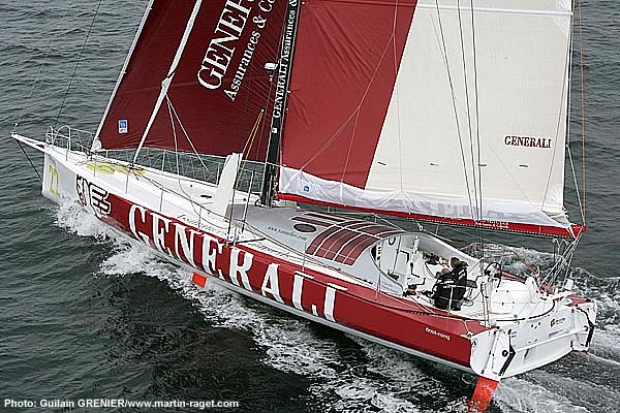
Generali 's boards and kick-up rudders look quite stubby compared to what we have become used to recently
The new Generali has a chine in her hull, artifically making the boat behave as if it is wider than it really is, but these are more extreme even than the Farr boats, extending almost all the way to her bow. While we didn't put a tap measure on her she appears every bit as beamy as the latest Farr boats like PRB and Delta Dore.
One of the most impressive features is her rig - not so much the thin Lorimar-built tube, or that it is fixed (whereas the masts on PRB and Delta Dorerotate), but her spindly full-width carbon fibre spreaders that are bonded directly on to the mast, the bottom arched aft to allow for a larger roach on the big genoa. For the power of the boats from the hull shape to the rig size and sail plan has dramatically increased. "The changes between this and the last winner is that our solent is [the size of] his genoa," says Eliès, who reckons the new generation boats have around 10-20% more sail area than the last generation.
"The idea is to have a powerful boat, like the Farr boats, but perhaps more so," says Eliès. "But a safe boat too. Because when you race for an insurance company you are not allowed to take any risks about the person or the boat. So we tried to have a very strong keel and a very strong mast."
Following the spate of keel foil troubles in the last Vendee Globe so Eliès says he spent much time contemplating the best option - carbon or fabricated or forged steel - before choosing the former. "I think steel is more sure, but the designers have built lots of carbon keel foils and they never lost one. So I decided to go down this road." For reasons of prudence Generali has two rams to cant her keel (the new PRB for example is believed to have just one). "We don’t take any risks about this piece," warns Eliès.
While the new Generali was only launched at her builders Multiplast in Vannes recently, already in sea trials they have given her a thrashing without incident. Eliès recounts: "One time just after the christening we sailed in rough conditions - we had 30-35 knots downwind. It looks like a good powerful boat. It is difficult to imagine now the performance. The first time you sail with the boat you say 'wow, we are at 100%' and then two years later you are sailing at 130%..."
A unique feature of Generali is that while her rig is fixed without deck spreaders, she does have two retractible poles mounted just forward of the chainplates that are purely used for the outboard sheeting of headsails - Eliès says the genoa and solent although one can see smaller gennikers sheeting from here too. While most thought deck spreaders were just a passing fad in the Open 60 class, they do seem to be making a re-appearance - Vincent Riou's PRB has them. Aside from making for a wider shroud base reducing weight aloft, crews are also using the deck spreaders for sheeting headsails - so this is effectively what Generali has, only that they are not spreaders for the shrouds, solely a sheeting pole.
Eliès is the first to admit that many of the ideas on his boat have been seen elsewhere. Most noticable is the 'MichDes' curved track, that encircles the cockpit, doubling not only as a mainsheet track, but also for the vang - a line stretching along the bottom of the boom that is cranked down to the track ( PRB also features this).
However Generali also has twin wheels. "I would like to have some pleasure driving," states Eliès. "During the two records with Orange I spent a lot of time on the wheel, so I think it is a good place."
Otherwise the cockpit has a single grinder, an aft deck (more Open 60s are heading towards cockpits that are open ended at the transom) and in common with the latest generation of boats - more protection around the front of the cockpit from the regular deluge of water coming over. On Generali the system is not nearly as extreme as on Jean-Pierre Dick's new Virbac-Paprec where there is a cockpit cover that slides all the way aft to the runner winches, but is a step in this direction, the cabin top extending aft over the cockpit with a lip to drain water off to the side. "We tried to make the boat a little bit less wet. I’m not sure it has worked, but it is better than the older boats," says Eliès. "I think what Virbac has is a good idea, but it is pretty heavy and Jean-Pierre is a tall guy, so he might have some back problems. But it is a good idea. One day I'm sure we’ll see some cockpits completely closed."
Eliès is reluctant for us to have a poke around below but we couldn't help notice that the layout just inside the cabin looks very similar to other Finot boats with the centrally-located chart table immediately forward. Despite all the new boats having canting keels, another new feature is just the huge quantity of water ballast they also carry. If he filled all the tanks on board Generali Eliès reckons he can add around 8 tonnes of ballast (ie double the displacement of the boat), but this is purely theoretical. "We never use it all. You just use one or two compartments together," he says. Quite simply the forward tanks are used upwind, the central tanks reaching and the aft tanks downwind.
The only aspect of Generali bucking the trend is that her twin asymmetric daggerboards (used to prevent leeway when the keel is canted) look extremely short. Eliès says that they drop down from deck level by a further 1m when fully lowered, but even so they still look small.
Generali is sistership to Alex Thomson's new Hugo Boss, but with a German clothing brand sponsor funding the campaign rather than an insurance company even Eliès reckons Thomson's boat will be more extreme. One wonders where this will all stop? While the new Open 60s are getting more and more powerful, their principle raison d'etre remains the Vendee Globe when they will be sailed by one solo skipper, who inevitably will be driving the boats at a lower efficiency. Yes, the boats have coffee grinders but no one seems to have made any other attempts to increase the efficiency with which a skipper carries out the sail handling. As Eliès says more than ever the next Vendee Globe will come down to the skipper - not so much their racing skill but their ability to realise the most from their extreme weapon (not his words).
Generali is currently competing in her first Open 60 race - the Calais Round Britain - from here Eliès says he will compete in the whole IMOCA circuit including August's Rolex Fastnet Race. Later this year he plans to do the Transat Jacques Vabre with fellow Figaro sailor and Orange crewman Sebastien Audigane.
More photos on the following pages...

Most Read
Most Commented
Comments
Businesses
Pro businesses
Editor's choice
Member blogs
-
 Ned Collier Wakefield: MOD70 round BarbadosWell that was intense. 12 hard fought for seconds for the win. In idyllic conditions, Tony Lawsons MOD ...
 -
 Mini Transat leg 2 reportThe second leg of the Mini Transat started on 31st October, just over a month after ...
 -
Leg 1 reportI’ve been working towards the Mini Transat now for three years. In 2013 I was part ...
Business blogs
-
 The Island Sailing Club in Cowes, Isle of Wight, is delighted that Prince Michael of Kent ...
 -
Peta Stuart-Hunt chats with the 25 year-old British solo sailor Lizzy Foreman before she sets sail ...
-
The 2015 Student Yachting World Cup (SYWoC), an ISAF-recognised event hosted and run by students for ...
Editor's Choice
All time favourites...
-
 Three legs down into Ian Walker’s
 -
 Winning all but two races at
 -
 For the first time in its
Latest Comments
Add a comment - Members log in