
A lesson in Open 60 design
Thursday January 4th 2007, Author: James Boyd, Location: none selected
With his company's decisive win in the last Volvo Ocean Race, maverick designer Juan Kouyoumdjian is soon to see his first Open 60 creation,
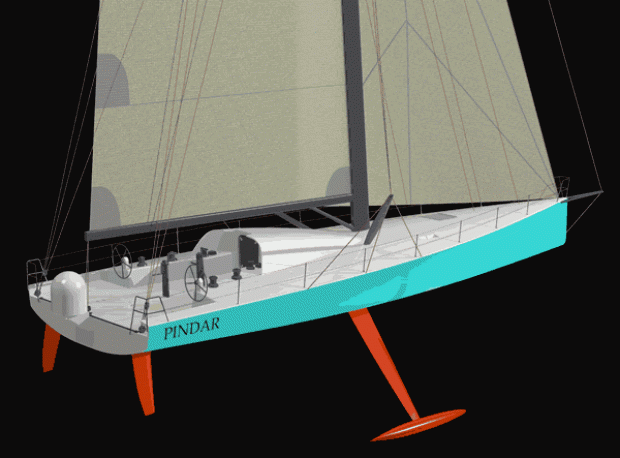
Pindar, launched in New Zealand for Mike Sanderson. Juan K is excited about the design - having developed a reputation as a rule beater following his work within the constraining IMS and the America's Cup and more recently the Volvo, the openness of the IMOCA 60 class is more suited to his fertile mind and we can expect a boat that will definitely be different, even if this isn't immediately evident from the latest CAD depictions of the new boat.
When we visited Kouyoumdjian's design office in Valencia in December he was about to have a new rack of computers delivered with a similar number of processors to that used by BMW Oracle Racing in their in house design office, but would be faster with dual core processors. But prior to this, using raw computing power, Juan K's team ran 24,000 race simulation for different Open 60 designs over Vendee Globe, Transat Jacques Vabre, Route du Rhum and Transat race courses. The upshot is a boat that, in the virtual world at least, will only be slower than the VO70 upwind in medium to heavy airs. "Any other time it will be faster than the VO70," says Juan K.
Design research and development applicable to the Open 60 got under way around 18 months ago looking at general aspects that might be applicable to any boat of this type, before they started specifically investigating Sanderson's direct requirements in May last year. Most of the work was carried out in CFD using the same tool as they used to create the ABN AMROs and then the tank to verify their results. "You could argue that CFD is more accurate than the tank, then why would you bother? In fact that was one of the conclusions that we made, but it is a good checkpoint - we don’t rely on the tank to give answers, we use it to cross check the CFD," says Juan K.
Specific details are still not being revealed about the new Pindar so Juan K speaks in general terms about their voyage of discovery. Obviously prior to starting much was learned from ABN AMRO Two and particular Sanderson's race winner ABN AMRO One as both boats have twin rudders, twin boards and a canting keel. Much of the R&D work that went into the VO70s is applicable to their smaller brother - from shape of the appendages to their relative positioning and how 'toed out' they are, etc. "We managed to get a hell of a lot of things tested, not only because we had two baots, but also because we had the means of doing a lot of testing. I heard from many people in the Open 60 world, that in two years with ABN AMRO we tested more than has happened in 15 years of Open 60 evolution."
The new Pindar, as expected, will be exceptionally stable. As her designer puts it: "We have looked at the stability in a big way and I can guarantee that Moose’s boat will be the most stable compared to what exists at the moment." She is anticipated to be one of the most beamy of the new designs and will have a chine, although the chine won't be as pronounced as it was on ABN AMRO One, where in retrospect Juan reckons they overdid it.
The boat will also gain stability through bulb weight - this is expected to be around a tonne heavier than the competition. With the Open 60 rule there are an entirely different set of drivers to the first version of the VO70 rule where it was imperative to get every gram out of the boat and into the bulb. "Bulb weight in the Open 60 is an output from an equation that includes the 10deg rule and the 127.5 and the angle of canting. For the same 10deg rule you can cant the keel more and be lighter, but the problem then is that you don’t satisfy the 127.5 and vica versa. So there are optimums that you have to find out. Generally the idea is that for a given righting moment and satisfying the 127.5 and 10 degrees you want to be as light as possible." Thus we can perhaps expect a similar increase in sail on the new Pindar.
Inevitably, this being Juan, there is some rule pushing going on. Cornerstone of the IMOCA Open rule is the famous 10degree rule, a static test with all movable ballast, both canting keel and water deployed. In fact this is a '20 degree rule' which states:
"From the vertical axis, due to the displacement of shifting weight: the amplitude from one extreme to the other...shall not exceed 20°." Technically this allows for an asymmetric boat - one which has more movable ballast in one direction than the other - to be created.
While this rule was introduced for the 1986 BOC Challenge more stability requirements were added to the IMOCA 60 rule prior to the 2000 Vendee Globe. This included a Angle of Vanishing Stability limit (the angle at which a boat wants to invert more than right) of 127.5 deg and a AVS worst case rule of 108 deg with all movable ballast on deployed on the 'wrong' side. It is this latter rule that Juan K says is poorly written suggesting that the new Pindar has a collosal amount of moveable ballast that somehow complies within the 10 deg and 127.5 deg AVS rules. "I think water ballast is a very efficient way of increasing righting moment when you need it. The rule allows an unlimited quantity of water ballast. You can have a 1-10 tonnes of water ballast for the same heel angle."
To conform with the 10 degree rule 'centreline' water ballast tanks - most modern Open 60s have sets of tanks forward, in the middle of the boat and aft - can extend out quite a long way from the centre line of the boat as it only starts contributing to the heeling effect of the boat in the test once it is outboard of the centre of buoyancy. On an exceptionally beamy boat this can be a long way from the centreline, but within this has the effect of merely sinking the boat at 10degrees during the test.

Juan points out to us a less obvious reason in his quest for ultimate stability: a boat that is more stable is also good for singlehanding as it can carry sail for longer and thus less changes need to be made and thus less sails need to be carried. "On the simulations we’ve done that is very clear," he says.
An obvious downside of having a very beamy boat is drag. However Juan says that this is not so applicable when dealing with planing boats. "This is a different world to America’s Cup. Low speed boats have a certain amount of dependency on beam. High speed boats don’t any more especially when they are as light as this." What is more important to minimise drag is keeping the bow out of the water.
The twin rudders on the new Pindar will be fixed as transom hung ones just don't work in Juan K's opinion and while the lifting rudder set up on the new Farr boats is refined it is too complex and, in his opinion, heavy to work up a similar system from scratch. "Moose thought that there were plenty of goodies on the boat already not to experiment with those, so we are planning on applying the same idea and philosophy as the Volvo, benefiting what we learned from the Volvo."
Following the spate of keel foil issues in the Open 60 class Juan's team have been focussing heavily on this. "These boats cannot be designed not to break - I am not going to stop saying that. If they break or doesn’t break, obviously relates to the quality of the engineering but something that is well engineered can break if the skipper brings the boat beyond the scope the engineers have used to design it. So it is down to a good symbiosis between the skipper and the engineer."
One area Juan warns about is friction in the keel pin and its bearing. "These need to be designed very carefully with the minimum of friction rather than assume that the friction is what you get in the laboratory. Once the boat has been put in the water and has been in the water for a month and it has been down to the Southern Ocean in different temperatures you are so far away from the laboratory..."
They have gone for a steel foil on the new Pindar rather than a high modulus carbon fibre as aside from price - one is perhaps four or five times the price (around 360,000 Euros) of a steel equivalent - the benefit of the weight gain in going carbon is significantly reduced on a wide boat.

Above the deck Juan's team has been focussing on minimising aerodynamic drag and the new Pindar will have a wingmast and deck spreaders. "Put it this way - I haven’t yet done a CFD run that has found it worst," he says. "On most of the tests we have done it is substantially better. When you combine the fact that you can use the deck spreaders for sheeting the headsails then up to 3.5 to 4% more efficient. All those things are interlinked – the efficiency of the wingmast and the camber of the mainsail, combined with the efficency of the sheeting angle of the headsail and the lower CofG of the mast."
Surprisingly despite a heavier tube weight a wingmast with deck spreaders has a lower centre of gravity than a conventionally rigged fixed mast, thanks to the lack of spreaders, diagonals, etc. Juan promises much innovation in the rig and seems keen on on the deck spreaders as a means of sheeting headsails and we can except to see some developments here.
We can also expect innovation in the twin daggerboards. What can we expect - curved ORMA 60-style boards?
The cockpit layout includes twin wheels and twin coffee grinders as the boat is intended to also do crewed racing as well as singlehanded. The cockpit is enclosed at the transom to increase the amount of volume available for water ballast aft.
The new Pindar is currently under construction at Cooksons in Auckland and will be shipped to Europe this summer.
Most Read
Most Commented
Comments
Businesses

Pro businesses
Editor's choice
Member blogs
-
 Ned Collier Wakefield: MOD70 round BarbadosWell that was intense. 12 hard fought for seconds for the win. In idyllic conditions, Tony Lawsons MOD ...
 -
 Mini Transat leg 2 reportThe second leg of the Mini Transat started on 31st October, just over a month after ...
 -
Leg 1 reportI’ve been working towards the Mini Transat now for three years. In 2013 I was part ...
Business blogs
-
 The Island Sailing Club in Cowes, Isle of Wight, is delighted that Prince Michael of Kent ...
 -
Peta Stuart-Hunt chats with the 25 year-old British solo sailor Lizzy Foreman before she sets sail ...
-
The 2015 Student Yachting World Cup (SYWoC), an ISAF-recognised event hosted and run by students for ...
Editor's Choice
All time favourites...
-
 Three legs down into Ian Walker’s
 -
 Winning all but two races at
 -
 For the first time in its
Latest Comments
Add a comment - Members log in