

Next step in offshore yachting
Tuesday July 4th 2006, Author: James Boyd, Location: United Kingdom
Meeting the silver haired, bespectacled, quietly spoken Yves Parlier, it is easy to forget that this is one of the most exceptional offshore yachtsmen and innovators in our sport at present. In the Anglo-Saxon world Parlier is best remembered for the super-human feat he pulled off in the Vendee Globe before last when his mast broke mid-Southern Ocean but he was not only able to salvage the pieces, but on pulling in to a small out lying island off New Zealand was able to rejoin the broken sections of mast using a makeshift oven and then restep the repaired spar that took him all the way to the finish half way around the world. In addition to being highly resourceful Parlier is also one of France's most competitive and successful offshore yachtsmen and has proved an incredble innovator (it was he who introduced deck spreaders and rotating rigs to the Open 60 class).
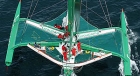
Aside from the mid-Vendee Globe mast rebuilding episode, Parlier's development of his latest catamaran, Médiatis Région Aquitaine, is perhaps another example of what an outstanding individual he is. The boat is certainly an interesting concept with stepped hulls like a seaplane or offshore powerboat (read our original feature about the boat: part 1 and 2) and no catamaran before with a mast stepped in each hull has been that great a performer.
Seeing the boat at the start of the Transat in 2004 it looked all wrong - while the 60ft trimarans gracefully swooped across the water, Parlier's catamaran was gouging great holes in it (see the video of this here), making for the wettest of rides in an extreme boat. And yet Parlier made it across the north Atlantic singlehanded, a feat every bit as amazing as Tabarly singlehanding his Whitbread maxi across to victory in 1976 or Pete Goss making it in a tiny Firebird catamaran in 1988.
After an aborted attempt in 2005 resulting in the capsize of his boat, this May Parlier finally demonstrated her real speed potential when he set a new singlehanded 24 hour record of 585 miles (read about this here). It is safe to say that Parlier must be one of the few individuals in the world who could have taken a concept as radical as Médiatis Région Aquitaineand made it a competitive ocean racing weapon.
Over last winter the team were busy at their base in Arcachon repairing the catamaranfollowing her capsize. Two new masts were built that were identical to the ones before except that the second reef and the ORC (storm jib) were made slightly higher. The main development work was made to the layout of the cockpits - putting in a seat for the helmsman and some much-needed plexi-glass protection. An automatic release mechanism was installed for both mainsheets and a waterproof computer display fitted in each cockpit to minimise the amount of time Parlier had to go below.
Parlier says that in general he is very happy with the overall concept of the boat. Although it can get loaded it is highly manoeuvrable and it feels safe. The principle change he would make if he were to build a new version of it it would be to have a cockpit slung centrally between the two cross beams. Aside from helping structurally and saving the weight of having two cockpits, this would be a great improvement in terms of actually sailing the boat. "The problem is the water. If you have a boat very wide and the cockpit in the middle you have no water and you can see the mainsail well upwind. When you are under the water [as they are at present] you don’t see the sail downwind so a central cockpit is a very good system for high speed."
With the singlehanded record in the bag, Parlier says his next attempt in the boat will be fully crewed. He made a spurious claim on the 60ft multihull record earlier in the year when he sailed 597 miles in 24 hours (the unofficial 60ft trimaran record in fact stands at 625.34 miles) but reckons there is considerably further to go. At the time of our conversation the record stood at 706 miles and Parlier was thinking about making an attempt on this next year. However now that Bruno Peyron has pushed this record up to a staggering 766 miles maybe this will not be so achievable in a 60 footer due to the sheer size differential between the two boats - Orange II has the considerable advantage of being 120ft long....
So now he has the singlehanded 24 hour record surely now is the time for Parlier to go up against the 60ft trimarans, by for example entering the Route du Rhum? "Yes I could, but I would have to change a lot of things. So I’m not doing the Route du Rhum. Last year after I had the accident [the capsize] we made a choice with my sponsor that I’d only do records - and my wife also!"
Parlier is also considering seeing the top speed he can get out of his boat on a short course. At present the top speed of Médiatis Région Aquitainehas been 41.8 knots when it was blowing 27deg from 115deg TWA. "We have never tried to go faster but we know sometimes we do more than 40 knots but we have never found the best conditions. We have to make tests for that and probably we can go to 45 knots. We need flat water and strong wind." To do this he would have to go to a special venue and he cites two examples as being Marseilles or the windsurfing mecca of Fuerteventura in the Canaries.

Ball of spray at the Transat start in 2004
Other more radical plans for the boat include seeing how well it works under kite power. "There are two solutions," says Parlier. "To keep the masts and have a kite and take off the masts and only have a kite. If we take the masts off we lose one tonne in weight." With the masts on he reckons they will sail on one hull, but the no masts solution might be better as it will keep the catamaran flatter while the lift generated by the kite would enough to make the boat skim along the surface of the water - in theory at least.
Parlier reckons that they will start work testing kite designs on their smaller test platforms back in Arcachon later this year. To advance this they plan to plunder kitesurfing technology - one of his design team, Romaric Neyhousser is keen on this sport and one of the young kite surf champions in France lives in Arcachon and can expect a phone call. "We will try to find a specialist to help us. There are some people who already work with that - kites for the cargo ships, etc. We don’t know yet much about that." However Parlier says there has been considerable development in the kites used by boarders, and their performance range has dramatically widened.
While it is tempting to imagine kite-powered craft only being able to go downwind at a rate of knots of course the principles work exactly the same as they do as sails, where the counteraction of forces between the sails and foils enables the boat to go upwind. Parlier reckons that they should be able to make much better progress upwind than a kiteboard, possibly as high as 40 degrees TWA. Parlier reckons he won't try this out in anger on the full-sized catamaran until 2008.

New multihull class
When we speak to Parlier it is in Gothenburg at the end of the Volvo Ocean Race, where he is in town to discuss with the 'Anglo Saxons' a new class of boat and race series he is planning.
In essence it is this: a one design 80ft long trimaran. This will be hi-tech yet simple compared with the present generation ORMA 60s. His boat will have a wingmast, but not one that cants, no lifting foils in the floats, no trim tab on the daggerboard, etc. Construction will be in carbon/foam as carbon/Nomex has proved too rigid for this type of boat. The boats will be built strongly enough and be of good enough quality to be capable of sailing around the world either non-stop singlehanded or fully crewed.
"If you make a round the world alone you can sail it non-stop and if you have six crew you make stops. That way you have the same sailing weight of the boat because with crew you have shorter legs and you carry less spares and less food and less diesel." The boat will be handful singlehanded but Parlier reckons it can be managed.
Obviously Parlier's scheme comes at a time following the success of Ellen MacArthur's 75ft B&Q Castorama trimaran and with two larger 100+ft incarnations of this boat now in build for Thomas Coville and Francis Joyon, both with round the world record breaking pretensions.
"For one designs we don’t need to make them as long as Sodebo or IDEC but I think we can have the same speed in the end because they have shorter floats and our boat will be lighter and more powerful," says Parlier.
The price tag on the new boat Parlier expected to be around 3 million Euros without sails. He imagines that the first suit of sails the boats will have will be Spectra, but he will relax the rule to allow 3DL for fully crewed races.
At present Parlier hasn't announced the designers of the boat, except that it is likely to be a team and he is still looking at different build options. One is to get a number of boatyards around France to build the various components of the boat and then to have a central yard assembling them. Another solution would be to build the components in France and then ship them to wherever a team wishes to assemble them. "The principle idea is to the have the same boats at the same weight at the end." He reckons the displacement of his new 80 footer will be around 10.8 tonnes.
The schedule at present is to have a boat launched by the end of 2007 with the first races in the beginning of 2008.
The big ground-breaking race for the fleet of boats will be around the world non-top singlehanded - a multihull Vendee Globe. It seems likely this would happen over 2008-9. From then on the circuit would consist of a round the world race once every two years alternating between solo non-stop and fully crewed with stops with a circuit in the Atlantic and Europe in between. Over the winters between round the world races he reckons they will have races to the southern hemisphere such as Africa or South America and probably in stages. While the class will be mainly offshore-focussed he expects them to hold Grand Prix in the stopovers a la Volvo Ocean Race
While a new era is dawning in the offshore multihull world, particularly with the 60ft trimaran class is at its lowest ebb, Parlier says he is not trying to kick the ORMA/MultiCup circuit while it is down. "I hope that goes on but we have difficulty because we know today how to make a trimaran very strong but with ORMA it is very complicated to change the rules and everyone wants different things and you cannot make decisions."
At a time when costs are spiralling out of control in the ORMA class, perhaps a one design fleet at a different size where costs are inherently limited is the way to go. A one design trimaran is also a much more likely way of getting non-French teams involved than the ORMA class, where teams will be starting from a much more level playing field. While the prospect of a round the world race in multihulls be it fully crewed or solo will have its detractors armed with strong arguments concerning safety, we think it an inevitable ultimate step oceanic racing must take and we congratulate Parlier for having the balls to make this proposition. We just hope that the design of the trimaran when it is finally revealed is not too wierd. A trimaran with hydro-planning stepped hulls for example might be faster and more ground breaking but we suspect won't see huge take-up among Anglo-Saxons.
Most Read
Most Commented
Comments
Businesses


Pro businesses
-
-
Italy
-
United Kingdom
-
Netherlands
Editor's choice
Member blogs
-
 Ned Collier Wakefield: MOD70 round BarbadosWell that was intense. 12 hard fought for seconds for the win. In idyllic conditions, Tony Lawsons MOD ...
 -
 Mini Transat leg 2 reportThe second leg of the Mini Transat started on 31st October, just over a month after ...
 -
Leg 1 reportI’ve been working towards the Mini Transat now for three years. In 2013 I was part ...
Business blogs
-
 The Island Sailing Club in Cowes, Isle of Wight, is delighted that Prince Michael of Kent ...
 -
Peta Stuart-Hunt chats with the 25 year-old British solo sailor Lizzy Foreman before she sets sail ...
-
The 2015 Student Yachting World Cup (SYWoC), an ISAF-recognised event hosted and run by students for ...
Editor's Choice
All time favourites...
-
 Three legs down into Ian Walker’s
 -
 Winning all but two races at
 -
 For the first time in its
Latest Comments
Add a comment - Members log in