
Three years, three round the worlds
Tuesday February 7th 2006, Author: James Boyd, Location: none selected
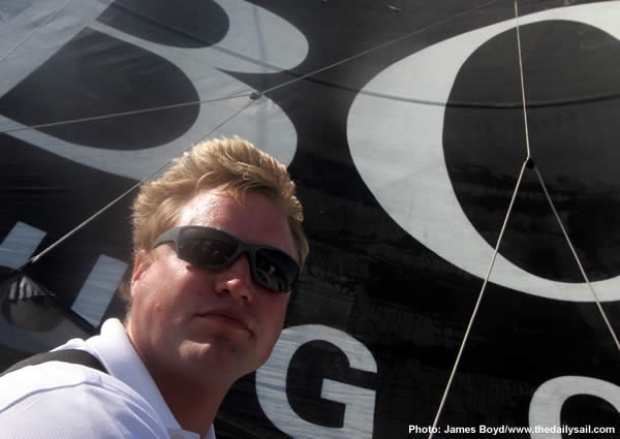
One of the most exciting projects in the UK at present is Alex Thomson's Hugo Boss Open 60 campaign. Thomson, the world's fastest singlehanded offshore sailor, has a highly ambitious program that includes a round the world race over the next three consecutive years and the building of a new Open 60.
Thomson has spent the last few weeks in Australia racing his Open 60 in the Rolex Sydney Hobart race and has been in Melbourne for the Volvo stopover and Skandia Geelong Week.
"I gave Boss the option of doing the Rolex Sydney-Hobart or doing the Transat Jacques Vabre and for them Australia is a good growing market and they preferred me to do the Sydney Hobart and that allowed us to do some good corporate work for them because the Hobart is a good challenging race to do," says Thomson.
While down here the team have also taken the opportunity to fit a new keel. Given the problems that have occurred to Open 60 keel foils over the last couple of years (read all about this here) - fabricated foils on Skandia and Ecover simply snapping and some horrific problems with the carbon foil on Roland Jourdain's Sill in the last Vendee Globe alone - this choice has not been an easy one.
Wisely or unwisely Thomson has opted for his new keel foil to be made of carbon fibre. "The previous keel was fabricated steel, that did the last Vendee. We had it fully checked before the last Vendee and it was okay, although it was coming to the end of its life. We did the Vendee and then when Nick’s keel [ Skandia] fell off we were sailing back at the same time and you suddenly start to think about every noise and crack you hear. And then Mike’s keel falls off [ Ecover] and I am sitting on a keel that’s older than any of them...! When I got home we took the boat out of the water and we had it ultrasounded and it had a crack. So when we came to build this new keel, because the fabricated one came to end of its life, we went carbon."
While Hugo Boss is a Marc Lombard design, the new keel has been designed by Simon Rogers. The change to carbon fibre from fabricated steel has saved around half the weight and this saved weight have been put into the bulb. The downside of fitting a carbon fibre keel however is its larger surface area and therefore more hydrodynamic drag. For Thomson, this is a necessary evil to give him peace of mind with regard to the strength of the foil.
In comparison Ecover is now fitted with a forged steel foil, as are the Volvo Open 70s. So why didn't he fit one of these? "This boat is already overweight. As with any metal you are going to suffer fatigue - you look at helicopter blades, etc they are all moving towards carbon. You suffer with a bit of surface area but you are gaining in righting moment and does that bit of surface area make any difference? I think it is miniscule and now I have a keel that will last me a life time - or until I stack it somewhere!"
In addition to changing to carbon fibre, the new keel foil on Hugo Boss is vertical as opposed to being raked back by 16 degrees. "The rake on the keel meant the boat was really good downhill, she sat bow up but when she was going upwind she was very bow up as well, so there was an awful trail of water out the back."
To compensate for this 1,000lt of water can now be brought on board in either one of two tanks in the stern of the boat (in addition to the 1,800lt of water that can be pumped up into either of the two forward tanks) to help bring the bow up when sailing downwind. "It has made the trim of the boat fore and aft correct in my opinion," continues Thomson. "It has made the boat slightly more tender off the breeze, because we’ve moved the pivot further forwards, but we expected that."
The difference is that there is now much more possibility of altering the trim of the boat fore and aft, a feature Thomson says we will be seeing more of in the new generation of Open 60s which may be able to take on as much as six tonnes of centreline water ballast - in addition to the canting keel. "Effectively you make the boat as light as you can and you double the weight of it with water," he says.
This morning Thomson left Melbourne to deliver the boat to the US via Cape Horn. The crew sailing with him include his shore crew of Simon Clark, Ross Daniel and Scott Gray (with the Volvo Keelboat Program). "The idea of the trip back is to do the part of the trip I didn’t do before [in the Vendee Globe]," says Thomson. "I could do it on my own, but I consider sailing alone is like sailing in a permanent crisis situation the whole time, so to do it with a crew allows you to develop some things and come up with new ideas for sails for the 5 Oceans and concepts for the new boat such as deck layout. If I sail back with my team so it allows them to understand what I go through so it allows them more ideas and makes them better able to prepare the boat."
Once around the Horn, Thomson will stop in to Punta del Este, Urugary where the crew will step off. "Then my father and my brother are joining me and we’re going to sail up to Newport, Rhode Island together," he says. Once in the US they continue their corporate work for Hugo Boss in Boston, New York and even Montreal before returning the boat to Europe to prepare for the Velux 5 Oceans starting from Bilbao on 22 October.
Aside from the keel foil, the only other changes Thomson says he is likely to make prior to the Velux 5 Oceans is lightning the boat. "For the Vendee Globe because of the lack of time we had we were trying to make it Alex-proof which is what we did. Basically we have come to the end of the modifications to this boat - there are not many other things we can do with it. We can lose weight as cheaply as possible and try and put in a strong performance for the race."
The issue over the Velux 5 Oceans has been competitors. Thomson has been a firm entry since the announcement of Velux's sponsorship. Just today Mike Golding and Bernard Stamm, winner of the previous race, have confirmed their entries in the race, so the field is looking a lot more promising. Conrad Humphreys still hopes to do it while Derek Hatfield's new Owen-Clarke designed Open 60 is still in construction. "There are a number of people talking about doing it," says Thomson. "The Velux 5 Oceans is a good training race for the Vendee. In comparison the Route du Rhum is quite a short race."
For Thomson the whole motivation is achieving a good result in the Vendee Globe. The Velux 5 Oceans is about completing the course he failed to complete in the Vendee Globe and getting a good result. "I look at what Clipper Ventures have done to it and they have got a good media plan, they have got a good broadcast plan, so hopefully there’ll be a good bunch of people in there."
By the time the Velux 5 Oceans is done and dusted in April 2007 hopefully Thomson's new Open 60 will be nearing completion. At present he says he hasn't decided upon a designer but we will know more in April. The new boat is likely to be built down under but will be worked up in Europe prior to the two handed non-stop Barcelona World Race starting on 11 November 2007.
Once the Barcelona World Race is over the boat will be put into refit and ready for the Transat in 2008 and the Vendee Globe the following November. "People say I might get tired of the whole thing. There is a good possibility of that, but I have set my mind that this is what I am going to do and I’m going to do it," says Thomson. "The best preparation for all these things is time on the water."
Aside from having an active calendar of events in which to compete, Thomson is in the enviable position of being at the heart of a class that is going supernova at present with nine new Open 60s in build and several more expected and names such as 2000 winner Michel Desjoyeaux, 2004 winner Vincent Riou, former 60ft trimaran skipper Marc Guillemot, Figaro winner Jeremie Beyou, another top Figaro sailor Yann Elies among those expected on the start line of the 2008 Vendee Globe. We understand at present there are 27 potential entries for the race.
"It is fantastic for the class," agrees Thomson. "IMOCA is managing it pretty well. It is becoming more professional. Hopefully there is a sponsor coming into the class. The level of competition is constantly going up and certainly for the next Vendee with all the new French guys coming in, there are going to be people pushing harder who know more about what they are doing and it is going to get harder and harder."
The only downside of the Open 60 class at present is that costs appear to be following the 60ft trimaran circuit and are also rising rapidly. Thomson says this is a function of the designs getting more complex and escalating construction costs. "I think the cost of carbon, the cost of materials and the cost of labour has gone up enormously. In France it is 40+ Euros per hour now. So I would probably look at building down here. The cost of labour is so much better. And you have to look at quality as well."
Most Read
Most Commented
Comments
Businesses

Pro businesses
-
United Kingdom
-
-
France
-
France
Editor's choice
Member blogs
-
 Ned Collier Wakefield: MOD70 round BarbadosWell that was intense. 12 hard fought for seconds for the win. In idyllic conditions, Tony Lawsons MOD ...
 -
 Mini Transat leg 2 reportThe second leg of the Mini Transat started on 31st October, just over a month after ...
 -
Leg 1 reportI’ve been working towards the Mini Transat now for three years. In 2013 I was part ...
Business blogs
-
 The Island Sailing Club in Cowes, Isle of Wight, is delighted that Prince Michael of Kent ...
 -
Peta Stuart-Hunt chats with the 25 year-old British solo sailor Lizzy Foreman before she sets sail ...
-
The 2015 Student Yachting World Cup (SYWoC), an ISAF-recognised event hosted and run by students for ...
Editor's Choice
All time favourites...
-
 Three legs down into Ian Walker’s
 -
 Winning all but two races at
 -
 For the first time in its
Latest Comments
Add a comment - Members log in