
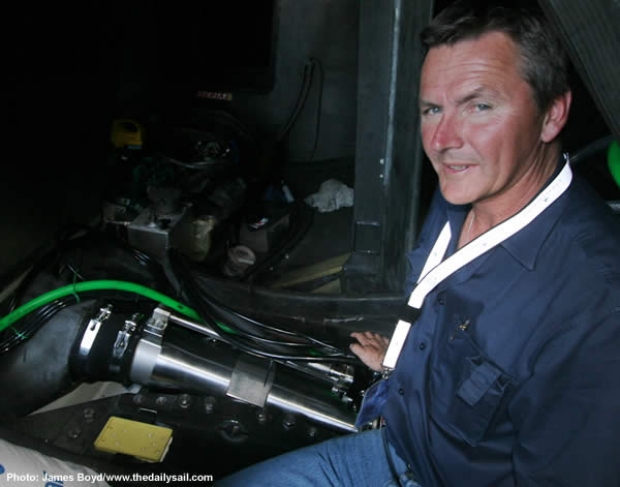
Push me-pull me
Tuesday January 31st 2006, Author: James Boyd, Location: none selected
Finally in Melbourne we have managed to track down a specialist supplier of canting keel hydraulics in Greg Waters, of Gosford, NSW-based company Central Coast Hydraulics & Engineering...
Waters has an extensive track records in hydraulics for yachts, despite this only dating back six years when he installed some sail handling systems for a large cruising yacht being built by Peter and Sari Ullrich's company Boat Speed, close to their HQ.
His first involvement with hydraulics for canting keels came with the launch of the maxZ86s Morning Glory and Pyewacket, which he designed the hydraulic circuitry for along with custom manufacturing the cylinders, hydraulic manifolds, etc. Central Coast has since between involved with almost all the canting keel maxis built in Australia including fitting the Cariboni keel canting system on the McConaghy-built Genuine Risk and their own home-grown products on the various Wild Oatses, including Bob Oatley's latest Rolex Sydney Hobart triple winner and Neville Crichton's Reichel Pugh-designed sistership Alfa Romeo. These later two boats represented a new step for the company who came up with all the valving that allowed the hydraulics to be operated by push-button, instead of a hand pump. Central Coast has also worked on or supplied the canting keel systems for Jean-Pierre Dick's Farr-designed Virbac and the Owen-Clarke Open 50 Artforms.
When it comes to the more serious business of Volvo Open 70 keel canting hydraulics, Central Coast have also supplied the systems and the stainless steel rams used on board Bouwe Bekking's movistar.
After the keel related issues of the last two legs, many teams are still making decisions about their canting arrangements and while Ericsson have chosen to rejig their existing titanium rams, on movistar skipper Bouwe Bekking has thrown the towel in with titanium rams and their appalling reliability record and is instead reverting to stainless steel rams, prefering reliability at the expense of a weight penalty.
The process of fitting a canting keel system to a boat involves extensive dialogue with the boat's designers, where the responsibility lies to come up with an anticipated load case, says Waters. They then together look at the spec of the system including cylinder size, the horsepower of the system, etc. There is of course the compromise to be made over the length of keel arm above the giant pin the keel rotates around. A longer lever arm requires less force to drive it but requires a ram with a longer (and thus heavier) throw as well as encroaching into the cockpit. "The problem is that the ram becomes so much longer that buckling becomes a very critical calculation," says Waters of this choice. "So there is a compromise all the time between length, weight and working pressure, etc."
In essence, Waters says the hydraulic systems they have created recently have developed only slightly since the systems they conjured up for the maxZ86s - after all hydraulics is hardly new technology, even if its application in this case is.
With some yachts, such as the maxZ86s and Artforms, they fitted single ram systems and on these the top of the keel was angled. This was to 'equalize the geometry' as Waters puts it, as well as a host of other reasons such as lowering the centre of gravity of this very heavy item.
On the Volvo Open 70s, the rule dictates that boats be fitted with twin rams for reasons of safety. Thus the boats have a ram mounted either side of the keel and the rams are speced so that in the event of one failing the other can drive the system on its own effectively. The problem with this - as Neal McDonald demonstrated with Ericsson on this last leg - is that if one ram fails, and the remaining ram is identical to the first then it is hard to have much faith in your remaining ram.
movistar was launched at Boat Speed hot on the heels of the ABN AMRO white boat early last spring. As with all Farr boats, she was designed to be fitted with carbon fibre rams, but at this early stage carbon fibre rams were not available and she was fitted with stainless steel ones. movistar then successfully sailed back to Europe setting a 24 hour record in the process.
When the carbon fibre rams did become available from a company in the US they were fitted in Sansenxo and lasted "scarcely 20 minutes" says Waters. "It was certainly an experiment and in the time frame we had they didn’t work. Basically everything was wrong with them. It became a mess very very quickly." The team changed back to their steel rams again.
While the rams are described as being 'carbon fibre; in fact they are more accurately 'carbon fibre-reinforced' stainless steel rams of a type presumably similar to those Isabelle Autissier experimented with on her Open 60 back in the mid-1990s.
"There was not enough time for development to get them up and running together properly," continues Waters. "There were many issues, but there was a fundamental design issue which needs a lot of research. You are mixing two materials together - carbon fibre and a metal."
Then in an attempt to ekk some more performance out of their boat movistar jumped on the bandwagon and just days before the start of the Volvo Ocean Race proper changed their well tried and tested stainless steel rams for titanium ones (not from Central Coast) in line with their fellow Farr boats. Thankfully before the start they ordered a second set of steel rams "just in case'.
While this seems like a rash move (which in the event it indeed proved to be) the weight saving was highly attractive. To give some idea: stainless steel rams each weigh 140kg, roughly twice the weight of titanium rams. Compared to titanium rams at 70kg a pop, carbon reinforced rams weigh around 55-60kg. Thus it is easy to see why the sailing team were so keen on using them. The present VO70 rams using on movistar have a 6in bore, while Waters says on the new Reichel-Pugh maxis, the bore is a whopping 10in!
After pulling out of leg one with structural problems around her keel area, movistar then suffered well documented problems with her titanium rams on the second leg. However contrary to other reports, Waters says it was the bolts on the 'front' side of the ram cylinder (ie nearest the keel) shearing off for reasons that still remain unclear. During this process they managed to lose some hydraulic fluid and were forced to top up with olive oil... "It worked fine for the short duration," says Waters. "We’ve taken the hydraulic system apart and apart from having horrible-looking oil in there it doesn’t appear to have done any damage."
Following leg two movistar has reverted once again to her stainless steel rams and is now fitted with one of her original rams on the port side and a brand new ram, a Mk2 of the original as Waters describes it, on the starboard side. In fact this differs little other than having more stainless componentry on it to reduce corrosion, says Waters. Under VOR rules stainless steel rams can be custom-built while titanium or carbon fibre ones must be off the shelf (manufacturers do make such products off the shelf for the aerospace and defense industries - only Cariboni, who have supplied ABN AMRO and Brasil1, have a 'dedicated' titanium Volvo ram package).
As we have mentioned the science of hydraulics is by no means new, and one would therefore imagine there not to be much variation between systems. However Waters says Central Coast's circuitry does differ from others (although he won't say how...)
One would imagine the basic components of the system to be similar from boat to boat. There is a donkey engine/generator and in the case of movistar this is mounted forward of the keel area. This is separate from the main engine that is beneath the forward end of the cockpit. The donkey engine drives two alternators and also the hydraulic pump. However under the race rules there has to be a separate system for driving the hydraulic rams and for this reason movistar has a DC electric pump mounted on a bulkhead on the port side of the boat. In addition to this they have a manual pump that would allow the keel to be canted from one side to the other in about 10 minutes says Waters. One imagines it might be possible to cant the keel using a hydraulic pump attached to the coffee grinders as the ORMA 60 trimarans use to cant hydraulically their rigs.
So why have their been so many failures generally with the hydraulic ram set-ups, we put it to Waters. "I think it is the search for the fine line between being the lightest and strong enough to do the job," he says. "The actual hydraulic component failure, valves, etc has not been an issue. The only problems they have had has been with lightly constructed rams chasing that fine corner to try and build the fastest boat."
Problems have been limited to rams themselves and the structure surrounding them. Waters also attributes this to the degree of guesswork going into the dynamic loads being applied to the boats. "Who really does know what the dynamic loads are?" he asks. "Until you start breaking them, then you can get some quantity of numbers. We know what has worked and what hasn’t worked, so obviously what is good is somewhere in between."
Waters also reckons that while titanium rams should certainly be strong enough, the ones being used simply weren't. "In my opinion, they should have been about 50% heavier, and even then, they would have saved a lot of weight in comparison with the ones we are going to mount now. Titanium has peculiarities that have to be taken into account when working with it, and it is better to make them a bit heavy rather than the ideal weight."
In essence their safety margin was insufficient. "This variable measures the number of times that can resist the theoretical pressure they work at, which, under normal sailing conditions is 35 tonnes for each hydraulic arm or 70 tonnes in all, but, on occasions, this figure is exceeded, for example when you fall over a wave, and that is when they are under the most stress. So: the titanium ones had a margin of between 1.5 and 2, while the ones we have mounted have a margin of between 5 and 6. So you could say that with the stainless steel hydraulic arms, we will triple the safety margin”.
Also the rams for the VO70s are being built for the ultimate offshore grand prix class and thus the strength:weight ratio of keel systems has been under much closer scrutiny, than say the maxZ86s, canting keel maxis or Open 60s.
The only other significant difference between canting systems is in their speed of operation. Open 60 or 50 keel systems don't require ultimate speed for example whereas all the inshore/coastal maxis take around 12 seconds to tack from one side to the other. This, we understand is around the same time as the ABN AMRO boats, but on movistar the keel takes 23 seconds to cant from side to side.
"That is purely down to horsepower," explains Waters. Movistar has a 20hp diesel donkey motor as this delivers the best compromise when it comes to fuel economy (carrying excess fuel equals carrying extra weight) but 20hp is not enough to achieve 10 second speeds. Not that this matters for the offshore legs, but for inshores it could play a major significant factor. Waters says that the system could be speeded up by driving the hydraulics from the main engine, but he is not aware of any Volvo Ocean Race teams having done this as this is not fuel efficient and also would require the whole spec of the cylinder to be increased again to accept more pressure in hydraulic system, more oil flow, etc.
See the video here of Greg Waters giving us a guided tour of movistar's ram set-up here. NB - this clip is 18MB in size and thus only suitable for downloading via quick broadband and then viewing in Windows Media Player. To view full screen (go on...try it) click Alt-Enter while viewing the video.
More photos on the following pages...
Most Read
Most Commented
Comments
Businesses


Pro businesses
-
United Kingdom
-
United Kingdom
-
France
-
Editor's choice
Member blogs
-
 Ned Collier Wakefield: MOD70 round BarbadosWell that was intense. 12 hard fought for seconds for the win. In idyllic conditions, Tony Lawsons MOD ...
 -
 Mini Transat leg 2 reportThe second leg of the Mini Transat started on 31st October, just over a month after ...
 -
Leg 1 reportI’ve been working towards the Mini Transat now for three years. In 2013 I was part ...
Business blogs
-
 The Island Sailing Club in Cowes, Isle of Wight, is delighted that Prince Michael of Kent ...
 -
Peta Stuart-Hunt chats with the 25 year-old British solo sailor Lizzy Foreman before she sets sail ...
-
The 2015 Student Yachting World Cup (SYWoC), an ISAF-recognised event hosted and run by students for ...
Editor's Choice
All time favourites...
-
 Three legs down into Ian Walker’s
 -
 Winning all but two races at
 -
 For the first time in its
Latest Comments
Add a comment - Members log in