
Fit for the Southern Ocean?
Monday January 2nd 2006, Author: James Boyd, Location: none selected
Leg two of the Volvo Ocean Race gets underway today with the fleet now back up to its full compliment of seven boats following the retirement of the
Pirates of the Caribbean and
movistar on the first leg.
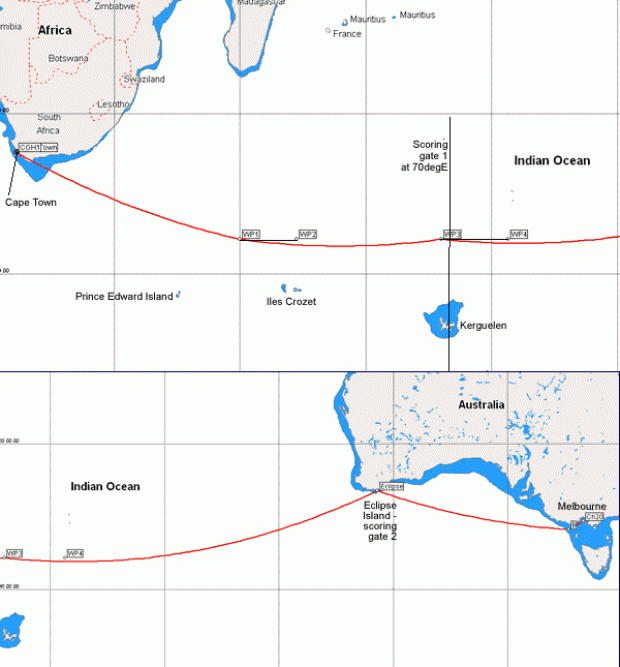
The course from Cape Town to Melbourne, in theory around 6,100 miles, takes the VO70s from Cape Town out round the Cape of Good Hope. From here the boats are expected to dive steeply south in order to hook up as quickly as possible with the strong westerly winds in the Roaring Forties. However the amount of exposure the boats will have to these bigger conditions has been limited for this leg by the race organisation's recent insertion of two ice gates both running along the latitude line of 42°S. Given that the centre of the Kerguelen archipelago is around 49°S and teams would normally have to decide whether they are going to leave this to port or starboard, gives some indication of the degree of the iceberg problem this year and the prudence of the race management.
"I remember eight years we went south of Kerguelen and we didn't see any ice on this leg," says Pirates skipper Paul Cayard. "It is cumbersome thinking about limits being placed on us, but if you start sailing through ice it is like playing Russian Roulette, although with pretty good odds, but you could lose a boat or a whole crew. So I guess I am okay with the ice markers. It will make the race course a little different, but it is the same for everybody and we'll just have to change our routing and strategy accordingly."
The new gates could considerably change the tactics for the opening stage of this leg although present routing still takes the boats south from Cape Town across a ridge on Wednesday before they get into the westerlies. As ever the question will be how far south to go before turning east and how much will the ice situation affect this decision. We could still see boats heading deep into the Roaring Forties before they hang a left.
Once they have dipped north of the first waypoint gate (they must cross 42°S somewhere between 45°E and 51°45E) the boats then continue on to the second which they must cross between 69°E and 77°E. Here they will also pass through the first scoring gate of the course along the line of longitude 70°E. This is the same longitude as Kerguelen, although thanks to the new gates the boats will be a whopping 430 miles further north of this.
Cape Town to 42°S 70°E is around 2,500 miles and from here it is another 2,270 miles to the second scoring mark of the leg at Eclipse Island just off Albany on the southwest corner of Australia. This mark was added for the last Volvo Ocean Race as a sop to the Australian rescue authorities following the series of deep ocean rescues they were forced to perform for Tony Bullimore and Raphael Dinelli in the 1996 Vendee Globe and of Isabelle Autissier in the previous BOC Challenge. The Volvo boats having to round Eclipse Island keeps them within relatively easy range of the local rescue authorities, although it does compromise the Southern Ocean element of the race as to get to the island at 35°S, the boats will have to sail out of the Southern Ocean, probably into the arms of the high pressure system that normally sits over southern Australia. Thus even if one boat pulls out a lead coming out of the Southern Ocean they are likely to fall into lighter winds approaching Eclipse allowing those astern to close up the concertina.
Round Eclipse Island, the boats then cross the Australian Bight to the entrance to Bass Straight a further 1,200 miles away and this will almost certainly see them diving south again to get into the stronger winds on offer in the Roaring 40s. Once into Bass Straight it is then a relatively short hop into Port Philip Bay and the finish line off Melbourne. It seems likely due to the compression en route up to Eclipse that there could be as tight a finish into Melbourne as there was into Sydney four years ago when five boats arrived within six hours after 6,500 miles of racing.
With the introduction of the new anti-ice gates so the leg time is expected to increase. Before it was announced teams were estimating the course to Melbourne taking 14.5 days. Since then there have been mutterings of it taking as much as 18.
One suspects that ice is not the only reason Volvo have added this waypoint. With the first leg claiming the scalps of two of the events' most high profile entries due to the structural breakage, the Volvo Open 70s are still clearly suffering teething problems - just as the Volvo Ocean 60s did when they were introduced for the 1993-4 race and suffered core shear issues - and the race organisation is understandably keen to minimise any further serious problems. A breakdown mid-Southern Ocean could easily turn catastrophic as Cape Town to Melbourne is potentially one of the most hazardous legs of the race.
Traditionally the Indian Ocean section of the Southern Ocean is the toughest part of any round the world race with the potential for boats to encounter not only strong westerly winds associated with the depressions that roar through the higher latitudes of this area, but also for a sharper more confused sea state than the longer swell usually found in the Pacific section of the Southern Ocean.
The question troubling many in Cape Town has been - are the new generation of canting keel Volvo Open 70s fit to take to the Southern Ocean at present?
Much blame for the technical problems so far experienced is being placed on the canting keel systems used on the VO70s. While canting keels are new to the Volvo Open 70 they have been successfully raced around the world since Christophe Auguin won the Vendee Globe with one fitted to his Open 60 Geodis in 1996. Numerous canting keel Open 60s have circumnavigated successfully since, although there have been exceptions such as the keel foils breaking on both Skandia and Ecover in the last Vendee.
However Open 60s to date have only been been raced around the world singlehanded and while pushed hard, are not pushed to the same extremes as fully crewed VO70s. They are also smaller and less heavily loaded than VO70s and designed to a rule which doesn't drive maximum weight to the bulb in the same extreme way as the VO70 rule does. For example while a VO70 bulb alone weighs somewhere around 6 tonnes, the all-up weight of an Open 60 is only 8-9 tonnes.
With the keel canting mechanism for a VO70, designers are pushed hard to make the best of the conflicting compromise between strength and reliability versus light weight, and this represents much more of a challenge than it does for the keel system of an Open 60: The keel canting mechanism and its surrounding structure are by far the most heavily loaded parts of a VO70. Once the breeze is over 20 knots the boats are often sailing faster than the waves and from time to time will find themselves launched. With the keel canted fully over to 40 degrees it is not unknown for both the foil and the bulb to become airborne as the 14 tonne VO70 flies over a wave crashing back down into the wave ahead. It doesn't take too much imagination to understand that the dynamic loads generated on the keel system in this scenario are enormous, potentially in excess of 100 tonnes. It is the first time canting systems experiencing these kind of loads have been raced around the world.
Fortunately to protect the hydraulic systems used to cant the keels from extreme loads they are are fitted with a release valve, so that when the load reaches a certain level the valve opens allowing the hydraulic fluid to escape from the rams. On ABN AMRO Two for example where the titanium Cariboni hydraulic rams (Cariboni are also used on Brazil 1) each have a breaking load of 200 tonnes, the release mechanism will trigger once the load reaches 120 tonnes.
It should also be noted that while the structural problems occurring to the Pirates and movistar were both keel related, they were otherwise unconnected: Pirates blowing one of the external fairings covering her keel pin (see photos here for explanation) resulting in a massive high pressure rush of sea water into her keel box, while movistar broke the substantial piece of carbon fibre structure upon which her starboard ram was seated, probably causing as a result the breakage to the aft bulkhead by the keel structure on the port side.
There is the tempting argument that the Pirates and movistar crews may have been pushing harder and broke because of this. It is certainly true when you examine the CVs of the crews on these boats that they have less experience in classes such as the Open 60s, 60ft trimarans and the G-Class maxi-multihulls: all high performance offshore boats where backing off when conditions become potentially boat breaking is a standard feature of how they are sailed. In contrast Volvo 60 sailors from the last race will tell you that they can usually count on one hand the occasions they were forced to slow their boats down because of conditions during the last race.
However the pushing harder theory is not obviously backed up when you examine the speeds of the boats that first night. Yes, Pirates and movistar were sailing fast - generally varying between 20-25 knots of boat speed until they broke at around 0500-0600 but this was the same throughout the front runners at this time. It seems most likely that movistar broke through fully launching herself off a wave and crashing down awkwardly while Pirates was a straightforward teething problem, the result of having sailed so few miles prior to the start. While the damage to the rudder and daggerboard tips and the keel foil indicate movistar suffered some sort of collision, it still seems to be unresolved whether or not this was a contributing factor to the failure they suffered. It is ironic that movistar, the only team to have tasted the Southern Ocean in their new boat prior to the start of this race, should be one of the two boats to have broken in the strong but far from extreme conditions over that first night.
While the pushing too hard theory may not have had a bearing on the Pirates and movistar incidents, it is still true that due to the 25% performance increase over their predecessors VO70s are more than capable of blowing up if pushed too hard. But by ''pushed too hard' what do we mean? Obviously all yachts have reefable mainsails and a range of headsails for different wind angles and strengths. The issue more precisely is when the sea state becomes too much for the boat to be sailed to its flat water VPPs.
Ericsson navigator Steve Hayles reckons that the VO70s are managable if uncomfortable upwind as you can slow them down to less than 10 knots, but the moment you slightly crack sheets it is a different story. "At around 60-70 TWA the boats will do 20 knots almost at the same angle as the waves and they won’t take that. No boat will take that. We are fortunate to have someone like Neal who has a decent naval architectural background and a strong idea about what the boat will structurally do. But it is hard for me to route taking into account when the boat is going to blow up. It is almost like you have to do the routing in the same way and then you modify it based on this extra information."
For this reason Hayles says they have been working hard to find a way of building sea state data into their routing. However this presents its own set of problems. Good quality sea state information is available in GRIB files (in the same way as it is, for example, for wind strength and direction) and this can be encoded to include swell, height, direction, wind waves, periods, etc. But what happens in the typical Southern Ocean example when a system passes overhead, the wind turns from northwest to southwest and you start getting a 90 degree cross-sea? "If you just sat there and said 'I never want to see a wave bigger than 5m' - well, I can write a piece of software for that and make sure the routing never takes you there, but that is not always the case because sometimes those 5m waves are exactly what you do want, but you need history in there as well. 'Significant wave height' is the average of the highest third, but it doesn’t tell you about the nature of that sea."
Interestingly ABN AMRO designer Juan Kouyoumdjian believes that the VO70s are not as vulnerable in the Southern Ocean as some might thing, thanks to their speed. "I think the Southern Ocean is not the nasty territory it used to be. I can understand why it had that reputation because crews used to go down there with heavy IOR boats or even Volvo 60s that did 15-18 knots downwind and they were surfing into these 23-25 knot waves, which means they were accelerating through the waves and were therefore very difficult to handle. These boats are always at 25-30 knots so they are much more in sync with the waves. So I think the Southern Ocean with these new generation boats is not really the trickiest part. I think the trickiest part will be after Rio, especially Portsmouth-Rotterdam. If the boats are going to break they are going to break there."
We have no doubt that as a design the VO70 is man enough for the job and, as we have said previously, Glenn Bourke and his team are to be commended for introducing such a ground breaking new boat. The argument that canting keel boats are unsuitable for being raced around the world is complete nonsense. The problem at present is one of teething problems on a new style of boat that is also the world's fastest breed of monohull, sailed by teams of highly competitive sailors, some of whom have not had enough sea time in their boats. In months or years to come we will wonder what all the fuss was about.
Most Read
Most Commented
Comments
Businesses


Pro businesses
-
United Kingdom
-
United Kingdom
-
-
United Kingdom
Editor's choice
Member blogs
-
 Ned Collier Wakefield: MOD70 round BarbadosWell that was intense. 12 hard fought for seconds for the win. In idyllic conditions, Tony Lawsons MOD ...
 -
 Mini Transat leg 2 reportThe second leg of the Mini Transat started on 31st October, just over a month after ...
 -
Leg 1 reportI’ve been working towards the Mini Transat now for three years. In 2013 I was part ...
Business blogs
-
 The Island Sailing Club in Cowes, Isle of Wight, is delighted that Prince Michael of Kent ...
 -
Peta Stuart-Hunt chats with the 25 year-old British solo sailor Lizzy Foreman before she sets sail ...
-
The 2015 Student Yachting World Cup (SYWoC), an ISAF-recognised event hosted and run by students for ...
Editor's Choice
All time favourites...
-
 Three legs down into Ian Walker’s
 -
 Winning all but two races at
 -
 For the first time in its
Latest Comments
Add a comment - Members log in