
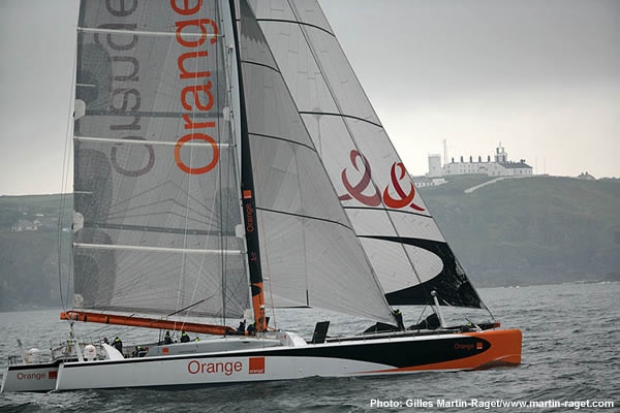
28.25 knots - average across the Atlantic
Thursday July 6th 2006, Author: James Boyd, Location: United Kingdom
Bruno Peyron and his crew on board the maxi-catamaran
Orange II this evening smashed the 4 day 17 hour 28 minute and 6 seconds belonging Steve Fossett and
PlayStation for the west to east crossing of the North Atlantic between New York and the Lizard.
Having passed the Ambrose light at the entrace to New York Harbour at 11:06GMT on Sunday 2 July, Orange II reached the finish line due south of the Liizard at 18:22 GMT this evening making her passage time a formidable 4 days 8 hours 23 minutes and 54 seconds, some 9 hours 28 minutes and 12 seconds faster than PlayStation's record (note this times are unofficial and await ratification from the WSSRC, who had timer Roger Armstrong down on the Lizard armed with stop watch and binoculars).
This makes her average speed for the 2,925 mile crossing a whopping 28.25 knots. Already Fossett's average speed across the Atlantic was 25.78, giving some indication of the extreme pace the big cat was travelling.
Orange II made an attempt on the transatlantic record when she was fairly new out of the box back in 2004 and on that occasion was a frustrating 30 minutes outside of PlayStation's time when the wind dropped off towards the finish (to read our interviews with Steve Fossett post his record click here and Peyron have his 2004 click here). However on that occasion the saving grace was becoming the first boat to take the outright 24 hour record above 700 miles, the team setting a new benchmark of 706 miles. This stood until earlier this week when once again Orange II set out on her record attempt and within the first 48 hours had managed to cover 766 miles in 24 hours or an average of 31.9 knots...
So how come they have found such new pace we asked the maxi-cat meister himself earlier:"We have found a few new tricks. We are not still at the maximum as you notice but it is still very fast."
So - the weather or the boat? "The weather was quite normal," says Peyron. "It wasn’t up to the same level as PlayStation because we have been obliged to do a lot of manoeuvres and sail changes, about 20 of them. The PlayStation weather was better because they crossed on one gybe without any manoeuvres. But the boat is definitely faster and the crew are now very much getting the right level of knowledge and that is the reason why we can get the maximum out of it."
Peyron says they have made a few changes to the boat which he won't talk about. We know that they went with the same mainsail they used on the Jules Verne Trophy but did put on a new staysail and two gennikers. The boat was lightened considerably prior to the Jules Verne Trophy attempt they completed last March when they set a new record of 50 days 16 hours and 20 minutes, 12 days 21 hours faster than Geronimo's record for the course and 7 days 17 hours faster than PlayStation's WSSRC-sanctioned record (read about this voyage - here)
"We removed a lot of weight and not too many spare parts and took no sails we wouldn’t use," continues Peyron. "So we were as light as we could be."
One of the biggest increases in performance we suspect has come from the drivers Peyron took with him this time including Banque Populaire skipper Pascal Bidegorry and French Olympic Tornado sailor Yann Guichard and Open 60 sailor Bernard Stamm. Stamm was part of Peyron's Jules Verne Trophy crew along with navigator Roger Nilson, Ronan le Goff, Florent Chastel and Jean-Baptiste Epron, Additional muscle for this transat came in the form of sail maker supremo Jean Baptiste le Vaillant of Incidences La Rochelle, multihull veteran Jacques Caraes, and Ludovic Agloar and Clement Surtel who were both part of the shore team for the Jules Verne attempt.
"I choose to make the team this time with a little more aggressive profile, due to the profile of the Atlantic compared to the round the world of course with very good helmsmen and very good performers and the same very good guys on the deck who make another very good team," says Peyron.
With multihull sailing a great deal of the performance comes down to bottle - ie confidence and familiarity with one's craft and since their attempt in 2004 Peyron says they have sailed the equivalent of one and a half times around the world. "Yes, we have a lot more confidence and we can push harder with the same level of safety of course. We took a few risk more than on the Jules Verne of course because it is not the same game and we pushed hard."
Peyron says that even he was surprised by their 24 hour record, particularly so as they had not yet reached the Gulf Stream at this stage. "It was too bad we hit this little growler or ice or something because the Gulf Stream arrived the day after which would have improved this number."
So would 800 miles be possible? "It is a very new idea. If you had asked me this question last year I would have said 'no way'. But now it is very different and I really believe it is not far away."
On maxi-catamarans, particularly enormous ones like Orange II with huge freeboard it is very difficult to get an idea of speed, in fact there is no sensation of going fast at all until you reach about 25 knots or there are some waves. Even at 35 knots - Peyron says the ride didn't feel very special "certainly no more than during the Jules Verne". We were trimming better, pushing hard and there wsa a lot of concentration, like usual – nothing special. We were just faster and it works. That’s all. Of course it is very impressive. You just see the speedometer always between 33 and 36 knots, occasionally 37 and this for something like 40 or 50 hours - that is very impressive! It is not like when you have a few surfs to 40 knots. We have been up to 41 but I don’t care. What is important is being all the time between 31 and 36.." Their best hour's average he says during the 24 hour record day was 37 knots..."We were on the edge, or under the edge but we were always in the feeling of having control. You know how I like to sail - I know when I want to push hard and I know when I want to lift a little bit the foot. It was just pushing hard but with a real level of awareness about the safety."
The collision with the unidentified floating object, took the bottom few inches off the bottom of the port (leeward) rudder and following this incident Peyron placed a speed limit on the boat of 30 knots, which he describes as being like trying to cross the ocean with the brakes on. The incident took away the tip of the rudder but left the stock and it is believed that the speed of the boat has been slowly eroding the remainder of the blade - crossing the Atlantic with a rudder that's getting progressively smaller...
With Playstation's weather and no rudder issues Peyron believes a record time below four days is more than possible. Even on this occasion without the ideal weather the routing was showing a cross of around four days prior to the incident.
Celebrations were going on at Chantier Multiplast in Vannes this evening, the yard where Orange II was designed and built having won their record back (prior to Fossett holding it, it had for more than a decade been held by Jet Services V (latterly Peyron's Commodore Explorer.)
"We are happy because we are always doing the same job," designer Yann Penfornis told us. "We start with one step and we work to deliver the new generation. It started with Commodore and we ended up with Club Med and then we had a long think about everything and then we did Orange II - a longer boat with a bit more freeboard, higher beams." An evolution of Orange II is in the pipeline too - a 41m long catamaran (5m longer than Orange II) which they are hoping will be the new Banque Populaire maxi-multihull. At present Bidegorry (who was sailing on board Orange II for this transat) has asked for design proposals from them, Nigel Irens/Benoit Cabaret and Van Peteghem/Prevost. Most recently Multiplast launched Franck Cammas' new Groupama III maxi-trimaran and on the cards now they have.
Penfornis says they have made no modifications to Orange II over the course of this winter but points out that since the last Transat record attempt then they have fitted new rudders. "They didn’t have enough aspect ratio and they weren’t happy above 32 knots. For the Jules Verne record they had different rudders which made for better manoeuvrability and made it safer - when you go over 40 knots it is good to know the boat will react."
To give some indication of how fast Orange II's transat record and her average speed of 28.25 knots is - the Queen Mary which held the Blue Ribard record for the west to east Atlantic record under until 1952 power was 31.69 knots....The Cunard liner Mauritania which held it until 1929 only managed 26.25 knots....
Our congratulations go to Bruno, Orange and the team.
Most Read
Most Commented
Comments
Businesses


Pro businesses
-
United Kingdom
-
-
Netherlands
-
United Kingdom
Editor's choice
Member blogs
-
 Ned Collier Wakefield: MOD70 round BarbadosWell that was intense. 12 hard fought for seconds for the win. In idyllic conditions, Tony Lawsons MOD ...
 -
 Mini Transat leg 2 reportThe second leg of the Mini Transat started on 31st October, just over a month after ...
 -
Leg 1 reportI’ve been working towards the Mini Transat now for three years. In 2013 I was part ...
Business blogs
-
 The Island Sailing Club in Cowes, Isle of Wight, is delighted that Prince Michael of Kent ...
 -
Peta Stuart-Hunt chats with the 25 year-old British solo sailor Lizzy Foreman before she sets sail ...
-
The 2015 Student Yachting World Cup (SYWoC), an ISAF-recognised event hosted and run by students for ...
Editor's Choice
All time favourites...
-
 Three legs down into Ian Walker’s
 -
 Winning all but two races at
 -
 For the first time in its
Latest Comments
Add a comment - Members log in