
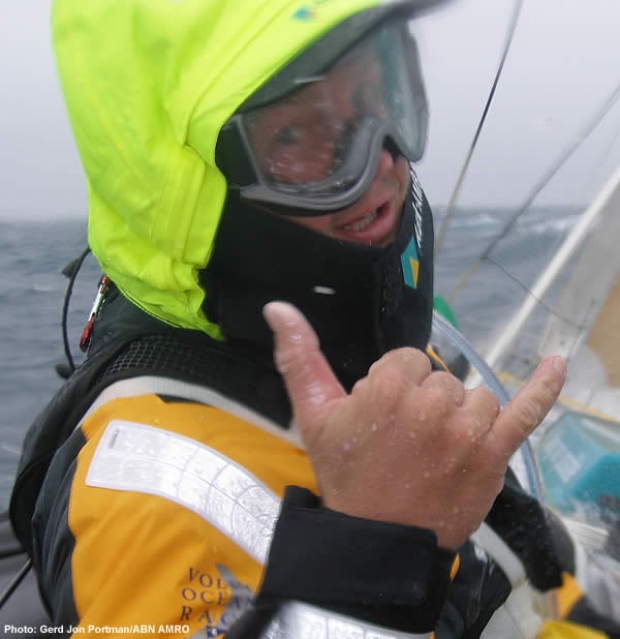
A view from the nipper
Friday February 10th 2006, Author: James Boyd, Location: none selected
Four years ago Kiwi sailor Scott Beavis was the nipper of the Volvo Ocean Race, bowman/trimmer on board Gunnar Krantz' promising but ill-fated
SEB. Appropriately perhaps four years on and now the grand old age of 26, this is now the name of Beavis' skipper aboard ABN AMRO Two, where Beavis has graduated back to the blunt end of the end of the world's fastest offshore monohull as watch captain.
thedailysail: Compared to the SEB experience, how are you finding ABN AMRO Two? Have you got used to it?
Scott Beavis: We are definitiely figuring out how to sail it and how to sail it our way [to find out more about this see our interview with Simon Fisher and Seb Josse here]. I think we sail our boat differently to how the older guys do and how the Farr boats sail. A lot of that comes through Seb’s leadership and his way of sailing.
TDS: Do you find his style pretty foreign to you?
SB: I am not super old so I haven’t had my ways set in concrete. Seb can look at the weather three or four days in advance and say okay in 24 hours we’ll need to push pretty hard. So until 20 hours time stay on this sail. Maybe we’ll miss out a sail change out and just chop out a gear - sail changes on these boats are just so painful. We do big bear aways all the time. I think it helps me being an ex-bowman knowing how hard it is up there for the guys. We make big allowances on our course when we are steering. During a sail change, we’ll steer down to 140-145degT, drop the sail, get the new one up trim it in and then come back up on course.
TDS: With the fleet hopefully getting more competitive will you be able to continue sailing that way?
SB: The reason we are where we are is because of the reliability issue. Maybe the other guys will figure out this is the way you have to sail these boats. We have been on the water longer than anyone else and we have done sail tests and peels against the other boats and we’ve figured out what is fast and what is not. Obviously it is risk v reward. How much you bear away to save the sails and make it easier for the crew and how much you come up and get everyone wet and damage the sails. There is a trade off and it is a fine line to walk.
TDS: What been the most hairy moment for you so far this race?
SB: The first night out of Sanxenxo is the only time I’ve felt a bit pensive. We lost our wind gear early on so we didn’t know how much wind there was. The forecast was supposed to be for 35 knots and in Cape Town people said they had 45 knots. So we had too much sail area up for sure, but it wasn’t that out of control. It was quite scary going down the waves, a lot of water, but we’d all been briefed about how you clip on or basically you are going to die on these boats, because they are so hard to turn around.
TDS: In this respect is the safety better in this race do you think?
SB: For sure. Definitely. It is so hard to turn these boats around. It is hard to sail them in a straight line let alone when you are reaching along at 25-30 knots when you have to turn around to find a guy. It is scary. So as we say 'clip on - or you’re going to die basically'.
TDS: What's the most wind you've seen in this race so far?
SB: The first night, 45 knots, but we only saw 22 knots on the dial.
TDS: How does this compare with the last race?
SB: In that race a couple of nights out into the Biscay from the start, when we broke our headboard car, it got pretty breezy. In the Southern Ocean we had a couple of 47 knot squalls come through, that was scary because you had to push. But who knows what is going to happen this time?
TDS: So is it more scary sailing the VO70?
SB: I wouldn’t say scary. The consequences of how fast you are going are scary. The actual boat is not that scary. You are going fast all the time, but you feel happy, you are in control. It is not scary sailing, but it is what can happen if it can go wrong. If it goes wrong, it goes wrong bad and that is in the back of everyone’s mind so there is some nervousness there.
TDS: Surely you feel the brute force of the boat, doesn't this make the VO70 ride more comparible with the new 100ft maxis?
SB: Yes, but I don’t want to sound blasé but you kind of get used to sailing at 20 knots. It was a big boat when I first hopped on it as the 60 was a big boat when I first hopped on that. You get used to it - the way of the sails, you know how much the rope’s loads are. Now sailing below 20 knots feels slow now, so we are pretty spoiled."
TDS: Presumably it is harder for the bowmen on the new VO70s?
SB: Maybe that is the impression people get, but on our boat the sailing seems to me to be a lot easier purely because we do slow down for sail changes. On the 60s you couldn’t give an inch away you never bore away changing from one reacher to another, you’d stay on course with all the water coming down the deck and it would be impossible to move the sails forward.
TDS: Have you injured yourself during this race? Do you think there are generally more injuries this time round?
SB: Nothing major - just a few cuts and scrapes. I think there are more injuries, just from the amount of water and how fast it is coming at you. We have adapted our way of sailing to try and prevent injuries and damage to the sails and deck gear, and we have also taken a lot of action as well. That first night on the first leg we all got washed around and a bit scared and we all got beaten up because of that. So now we have stoppers in our jacklines. Instead of just clipping onto jacklines you clip on to padeyes so you can only travel 1.5m. We think about it a lot.
On the foredeck Jonny and the other bowman they just hang on. They have a bowman’s harness and they have mid-long strop which is long enough for them to crawl around on the foredeck. On the helm you tether straight into the middle of the wheel or onto the windward runner because it has a spike on it, so that if the cable breaks you can run to the leeward wheel.
The trimmers wrap their tether goes around one of the winches like the forward winch and they pull back against it so they are already at max extension. Normally it is the windward runner winch, clip it on to itself and back around. The grinder hangs on and has a strop going through their legs tucked out behind you.
TDS: You've not had that many serious injuries on board.
SB: We have had a lot of injuries but Timo has noted our crew is the least injured out there and a lot of that comes from the way we sail the boat.
TDS: We understand you might be changing the watch system? Seb doesn't feel you need so many people on deck for the majority of the time...
SB: We are looking at changing it a little bit into more of a rolling system. On the way to Wellington we are going to stick to the same watch system where you have a watch captain and a bowman paired together and a trimmer and pitman. Then we are changing the rolling system so there are three definitely on deck and then the stand-by guy who is ready to go all the time.
We have found that we can do pretty much anything we need to do ie reefing or small sail changes like the staysails, with four guys on deck and that is enough. After that anything else is a major and we get everyone up. So we figured there wasn’t a need for the stand-by guy. And on a colder leg it will keep everyone out of the cold as much as possible. And the way we are sailing the boat we don’t need that fourth guy on deck when we are reaching along. With the spinnaker up you need two grinders, but anything else one is enough.
TDS: Aside from being a watch captain do you have any other responsibilities?
SB: I’m in the charge of the rig. I am a sailmaker by trade but there are enough sailmakers on board that we decided they could look after that and there was a hole in the rig program and I am quite interested in that side of things, so I put my hand up.
TDS: How separate is the white boat program from the black boat?
SB: They leave us a pretty long leash to do what we want within reason. We always bounce ideas off them before we start trying stuff. A few things are starting to appear on their boat which we’ve figured out on our boat. So it is nice to see that, you are at the right level and you have good ideas which are worthwhile.
TDS: How is it being part of an under 30 team?
SB: We don’t really feel we’re that inexperienced. We’ve sailed the boat quite a lot. The only time we’re going to have a problem is if we drop a rig or the keel falls off or we flip or roll where we haven’t experience it. That scares me a little bit, if something like that happens - whether we can take it on and deal with it. When things like that happen you have to rely in instinct a lot and that comes down to experience. But hopefully we don’t see that. As far as sailing the boat now we are as happy as anyone else out there.

TDS: Do you think you have an opportunity to better your 24 hour record en route to the Horn?
SB: There is an opportunity if the weather sets itself up again. Half way through the day [when they set the record on leg two] we reckoned we were fast enough to do something here. I don’t think we changed our course or our way of sailing. I think we would have pushed as hard as we did during the race or had we been on ourselves out there trying to beat the record. Hopefully we’ll get another chance of doing it. I think 600 miles are possible in the right conditions, bigger waves. We don’t need any more wind. 35 knots is more than enough wind.
TDS: What do you think of the canting keel - how does it feel different?
SB: Does it make the boat feel different. It has a little bit of a funny motion. Also when you are reaching above 120deg when you have no daggerboard down and the keel is at max cant it is nice just to slide the boat down the wave. It is the most awesome thing. We have this thing on board called 'crab walking' where you take off down a wave you are chasing the apparent so much you end up getting caught going sideways and the only thing that brings you back is when the windward rudder bites - it is a lot of fun doing that! It is nice to have such control that you can throw the boat around as much as you want.
TDS: With the twin rudders there is less possibility of broaching? Have you broached yet?
SB: Not a major one, a little skid here and there. It is amazing how much control you have. When we started sailing the boat we used to hear the cavitation on the rudder and everyone would freak out and ease the main and stuff, but now - off you go and you get used to it. And you find your limits. With the rudders it is a little bit sketchy in that when you are sailing downwind in a bit of breeze and you roll a little bit to windward the windward rudder bites and you get a couple of degrees more helm. So it does take over a little bit, but as long as you know where you are at heel-wise and you start correcting before it gets too far over and does the big S-bend.
TDS: Have you sailed the boat with the keel down to leeward?
SB: In light winds, but not really. Maybe 5 degrees to leeward. But I don’t think we’d ever fully cant the keel to leeward.
TDS: You obviously have one tonne of water ballast inside the transom - does that make a difference?
SB: When you are into the top end of the downwind sails, it definitely helps with the nose diving. Our boat is probably the fullest boat in the fleet apart from the Australian boat. So you notice it for sure and if you don’t need it in and you’ve got it in, it feels really sluggish. But when you put it in it loads up the helm quite a lot because it pushes the back in a bit.
TDS: Do they go upwind as well as the VO60s?
SB: Yes - they are so much faster and they point higher. Everyone says they have positive leeway, but I can’t see it. I think zero leeway or maybe one or two. It is a nice feeling. And having that canting keel, seeing the bulb sitting next to you when you are driving that’s cool.
TDS: The ABN AMRO boats also have the biggest boards? Do you need all of that?
SB: Juan thinks so. They are big and we do have to look after them a little bit more because of the loads and forces on them. If we are slamming on waves we lift them up a bit to take some of the sideways force off them. But when you are in 15 knots sailing upwind, full powered up and fully stacked it is a nice feeling...
Most Read
Most Commented
Comments
Businesses


Pro businesses
-
France
-
Italy
-
Italy
-
United Kingdom
Editor's choice
Member blogs
-
 Ned Collier Wakefield: MOD70 round BarbadosWell that was intense. 12 hard fought for seconds for the win. In idyllic conditions, Tony Lawsons MOD ...
 -
 Mini Transat leg 2 reportThe second leg of the Mini Transat started on 31st October, just over a month after ...
 -
Leg 1 reportI’ve been working towards the Mini Transat now for three years. In 2013 I was part ...
Business blogs
-
 The Island Sailing Club in Cowes, Isle of Wight, is delighted that Prince Michael of Kent ...
 -
Peta Stuart-Hunt chats with the 25 year-old British solo sailor Lizzy Foreman before she sets sail ...
-
The 2015 Student Yachting World Cup (SYWoC), an ISAF-recognised event hosted and run by students for ...
Editor's Choice
All time favourites...
-
 Three legs down into Ian Walker’s
 -
 Winning all but two races at
 -
 For the first time in its
Latest Comments
Add a comment - Members log in