
Vincent's vision
Tuesday August 15th 2006, Author: James Boyd, Location: France
If getting ahead in offshore yacht racing is all about experience and preparation, then Vincent Riou and his latest
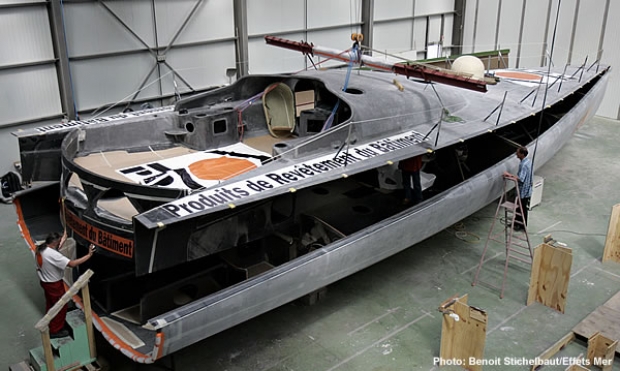
PRB Open 60 are in good shape. Down at CDK Composites in the Figaro class stronghold of Port la Foret the new boat is just over a month away from being launched when we had the opportunity to crawl around her. Along with Dominique Wavre's new Owen Clarke-designed
Temenos - currently deck cargo en route to Europe, the new
PRB will be one of the first new generation Open 60s to be launched and we can expect her to be followed by as many as ten others over the course of the next two years in the build up to Vendee Globe 2008.
To recap - the grey haired, bespectacled Vincent Riou for the 2000 Vendee Globe worked as technical manager for Michel Desjoyeaux's winning PRB campaign. Four years on with Desjoyeaux having moved on to his Geant 60ft trimaran Riou was given the opportunity to defend Desjoyeaux's title in the Vendee Globe, a feat he achieved in style - to win with a five year old boat came as something of a kick in the teeth to the skippers sailing new boats in that race.
While it would be nice if Sam Davies could post a third win aboard the old PRB (now Roxy) in the next Vendee Globe, Riou reckons it will be the last time we see an old generation boat winning the race. "I think it is more and more the case in the future - if you don’t have the best boat you will have little chance to win."
This time around Riou remains with Desjoyeaux's company Mer Agitee (read more about this company here) and he and Desjoyeaux both have new boats from the drawing board of Farr Yacht Design. Farr also have boats in build for last year's Solitaire du Figaro winner Jeremie Beyou and Virbac Paprec skipper Jean Pierre Dick.
While back in 2000 Michel Desjoyeaux told us that boats such as PRB and Kingfisher that had come out on top of that Vendee Globe race were not the most powerful competing but were the boats sailed most efficiently, the new generation Open 60s for the 2008 race look set to counter this trend. That a new breed of Volvo Open 70s has slipped in between this last Vendee Globe and the next, all with substantially larger budgets than Open 60 campaigns, is something that has been not lost on the Open 60 fraternity. Regardless of the designer, we can look forward to a new generation of boats featuring more sail area and to counter this brutally more righting moment derived from hull form, water ballast, bulb weight and keel canting angle than we have ever seen before. The new generation of boats we can expect wil be a more substantial step on from the 2004 generation boats, than the 2004 boats were from the 2000 ones.
The old PRB was a typical Michel Desjoyeaux oddity - a boat designed by Groupe Finot but using the deck mould from the Lombard-designed Whirlp ool / Sill. This time the choice to go with Farr was twofold says Riou. "When I came back [from the Vendee Globe] we had discussions with PRB who said it was possible to make a new boat. We had two options - to go back with some sort of team led up by Finot or to go with Farr. PRB wanted the new boat to race in the Route du Rhum and it became quite obvious that we weren’t going to have time to design a boat [with Finot] in time, while Farr had already been doing some design work and research." While Jean-Pierre Dick's Virbac, the first Farr Yacht Design Open 60, didn't make the podium in the last Vendee, the boat had proved herself to have potential and a good all-round performance winning the monohull class in the last two doublehanded Transat Jacques Vabres.
Riou and his Project Manager Gregoire Metz are keeping tight lipped about exactly how much more powerful the new PRB will be compared to the last or even compared to Virbac - other than it will be more. Boats out of the water do appear bigger, but even so the new boat does appear to have more beam compared to the old PRB (5.4m), Virbac (5.5m) and is more in the region of Ecover (5.75m) or even the 1990 generation Groupe Finot boats that were close to 6m. "When you run the VPP that is what everything tells you – go for more power," said Metz. "I would say that everybody will be going to 95% of the [potential of the] boat. In the last Vendee you had it, but in the ones before that they were like an adventure. Now it is more like a long Figaro race so that 2-3% improvement you will get in the new designs will make the difference." Significantly the boat also has a chine in its run aft like the 2004 generation Lombard Open 60s and some of the Volvo Open 70s.
Over the last decade the performance characteristics of Open 60s has evolved. Back in the 1990s the boats tended to be fat arsed reaching machines, but since showing a tendency to turn turtle and stay that way in the late 1990s, beams has been going down while since the 2000 race their upwind has been developed. While Open 60s need reaching power to go fast in the Southern Ocean, they also must still perform on the Atlantic legs where according to Riou in the last Vendee Globe he experienced 10 days of upwind sailing. This time round and particularly post Volvo Ocean Race we can expect this trend towards better upwind performance continue with boats having the ability to sheet headsails at tighter angles, while the most tell tale sign will be the length of the daggerboards.
PRB obviously has a canting keel and will have twin asymmetric boards. Like Virbac these boards will be more vertical (ie less toed out) in the boat than those on other design and this has been confirmed by Farr's Volvo Open 70 research. As Farr's Patrick Shaughnessy explained it to us: "Tanking testing we have done about canard positioning and angle tell us that a relatively upright canard when the boat is heeled produces some lift and keeps the bow up reaching. So when you go reaching you have a choice - if you want to create up a bow up attitude you either do it with volume in the forward bow sections or you go around looking for lift somewhere else. In your canard, keel and rudder you can affect the attitude of the boat high speed reaching."
While in the past performance in the Vendee Globe has all be about the potential of the skippers, with more and more Figaro sailors coming into the class, such as Jeremie Beyou and Yann Elies, Riou reckons that the boat will once again become an increasingly important part of the equation. "You see this becoming more and more professional now. You can expect the guys to be at a similar level with all the Figaro racers who are very good coming into it. So then the little percentage improvements in boat speed you boat will have could make all the difference." Riou reckons that in the last Vendee Globe on average he was pushing the boat at 80-90% of its polars. "Sometimes 100%, sometimes 60%....From Cape Horn back to home? 110%!"
However this still assumes that the skippers will be able to up their own horsepower in order to handle the increased power, this is not so much for trimming but the energy expended reefing and changing sails. For example we have heard of no new labour saving devices to handle the biggest sails other than bigger winches. Patrick Shaughnessy confirms that generally loadings are up on their new 60s and winch sizing the systems has increased accordingly.
One of the most obvious differencies with PRB is the new cockpit layout which is part old PRB, part Virbac. Firstly the cockpit is both deep and is effectively open ended, with the same semi-circular main sheet track from Riou's previous boat. Once upon a time the cockpits on Open 60s were tiny and enclosed the idea being that the skipper would have less distance to travel in the event of a fall and also less opportunity to fall out of the cockpit. "The small cockpits - they are like a swimming pool," says Metz of why this development has occurred. "You don’t fall out of it - you float out of it!" This is particularly true when there is considerable rope lurking in the cockpit ready to block up cockpit drains. PRB's open ended cockpit allows water to disappear unimpeded over the transom. However the boat has very much more protection than a VO70 with a substantial cabintop. This cabintop is much sleeker than Virbac's and this combined with the boat's substantial deck camber should be enough to comply with the IMOCA Open 60 class stability rules that demand the boat to be rightable from a complete inversion.
The cockpit will also a feature a coffee grinder, winches positioned closer to the front of the cockpit in an attempt to centralise weight, while there are two hatches to enable Riou to get down below, from the high side. The twin companionways also allow all the lines from the mast to be led back through a tunnel within the cabintop between the doors and out into the cockpit where they are handled by a central ultility winch.
Although it was obviously not fitted when we had a look at PRB, the new boat will feature a rotating wingmast with deck spreaders. This is unusual as effectively this technology has come full circle. When Yves Parlier first fitted deck spreaders to his Aquitaine Innovations Open 60 prior to the 1996 Vendee Globe the idea was to use the unusual looking trawler-style spreaders to widen the shroud base thereby reducing weight aloft both in rigging and in the mast. Since then evolutions have included a wingmast fitted with no spreaders (on Sodebo) and even PRB's first rig used in the 2000 Vendee Globe was a wingmast fitted with hinged spreaders as had been previously used on Tony Bullimore's ill-fated Exide Challenger ketch in the 1996 race. When PRB was dismasted Riou refitted her with a standard low weight, fixed mast configuration.
"All the designers today say that the wingmast is better - I have no opinion," says Riou. "I think the new boats will be faster so aerodynamics will be more important for the next generation, but I am not sure. I think today still nobody knows what is the best." As to the deck spreaders Riou feels it is the best solution for holding up a wingmast as they can also be used to sheet headsails.
While skipper potential and boat speed are vital, equally important in the Vendee Globe is reliability. Fortunately Riou is in a good position to tick this box. With effectively two Vendee campaigns under his belt he has the technical experience to develop a boat like this and this, he points out, is where the newbie Open 60 sailors such as a the Figaro hotshots, may come unstuck. "The class will be more competitive, but not next year because the new skippers won’t have experience of these sort of boats. But in two or three years the level will be better," warns Riou.
Metz agrees: "There are so many decisions to be made that will have a huge consequence on the race itself. So it is hard if you don’t have a good feel for what makes a choice fast or not or know how to handle it when singlehanded or "no, I won’t be able to handle it because it is too complicated". There are many many decisions to be made."
Riou also has more time to practise with more than two years to go before the next Vendee Globe and with the Route du Rhum, the Transat, the Transat Jacques Vabre and even the doublehanded Barcelona Race - which he will sail with ABN AMRO Two skipper and fellow Vendee sailor Seb Josse.
Development may be further improved if he and his fellow Mer Agitee skipper Michel Desjoyeaux get an opportunity to carry out some two boat testing. "It remains to be seen if Mich's boat is going to be the same - every minute that goes by he has a new idea!" says Metz. "But the idea is to do that." A build slot is available at CDK from September and this has Desjoyeaux's name on it but he has yet to secure a backer, despite strong rumours of his talking to 60ft trimaran sponsor Foncia.
The price tag for the new PRB is 2.3 million Euros and Riou says they don't have the biggest budget. Costs are unquestionably going up in the Open 60 class and we suspect this will go a stage further when Volvo sailors coming into the class start applying their scale of budgets to campaigns. "You can’t avoid it getting more expensive - and that is the same for all race boats," says Metz. "It is natural it is going to get more expense - the man hours aren’t going up so much but carbon is more expensive than it was a year ago or two years ago. But the class is keeping a close eye on that to reduce it as much as possible by taking the necessary decisions and restricting the rule and by making a calendar that fits into reality."
PRB will be one of three new Open 60s are expected to be on the start line of the Route du Rhum on 29 October - along with Jeremie Beyou's Delta Dore, currently under construction at JMV Industries in Cherbourg and Dominique Wavre's new Temenos.
More photos on the following pages....

Most Read
Most Commented
Comments
Businesses

Pro businesses
-
United Kingdom
-
Netherlands
-
United Kingdom
-
United Kingdom
Editor's choice
Member blogs
-
 Ned Collier Wakefield: MOD70 round BarbadosWell that was intense. 12 hard fought for seconds for the win. In idyllic conditions, Tony Lawsons MOD ...
 -
 Mini Transat leg 2 reportThe second leg of the Mini Transat started on 31st October, just over a month after ...
 -
Leg 1 reportI’ve been working towards the Mini Transat now for three years. In 2013 I was part ...
Business blogs
-
 The Island Sailing Club in Cowes, Isle of Wight, is delighted that Prince Michael of Kent ...
 -
Peta Stuart-Hunt chats with the 25 year-old British solo sailor Lizzy Foreman before she sets sail ...
-
The 2015 Student Yachting World Cup (SYWoC), an ISAF-recognised event hosted and run by students for ...
Editor's Choice
All time favourites...
-
 Three legs down into Ian Walker’s
 -
 Winning all but two races at
 -
 For the first time in its
Latest Comments
Add a comment - Members log in