
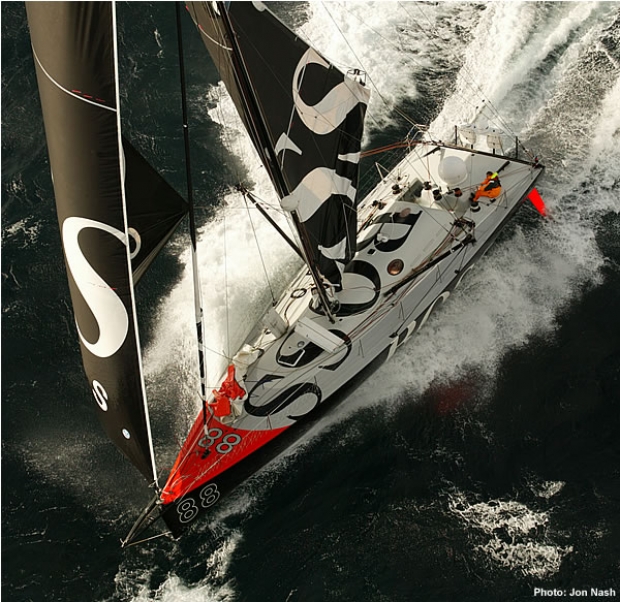
To finish first, first you must finish
Tuesday October 3rd 2006, Author: James Boyd, Location: United Kingdom
The start of Velux 5 Oceans, the latest incarnation of the BOC Challenge/Around Alone singlehanded round the world race with stops, from Bilbao on 22 October will mark the first of three Open 60 round the world races in as many years for
Hugo Boss skipper Alex Thomson. It will also be the last race he does in his present boat, the former
Sill previously campaigned by Roland Jourdain. The new
Hugo Boss, a Finot-Conq design, is currently under construction at Neville Hutton's yard in Lymington ready for Thomson to step on board once he gets back from his latest adventure.
Considerable work has been carried out to the present Hugo Boss since we sailed her in Skandia Geelong Week in January (read about this and see the video here). Prior to this the boat had been fitted with a new keel foil, this time made of carbon fibre rather than fabricated steel. "The surface area is bigger but the centre of gravity goes down a bit and it is lighter so we have more weight in the bulb," explains Thomson. "As we were coming back from Cape Town during the Vendee [as readers will recall Hugo Boss' deck was punctured and Alex had retired to Cape Town during the Vendee], Nick Moloney’s keel fell off. You start to listen to what is happening and whenever you hear a noise you start looking at the keel – especially because mine was one of the oldest. And then when Mike’s fell off [on Ecover shortly before the Vendee finish] it was even worse. So we came back, pulled the boat out of the water and found our keel had a crack in it..." It seems that the foils on canting keel boats have to withstand considerably more abuse load-wise than fixed keels (check out part one and part two of our feature about canting keel issues - pre-Volvo).

As Thomson and his crew were en route through the Southern Ocean delivering Hugo Boss back to the northern hemisphere in February this year, so just short of Cape Horn she was dismasted. "The deck spreader broke," Thomson recounts the incident. "We were left with a broken deck spreader, the forward chainplate for the deck spreader got ripped out of the deck, the aft stay for the deck spreader broke off on the end of the deck spreader, did a 180 and fired itself through the hull..."
While the rig at the time was a multihull-style rotating wingmast with deck spreaders, so now Thomson has replaced it with a conventional fixed mast with no deck spreaders, made by Southern Spars and costing in excess of £300,000. The tube is the same section as the one Mike Sanderson had built for Pindar (now Brian Thompson's Artemis) except it is slightly shorter. "It is a bit weird. I had a wingmast and everyone was conventional and now I’m going conventional and everyone else is going wingmast," Thomson admits. For example while PRB, Vincent Riou's Vendee winner had a fixed mast, the new PRB has a rotating wing.
Thomson says he made the change to the more conservative rig not for security reasons but because in practise he couldn't see the performance advantage. "If there was a definitive way to go then everyone would go there. In the tunnel certainly it is wingmast all the way," he says of the variation in Open 60 rig configurations. "But my rig was a big section and we did the test - I sailed upwind, reaching, downwind in 10-15, 20, 25 knots of wind, rotating it from 0-60 degrees and there was no difference in boat speed."
The new conventionally-rigged spar should be more reliable and it is certainly lighter and requires no deck spreaders. "People used to ask 'what's the best thing about your wingmast and I’d say ‘people don’t park against me in the marina!’" he quips. Thomson plans to fit a similar fixed mast on his new Hugo Boss and so is using this rig as a trial horse for the new one Southern Spars will be delivering next year.
In addition to the new rig, Thomson has gone out on a limb and the present Hugo Boss is the first Open 60 (and in fact the first hardore offshore boat) to fit Composite Rigging's new Element C6 carbon fibre standing rigging. More on this tomorrow, but Thomson says that compared to PBO it is more expensive, but a little lighter. Aside from the rigging being made from carbon fibre filaments, it is also continuous, minimising the attachment at the spreaders, thereby reducing windage aloft, but will mean that in the event of any chafe occurring the carbon rod will have to be replaced from masthead to chain plate.

Again they are trial horsing the carbon rigging for the new boat. "When we get to Fremantle the D1 will come off and go back to the States [where it's made] and be broken and then the other D1 will be broken after Norfolk, so it will give them a really good idea of what is going on." On Hugo Boss the shrouds terminate at titanium bottlescrews attached to carbon fibre chainplates on deck. A new suit of sails has been fitted, made by North New Zealand and designed by the same person who made the sails for Brasil 1 in the Volvo Ocean Race.
Down below Thomson says the canting system for the keel has been revamped although they have kept the same rams. More water ballast has been added aft bringing tankage up to 1 tonne (1,000lt) per side there. Hugo Boss is fitted with fore and aft tanks (there is no middle tank as some Open 60s have) to alter her lateral trim through the transfer of 2,500lt of water in total between her two sets of tanks. Thomson theorises that altering the displacement in this way adds loads to the rig and was possibly the reason for their dismasting earlier this year.
At Hugo Boss' futuristic-looking chart table, featuring a carbon fibre seat on rails, all the original NKE electronics have been changed over to new B&G gear. They have tried the TWP2 brain for the system - Thomson says this is the future certainly, but for Velux 5 Oceans they have reverted to the more belt and braces Hercules system. "The most important thing for me for this race is to finish and then to be on the podium is second," admits Thomson.
In Open 60 circles Thomson has earned the reputation for pushing his boats too hard and it will be interesting to see how this is reflected in his new boat. Thomson says we can hold him to his pre-Velux 5 Oceans declaration that he is in the race to finish. "It would great to win it, it would great to be on the podium but my absolute priority is to finish."
Meanwhile as Thomson sets sail round the world, so build work continues on his new Open 60. He says he is happy with the team he has put in place to carry out the work - while Neville Hutton has never built an Open 60 before, he has done a TP52 and has taken on more staff including many previously with Green Marine. Significantly construction is being project managed by Volvo Ocean Race build-guru Jason Carrington. The new hull is being built in carbon/Kevlar Nomex using female tooling.
"The build has already started. We’ve done the mock-ups for the cockpit and the interior - so I’ve already been in it driving it!" enthuses Thomson. "The great thing about Finot is that they know their stuff and there is some really good feedback going backwards and forwards. And they are happy to listen to ideas we’ve got. SP [who are engineering the boat] have been fantastic. I went to them before I went to Finot."
Little in the way of detail is being revealed at this stage about the new boat except that it will be powerful, as seems to be the trend with the new generation Open 60s. Thomson gives the impression that this power will derive from the hull and bulb rather than a Dominique Wavre-style monstrous sail plan, but whether it is as extreme as the rumoured 6.3m beam of Juan K's new Pindar for Mike Sanderson remains to be seen (the present Hugo Boss a 5.5m Bmax in comparison). "Where do you stop?" queries Thomson. "Boats get heavier if you get wider and wider and then you have a problem with the 180° test, so your bulb has to get heavier."
Another priority with the new boat will be making her more comfortable to sail. The present Hugo Boss not only has one of the lowest freeboards in the Open 60 fleet, but also has a tendency to scoop water up over her bow and send it hurtling back down the deck as the bow rises (see photos of this here ). "It is so wet and horrible," says Thomson, shortly to set out on 30,000 miles of racing on this very boat. "I can’t deal with that. It takes out the fun of going up on deck. We thought hard about how we can make things easier [on the new boat]."
Significant races for the new boat will be the Barcelona World Race and the ultimate objective - the Vendee Globe in 2008. Vital for the former will be boat speed, while for the latter it will be handability, maintains Thomson. The Barcelona event is two handed and for this he will be sailing with America's Cup and Volvo Ocean Race veteran Andrew Cape. While Capey's experience of Open 60s is limited, he is familiar with this style of boat having competed in the Mini Transat. "The idea was to find someone with complimentary skills, skills I didn’t have, ideally a navigator because that is one of the areas that is hard and comes from experience," says Thomson.
Thomson is training himself, very much in the same way as Ellen MacArthur did prior to her Vendee Globe. He too for example is getting some weather tuition from the great Jean-Yves Bernot. "Again we are looking at the Vendee as the pinnacle and then we have got all these things to lead up to it," explains Thomson. "It is a bit like an Olympic campaign with lots of training races - we have got all these steps. If you look at where the level is going to be in the Vendee - it is going to be way up there. So we are looking to be that much above it."
Key to his training, Thomson feels, will be spending as much time getting miles under his belt in the new boat as possible. "Time on the water will be a critical thing. I think the Barcelona race, for me, is a wicked race to do as a build up to the Vendee. How comfortable are you going to get when you push the boat that hard?" But then we know Alex doesn't need a crew to do this...
While he will sail the Barcelona World Race, he isn't so keen on the Transat, the major race traditionally held the summer before the Vendee Globe. The first race for the new boat after she is launched in April next year is likely to be the Gotland Runt.
As to the Velux 5 Oceans, Thomson is bullish. While the hull of the present Hugo Boss is getting old now, pretty much everything else on board her is new. In the first of his three round the world races Thomson can expect stiff competition from Mike Golding, keen (to put it mildly) to get a round the world race win finally under his belt and the hugely experience Swiss seadog Bernard Stamm, winner of the last Around Alone. "We went up against Mike at Cowes Week and we were the same upwind. It was really good because we’ve always been weaker than him and that was with our little boards, our old ones," says Thomson.
We wait to see if Thomson can temper his competitive urge in the Velux 5 Oceans. In the meantime his shore team wander round muttering about making the boat 'Alex-proof'.
Most Read
Most Commented
Comments
Businesses

Pro businesses
-
Italy
-
-
Netherlands
-
Italy
Editor's choice
Member blogs
-
 Ned Collier Wakefield: MOD70 round BarbadosWell that was intense. 12 hard fought for seconds for the win. In idyllic conditions, Tony Lawsons MOD ...
 -
 Mini Transat leg 2 reportThe second leg of the Mini Transat started on 31st October, just over a month after ...
 -
Leg 1 reportI’ve been working towards the Mini Transat now for three years. In 2013 I was part ...
Business blogs
-
 The Island Sailing Club in Cowes, Isle of Wight, is delighted that Prince Michael of Kent ...
 -
Peta Stuart-Hunt chats with the 25 year-old British solo sailor Lizzy Foreman before she sets sail ...
-
The 2015 Student Yachting World Cup (SYWoC), an ISAF-recognised event hosted and run by students for ...
Editor's Choice
All time favourites...
-
 Three legs down into Ian Walker’s
 -
 Winning all but two races at
 -
 For the first time in its
Latest Comments
Add a comment - Members log in