
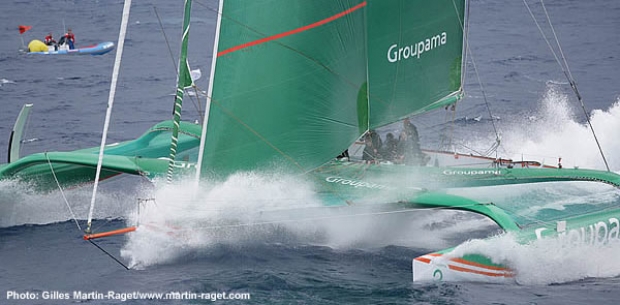
Can the world's most exciting race boat class stop the rot?
Friday July 14th 2006, Author: James Boyd, Location: France
Despite being in our opinion the most exciting race boat class in the world, the sorry fact is that the 60ft trimaran circuit is in rapid decline at present with boats actively racing at their lowest number ever, despite (or because of - depending upon your opinion) Baron Rothschild's MultiCup, a new circuit introduced this year that focusses more on fully crewed grand prix events than it does the shorthanded offshore ones.
The rot set in during the Route du Rhum back in 2002 when a phenomenal 18 of these 60ft long by 60ft wide monsters took the start line. However due to the exceptionally harsh November weather in the Atlantic, where the boats genuiinely did receive a hammering, only three boats completed the course, only one of these without stopping to effect repairs.
"Oh, this is an abherration, the weather was terrible - no need to change anything," was the feeling among most involved with the class in the aftermath of the event. And to some extent they appeared right. Come the Transat Jacques Vabre in 2003 numbers had dropped to 14 but all finished with the exception of Giovanni Soldini's TIM. The Transat across the North Atlantic in 2004 showed a similarly successful record with 12 boats competing and only one boat retiring due to a broken daggerboard.
However come the 2005 Transat Jacques Vabre, numbers were now down to 10 and once again the boats began dropping like flies - and this time bad weather seemed not to be the cause. Boats pulled out with a spate of structural issues and boats such as Foncia, Orange, TIM and even race favourite Groupama II capsized. Of the ten starters just four finished - an unacceptible attritition rate particularly with the Route du Rhum fresh in the people's memories.
Following the TJV so the ORMA 60ft trimaran class have attempted to get their house in order, Baron Benjamin Rothschild wading in with the establishment of the MultiCup. This in theory would appear to be good news in that the class has good organisation and some decent backing for the first time in four years, except that no further restrictions have been made on the boats and costs continue to increase. While length overall has remained static, rather than the class reign themselves in when it comes to sail area, this has continued to increase particularly through ever-enlarging square top mainsails. It is felt that this, along with the boat's increased performance due to the latest lifting foils in their floats and with the boats being driven harder having two crew rather than one on board, is what contributed to the TJV carnage.
Within this context this year we see just five of these magnificent boats competing on the MultiCup circuit, and even this number has dwindled to as low as three following the dismasting of Gitana 12 prior to the Marseille Grand Prix and prior to that the dramatic capsize of Pascal Bidegorry's Banque Populaire during the windy race at the Trophée CG des Alpes Maritimes at the end of the first race of the season down from London.
So what lies in store for the world's most exciting race boat class? Has the rot set in too deep?
The fear is that class looks set to dwindle further in 2007: Michel Desjoyeaux's contract with his French supermarket chain backer Geant runs out post Route du Rhum and he will then begin to focus on his new Open 60 campaign. Meanwhile Groupama and Banque Populaire are turning their attentions towards larger G-Class maxi-multihulls. Franck Cammas intends to take Groupama III on an attempt on Orange II's Jules Verne Trophy time this coming winter. However the team's communication guru Vincent Borde says this is only to fill in the gap in their publicity that regularly takes place over the winter. "When we make Groupama III it was to have some good visibility all the year, during the winter with Groupama III and during the summer with Groupama II. So for us it doesn’t change."
Groupama's set-up is also what Banque Populaire have in mind for themselves. They are now in the market for a new G-Class maxi-multihull, but still plan to race their 60 next year.
"The future depends upon other countries coming sailing with us," says Vincent Borde of what a solution might be. "I don’t know what Benjamin Rothschild is doing, perhaps he is calling his friends and saying ‘come sailing with me’ as he did with Ambassador for the general sponsorship. For sure it will be difficult to stay at only four boats because when one of these has a technical problem, afterwards you only have three as it was in Trapani and three is not enough."
 Ironically and as if to prove how little appetite there is for the MultiCup at the moment - while their circuit is attracting less than one handful of boats, for this year's Route du Rhum there are still an impressive fifteen 60 foot multihulls entered at this stage, although we suspect the number may end up being closer to 12. We say 'multihulls' because it appears that deposed
Banque Populaire skipper Lalou Roucayrol has recently entered Yves Parlier's radical seaplane-hulled, twin-masted catamaran
Médiatis Région Aquitaine, the present holder of the outright singlehanded 24 hour record, in the singlehanded race between St Malo and Guadeloupe.
Ironically and as if to prove how little appetite there is for the MultiCup at the moment - while their circuit is attracting less than one handful of boats, for this year's Route du Rhum there are still an impressive fifteen 60 foot multihulls entered at this stage, although we suspect the number may end up being closer to 12. We say 'multihulls' because it appears that deposed
Banque Populaire skipper Lalou Roucayrol has recently entered Yves Parlier's radical seaplane-hulled, twin-masted catamaran
Médiatis Région Aquitaine, the present holder of the outright singlehanded 24 hour record, in the singlehanded race between St Malo and Guadeloupe.
The Route du Rhum of course remains the most important sailing event for these boats in France, particularly for French sponsors - it is allegedly the third biggest sporting event in the country outside of the World Cup and cycling's Tour de France. So it would perhaps stand to reason that if there is a circuit for the 60 footers to be run in France, surely it should be more orientated towards short handed and offshore racing?
Today the 60ft trimarans start their MultiCup Grand Prix in Portimao, Portugal where four are expected to be racing: Geant, Groupama and both the Gitanas. It is believed that a Russian syndicate is sniffing around the circuit - they were at Marseille to watch the racing and are expected back for Portimao and there are also supposed to be some Swiss owners interested. Several French skippers are also keen to get involved again, 2004 Figaro winner Charles Caudrelier being one, former Belgacom skipper Jean-Luc Nelias being another. The problem has been finding money in a class where costs have been escalating at a time when sponsor's return on investment has been diminishing.
 "I think one of the positive points for the future if people want to come is that there are some boats for sale such as
Foncia and
Geant," continues Vincent Borde. "Perhaps if the Route du Rhum is a success and if all the boats arrive in Guadeloupe it would be good for the ORMA circuit. It is difficult to know, but I hope we have some new people coming because these boats are marvellous."
"I think one of the positive points for the future if people want to come is that there are some boats for sale such as
Foncia and
Geant," continues Vincent Borde. "Perhaps if the Route du Rhum is a success and if all the boats arrive in Guadeloupe it would be good for the ORMA circuit. It is difficult to know, but I hope we have some new people coming because these boats are marvellous."
While the class is in this conundrum not surprisingly no new boats are being built. Vincent Lauriot Prevost of leading 60ft trimaran designers van Peteghem/Prevost (VPLP) says they haven't even had an enquiry for a new 60ft trimaran in recent years. Their company still is doing well in large cruising multihulls but more recently has joined forces with talented up and coming designer Guillaume Verdier in creating the new Safran Open 60 monohull for former trimaran skipper Marc Guillemot.
Meanwhile....
While no new boats are being built, development work has continued apace in the remaining 60ft trimaran camps. Prevost says he wasn't involved much with Michel Desjoyeaux's Geant campaign this winter as they were carrying out some internal developments including a new centreboard and a new kick-up rudder, while Groupama were more focussed on salvaging and rebuilding Groupama II after her capsize in the Transat Jacques Vabre (as well as finishing their new 105ft whopper, Groupama III). Where VPLP have been focussing is on Baron Rothschild's Gitana team, the only two boat campaign in the 60ft multihull world and the one which on paper at least should be most likely to topple the dominance of Cammas' Groupama campaign - although perhaps too late (it should be remembered that while a spate of new builds happened prior to the 2002 Route du Rhum Groupama II is the new 60ft tri to have been built since then).
Over the winter considerable work was carried out on the Gitana trimarans at their impressive base in St Philibert, across the water from the Breton multihull mecca of La Trinite-sur-Mer. The two boats were inside two adjoining sheds where a majority of the work carried out focussed on transforming Jean le Cam's old Bonduelle (now Gitana XII) into a state of the art 2006 60ft trimaran alongside the old Belgacom (now Gitana XI).
" Bonduelle was really dedicated to singlehanded sailing as Jean le Cam wanted it, so we had to work on the cockpit arrangement and the hydraulic systems," says Vincent Lauriot Prevost. "The hydraulic systems, particularly those used to cant her 100ft tall wingmast to weather was not fast enough to use in grand prix. "And we made some big work on the foils."
While we say no rules have been introduced into the 60ft multihull class, this is not strictly true - the foil area used for vertical lift has now been restricted to prevent the boats from going fully airborne, so teams have been working on ways to optimise this. Prevost says that the way the retractible curved foils in each of Gitana XII's floats exits the float is more vertical, compared to the way it happens on Gitana XI. This is due to Gitana XII's foils having a slightly different curvature. "If they are more curved you can get the same maximum area allowed under the rules," he says.
Research into this, as well as the other appendages, VPLP carry out with the help of simulation guru Mick Kermarec, who outside of France is better known for his America's Cup work last time round with Prada, this time with BMW Oracle Racing. "We try not to make big differences, just improvements, to improve the capacity of the boat to be on the foil while making it more stable, trying to get more transverse lift and more efficiency when they are two thirds immersed and still having good vertical power when it is fully down," Prevost continues. "By the curve and by the implantation in the floats there are lots of parameters you can play with."
Aside from the lifting foil in each float Gitana are also trying out a new kick-up main rudder system. "That is to reduce the drag. When you have a liftable main rudder you have to think about the rudders on the floats and make them bigger," says Prevost. The section has been improved to work at higher speed to overcome the cavitation problems the old rudders used to suffer from when sailing at maximum warp factor. Again they have worked with Mick Kermarec on this.
On Gitana XII over the winter they also dramatically changed the cockpit optimising it more for Grand Prix racing than le Cam's offshore configuration. The cockpit has been enlarged to accept a crew of 10 while the sole has been raised. The upshot now is that the Gitanas now have the same rudders, centreboards and rigs, the only remaining differences being the platform (the underwater section of Gitana XI's main hull was sliced off and replaced over the winter) and their lifting foils.
A major weight-saving regime has also taken place on the Gitanas, XI now being down to around 6.1 tonnes, compared to Groupama II which is 5.9-6.0. "There is less than 200kg difference between the boats now - it is becoming closer and closer," says Prevost, presumably only referring to the boats on the MultiCup as we suspect some of the other less tricked up boats we will be seeing there won't be as slimline.
 As to what will happen to the class Prevost is at a loss. One relatively elegant and cost effective solution would be to allow two rigs for the boats - the present rig for Grand Prix and a cut-down version of it for short-handed events such as the Route du Rhum. Unfortunately there are some skippers such as Michel Desjoyeaux who are ardently opposed to this, believing that this should be up to the skippers to decide how much sail they can handle. Unfortunately this view could represent the death of the class. "That is always the problem," says Prevost. "Fully crewed I think they can manage the sail area. When it is singlehanded or doublehanded it is down to managing the risk - if it is under canvassed or over canvassed. [At the time of Groupama's capsize in the TJV]
Geant was sailing under and
Groupama was sailing over, just on the edge. So it is the risk of the competition. The problem with these boats is that when it goes wrong it goes REALLY wrong."
As to what will happen to the class Prevost is at a loss. One relatively elegant and cost effective solution would be to allow two rigs for the boats - the present rig for Grand Prix and a cut-down version of it for short-handed events such as the Route du Rhum. Unfortunately there are some skippers such as Michel Desjoyeaux who are ardently opposed to this, believing that this should be up to the skippers to decide how much sail they can handle. Unfortunately this view could represent the death of the class. "That is always the problem," says Prevost. "Fully crewed I think they can manage the sail area. When it is singlehanded or doublehanded it is down to managing the risk - if it is under canvassed or over canvassed. [At the time of Groupama's capsize in the TJV]
Geant was sailing under and
Groupama was sailing over, just on the edge. So it is the risk of the competition. The problem with these boats is that when it goes wrong it goes REALLY wrong."
Meanwhile Prevost and van Peteghem have been having to break out their Southampton course notes on monohull design. They have found working on Marc Guillemot's new open 60 Safran an interesting challenge, particularly with both designers and skipper approaching the problem from a background of ORMA 60s. It should be remembered that Yves Parlier revolutionised the class in the late 1990s with his Aquitaine Innovations, which used revolutionary deck spreaders to allow what was effectively a depowered 60ft trimaran rig fitted to his Open 60.
"I definitely think it is different, but combining monohull philosophy and multihull philosophy can result in some interesting areas, in the sail plan for example," says Prevost. He adds that some of the evolution in the Open 60 world has been the same in the 60ft trimaran world, particularly when it comes to overall beam. Where the tris have gone from being ultra-wide ( Belgacom now Gitana XI for example is wider than it is long) and subsequently got narrow, the same has also happened to the Open 60s. There the trend in the 1990s was to go ultra-wide but this had to be capped after a number of boats turned upside down and failed to right. Boats have narrowed down since then but we suspect the trend may be reversed once again with the new generation of boats where the power is needed to counter the larger sail plans (sound familiar?).
"In multihulls we went to very wide and we found widest wasn’t the fastest because singlehanded you have to be able to exploit the power," says Prevost wisely. "It is the same in a singlehanded monohull."
The designers have been working carefully with Guillemot on the ergonomics and went as far as building a full-sized deck mock-up this spring. Construction of the boat has now started down at Thierry Eluere's yard near Arcachon, where Parlier's Aquitaine Innovations Open 60 and Médiatis Région Aquitaine catamaran were built. Launch date for the new Safran will be spring 2007.
What is the future of the 60ft trimaran class? What should be done to stop the rot? Should thedailysail begin a 'save the 60ft trimaran' campaign? Send us your views here .
More photos on the following pages...

Most Read
Most Commented
Comments
Businesses
Pro businesses
-
-
United Kingdom
-
-
United Kingdom
Editor's choice
Member blogs
-
 Ned Collier Wakefield: MOD70 round BarbadosWell that was intense. 12 hard fought for seconds for the win. In idyllic conditions, Tony Lawsons MOD ...
 -
 Mini Transat leg 2 reportThe second leg of the Mini Transat started on 31st October, just over a month after ...
 -
Leg 1 reportI’ve been working towards the Mini Transat now for three years. In 2013 I was part ...
Business blogs
-
 The Island Sailing Club in Cowes, Isle of Wight, is delighted that Prince Michael of Kent ...
 -
Peta Stuart-Hunt chats with the 25 year-old British solo sailor Lizzy Foreman before she sets sail ...
-
The 2015 Student Yachting World Cup (SYWoC), an ISAF-recognised event hosted and run by students for ...
Editor's Choice
All time favourites...
-
 Three legs down into Ian Walker’s
 -
 Winning all but two races at
 -
 For the first time in its
Latest Comments
Add a comment - Members log in