
The future of canting keels?
Friday April 21st 2006, Author: James Boyd, Location: United Kingdom
Canting keels may have transformed the performance of sail boats in one fell swoop, but with the spate of breakages earlier in this Volvo Ocean Race few would argue that this technology is still very much in its infancy.
Perhaps most exciting about canting keel is that so many avenues have yet to be explored. For example when it comes to the mounting of the giant pin around which the keel foil rotates, the arrangements on Volvo Open 70s is very different from other canting keel classes. Open 60s for example have this pin in line with the hull exit, but under the VO70 rule it can mounted inside the boat. The VO70 arrangement possibly makes for a more sound structural mount for the pin, but equally requires a larger aperture in the hull that must be covered up by, in the case of the Farr boats, 'bomb bay doors' and these have created their own set of problems. Conversely the Open 60 arrangement has more of the pin fairing outside of the hull and is more draggy. It seems unlikely that for the next iteration of the VO70 rule mounting the pin inside the boat will still be allowed.
While keels canted by hydraulic rams, as favoured on the Volvo Open 70s and Open 60s, may be the norm at present, there are still many new variations yet to be investigated fully. On small yachts, such as Minis, the top of the keel is canted by block and tackle, the top of the keel foil protruding almost to the cabin top inside the boat to give a long enough level arm. This system has been scaled up to a few Open 60s such as Thierry Dubois' Solidaires where its benefits are seen as simplicity and...no bulky, heavy hydraulic rams.
This neatly brings us on to the whole argument about whether powered systems should be allowed at all for canting keel systems. One can imagine that the arrangement on Solidaires would benefit greatly from the block and tackle being driven by a powered winch and if hydraulic rams are allowed, then why not this? So if one is allowed to press a button to cant a yacht's keel through 80 degrees during a tack, then why is it that are you not allowed to stick a halyard onto a powered winch to hoist a sail?
If power was banned from Volvo Open 70 keel systems what would be the alternative? Gravity almost certainly would be brought into play more. Mike Golding became a great expert in the unpowered keel cant during the Transat race in 2004 when one of the electronic components used to control the keel, broke resulting in him having to perfect the system of dumping his keel down prior to a tack. A block and tackle system would be nearly impossible to build to handle the enormous loads of a Volvo 70 keel compared to that of an Open 60, but one could imagine the coffee grinders being hooked up to a hydraulic pump, the keel dropped down by gravity and then the rinders canting up the last few degrees by a hydraulic ram using similar (but bigger) gear as 60ft trimaran crews use to cant the rigs on their craft.
Anyone with views on this should write to us here....
One area of development that will definitely have legs for the future is another alternative to the hydraulic ram.
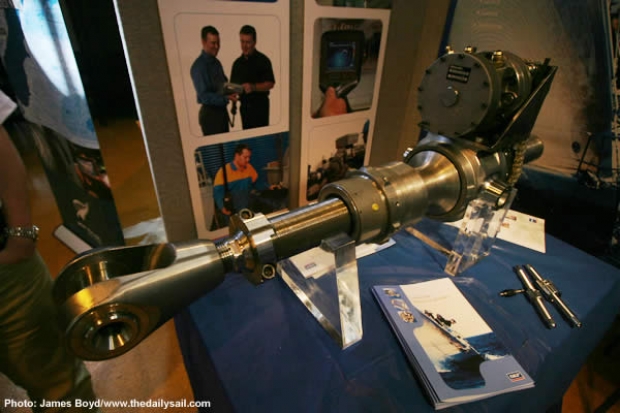
Back in February at the High Performance Yacht Design Conference in Auckland, one of the sponsors of the event, SKF, a Swedish company who are world experts in bearings, was exhibiting a keel ram system operated by what is perhaps most understandably described as a worm drive, originally developed for Ericsson Racing Team to use on their VO70.
"We were finished in time and we reached a target of the weight and so on, but still they didn’t dare use it and they regret it now," Pontus Claesson, SKF's Technical Manager for the Nordic region, told us. "They were 50-50 in the team when they took the decision. They said it is definitely the future, but if we take this still unknown solution we may jeopardise our chances in the race. We should take the same solution as everyone else. But some people in the team were very disappointed. I can’t say that they would not have had trouble if they had gone with this solution because a lot of the trouble has been structural with the new designs."
The SKF system is best imagined as a giant nut and bolt arrangement where the nut is fixed to the head of the keel, moved as the bolt is mechanically turned, the nut and bolt both obviously able to swivel according to the degree the keel is canted. But SKD's expertise in bearings has allowed their system to be a whole lot more sophisticated.
For example at the HPYD conference Claesson showed us a number of alternatives for the 'nut'. The most impressive of these was a nut running on a system of recycling ball bearings (below) that was so free from friction that when turned vertically gravity was enough to make the nut spin down around the bolt. Sweet as a nut, you might say.

An alternative being used on their Volvo Open 70 ram was a type of bearing known as a 'planetary roller screw' (see photo below). This effectively is similar to the ball bearing type nut but instead of having a ball bearing race separating the nut and bolt it uses rollers. This system is ideal for high load applications such as canting keels as essentially it has more metal to metal contact between nut and bolt. "It makes it very reliable and there is a lot less friction in that compared to a sliding nut," says Claesson. "You can get even less friction if you use balls instead but then you suddenly get into trouble with the power-density: a ball nut will be about double the size, but the efficency will be higher. And if you have balls they can jam. With this if they are overload they will not stop rolling." A downside of roller screws is that they are a little more expensive due to having more parts and the precision with which they must be built. However roller balls suffer much more from contamination or being maintained using the wrong type of grease."

A conventional nut and bolt arrangement or a worm drive where there is effectively a gear mechanism on the nut is around 25-30% the efficiency of the proposed SKF system while the start efficency can be less than 10%, maintains Claesson.
The ram system being proposed by SKF has a dynamic driving force of 45 tonnes. The version on display at the HPYD conference was built for the Volvo Open 70 where two independent drive systems are required, so the primary system was a hydraulic motor driven directly from an engine with an electric motor as a backup. However this is the not optimum solution says Claesson. "Our concept is for an electrical drive of the planetary roller screw. That is more efficient and less weight. And it is the cleanest and safest way. I spend my life changing hydraulic systems over to electrical systems and you save about 50% of energy."
The SKF ram set-up could represent a weight saving of around 25-40% over the systems presently being used on the VO70s reckons Claesson. "This all-steel solution has the same system weight as the current solution with titanium cylinders - that was the target and we achieved that without using 'risky' materials [eg: titanium]. If we go for an electro-mechanical drive then we can make further savings, maybe 100kg, because we don’t need the tank, the oil, etc. Then on the other hand we have to use the batteries, but I made the calculation that the batteries that you already have in the Ericsson boat is already more enough to power electrical motors. You have to maintain them right, but you have energy for at least 100 tacks without recharging and that is a pessimistic value."
At present the rams on the Volvo Open 70s are powered by hydraulic pumps driven by the generator on the Farr boats and the more powerful main engine on the ABN AMRO boats. With more grunt coming from the main engine, the ABN AMRO system can incorporate a larger hydraulic pump able to cant the keel through a complete tack in 10 seconds, compared to as much as 30 seconds on the smaller generator-driven systems.
Speed-wise the SKD system appears to be approaching the speeds of the main engine-driven hydraulic system ram systems. Claesson says they built a full-scale test rig with two actuators, driven by a 20hp diesel (similar to a Volvo 70 generator) and they were able to fully cant the keel tack to tack with a 6 tonne bulb fully from the vertical in 20 seconds. He reckons by optimising the system more the time could be reduced to 15 seconds: their test rig used longer than normal hydraulic pipes and Claesson reckons that they could have found a more efficient motor if they had changed to a higher voltage version (although anything more than 24v is not to be recommended for marine applications) or used a brush-less motor.
This system would be particularly interesting for use on Open 60 where on singlehanded races the speed of tacking the keel is by no means as crucial - in fact it is better if the keel is canted at a more leisurely pace. While the SKF system has yet to be tried out in anger on a Volvo Open 70, SKF at present are in discussion with an Open 60 campaign to pilot their ram arrangement. On an Open 60 the forces are around half those of the Volvo 70 and Claesson reckons they would probably use a single ram set up (dual rams are required under the VO70 rule).
Another advantage of a non-hydraulic system is one of reliability says Claesson. "That was the gut feeling that caused the enquiry to us. Sailing for nine months with 300Bar of dynamic load - it doesn’t feel good. Isn’t there a better solution to have a pure mechanical link that is maybe easier to understand and you can detect the problems?" He does acknowledge that there could be fatigue problems from bending that could not be so easy to detect. However with no hydraulics maintenance is considerably easier as is removal and replacement of the system. There is no hydraulic fluid to spill into the bilges.
If there is a downside to the SKF system it is one of cost. Despite the apparent simplicity of the SKF system, the precision of the metalwork required to build a the planetry roller system makes the system more expensive than a hydraulic ram arrange. "If this had been cheaper than the hydraulic system then it would aready be ruling the market," says Claesson.
Watch this space.
To read more about this - see these documents


Most Read
Most Commented
Comments
Businesses

Pro businesses
Editor's choice
Member blogs
-
 Ned Collier Wakefield: MOD70 round BarbadosWell that was intense. 12 hard fought for seconds for the win. In idyllic conditions, Tony Lawsons MOD ...
 -
 Mini Transat leg 2 reportThe second leg of the Mini Transat started on 31st October, just over a month after ...
 -
Leg 1 reportI’ve been working towards the Mini Transat now for three years. In 2013 I was part ...
Business blogs
-
 The Island Sailing Club in Cowes, Isle of Wight, is delighted that Prince Michael of Kent ...
 -
Peta Stuart-Hunt chats with the 25 year-old British solo sailor Lizzy Foreman before she sets sail ...
-
The 2015 Student Yachting World Cup (SYWoC), an ISAF-recognised event hosted and run by students for ...
Editor's Choice
All time favourites...
-
 Three legs down into Ian Walker’s
 -
 Winning all but two races at
 -
 For the first time in its
Latest Comments
Add a comment - Members log in