
Rolex Sydney Hobart weather
Wednesday December 20th 2006, Author: James Boyd, Location: Australasia
With the 1998 Hobart race, when six lost their lives, still fresh in the memory, those involved with the Rolex Sydney Hobart pay extra-special attention to the weather forecast. With this in mind, so earlier today Barry Hanstrum, New South Wales Regional Director of the Australian Bureau of Meteorology gave a long term synopsis of the conditions competitors can expect during this year's course.
"That we are able to make some comment even six day out is testament to the huge advances that have been made in meteorological science over the last 10 years or so," he started. Hanstrum later told us that thanks to the advent of considerably more satellite weather observation tools, the accuracy of their forecasts since the disastrous 1998 race have shown a marked improvement. Day three of a three day forecast is now as accurate as it was for a 24 hour forecast eight years ago.
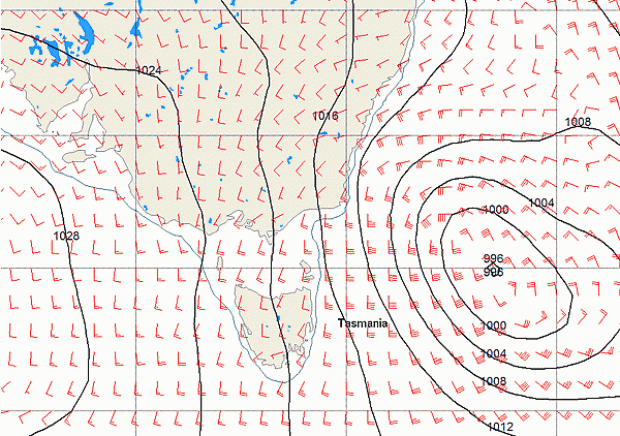
"A strong high pressure system is going to move into Great Australia Bight over the weekend, and be quite intense and strong," continued Hanstrum. "Its main influence will be to drive cold air from the Antarctic region up over the southeast part of the continent."
Of course after weeks of the weather following a routine pattern for the Rolex Sydney Hobart it will show a marked change. Today there has been torrential rain and Hanstrum reckons these wintry conditions will last all the way through Christmas. Grrrr.
"So we are going into a fairly dynamic period of weather where cold air from the very high latitudes will be pushing northwards over the south of the country over the weekend. The combination of cold air and warm moist air that is currently over New South Wales is the recipe for the development of low pressure systems." Such an intense low, known locally a 'bomb' is at present forecast to form off the NSW coast late on Sunday and into Christmas Day and will head east. By the time the boats head out of Sydney Heads it will be into the southerly breeze between the west side of the depression and the high off to the Australia Bight.
As Adrienne Cahalan puts i,t the weather is similar to the 1998 race except the boats will be heading out into it two days advanced. The biggest issue with a southerly in the Rolex Sydney Hobart is that this presents competitors with a wind against current situation as a southerly of potentially 30 knots kicking up the south flowing East Australian Coast Current that runs at 2-3 knots. "That is boat breaking stuff because the seas lose their backs. No boats like that," she says.
While the wind is almost certain to be southerly, Hanstrum says that the biggest unknown is exactly how much of it there will be. This will depend upon the timing of movement of the low. If it is well on its way to see our friends in New Zealand then it will be less intense than if it has only just moved off the NSW coast in which case it will is likely to be gale force. More certain is that the system is likely to continue to move away to the east and hence it will be an improving forecast, even if the highly unpleasant, boat breaking sea state continues. As the low moves further east it should be replaced by the high pressure ridge moving in from the west causing a lightening of the weather.
Hanstrum reckons it is most likely the wind will be 20-30 knots from the south on start day.
So the present forecast is for a 'big boat race' with the wind set to be on the nose but strongest for the leaders while it is likely to get light for the mid-fleet down. The question is which of the big boats will it favour most? If it is 20 knots or more then ABN AMRO One could well be in good shape. She has enormous daggerboards and goes upwind like a train. Her crew can also push the black boat harder than they can on Wild Oats XI, which has the additional advantage of 30ft more waterline length.
While the talk is of the weather moving off to the east, the standard GFS model is currently showing the depression in the Tasman Sea and high off the Great Australian Bight to be virtually static. This would an extremely bad scenario if it were to take place. Fortunately it is a long way out and thus likely to be highly inaccurate. Fingers crossed.

Most Read
Most Commented
Comments
Businesses

Pro businesses
-
Netherlands
-
United Kingdom
-
Italy
-
France
Editor's choice
Member blogs
-
 Ned Collier Wakefield: MOD70 round BarbadosWell that was intense. 12 hard fought for seconds for the win. In idyllic conditions, Tony Lawsons MOD ...
 -
 Mini Transat leg 2 reportThe second leg of the Mini Transat started on 31st October, just over a month after ...
 -
Leg 1 reportI’ve been working towards the Mini Transat now for three years. In 2013 I was part ...
Business blogs
-
 The Island Sailing Club in Cowes, Isle of Wight, is delighted that Prince Michael of Kent ...
 -
Peta Stuart-Hunt chats with the 25 year-old British solo sailor Lizzy Foreman before she sets sail ...
-
The 2015 Student Yachting World Cup (SYWoC), an ISAF-recognised event hosted and run by students for ...
Editor's Choice
All time favourites...
-
 Three legs down into Ian Walker’s
 -
 Winning all but two races at
 -
 For the first time in its
Latest Comments
Add a comment - Members log in