
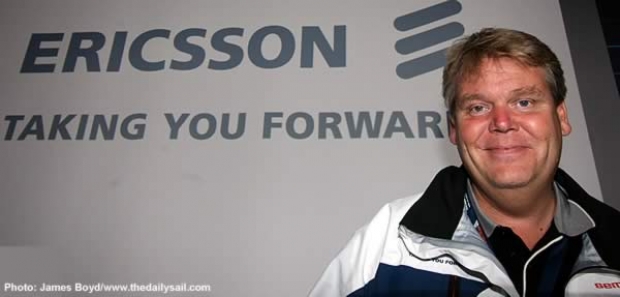
A sponsor's viewpoint
Tuesday June 20th 2006, Author: James Boyd, Location: Scandinavia
One of the features of this last Volvo Ocean Race was the presence of some truly global mega-brands in the race.
Few businesses are more fast moving globally than the cellular telecoms industry. With 800 million cellular phones sold around the world last year alone the cellular phone is at present the 'most sold' consumer item on our planet. And this shows no sign of let up. By 2010 it has been estimated that there will be 3 billion mobile phone subscribers globally (a little under the half the world's population). Thus it is almost a privilege that a company such as Swedish cellular phone giant Ericsson, employer of more than 56,000 people who product is used in 130 countries, should be involved with our sport.
Ericsson became involved with the Volvo Ocean Race four years ago when Sony Ericsson backed Gunnar Krantz' SEB campaign. This time round they were title sponsor of Neal McDonald's boat, a project run by Atlant in Sweden.
So why is Ericsson so interested in yachting, we ask Bert Nordberg, Ericsson's Executive Vice-President Sales and Marketing and one of the key decision makers when it comes to sports sponsorship? "I think in Sweden if you go to Stockholm and see the archipelago you would understand…" he says. "We started to sail many years ago as Vikings and we continue! It has been a tradition in this country to join the round the world race. We are a water people. Most of the big cities here are on the water, so I think there is a tradition in the country. Then some of us happen to be more interested than others..."
On a more serious note, Nordberg takes the opportunity to compare yacht racing with other sports: "If you want to do something global, then it becomes very limited what you can do: Football doesn’t work in the US. Cricket doesn’t work up in my countries. Golf works but doesn’t get the attention because when you come in from the 18th hole you don’t get journalists meeting you unless you have Tiger Woods with you.
"Then you look at Formula 1 which I happen to think is very noisy. And it doesn’t give me the thrill. And it is here and here and here. I have been to a few Formula 1 Grand Prix and it seems to be more consumer orientated. We are business to business. So I was looking for something where you could spend quality time with your customers, where you can show your products and not only make it for fun because it requires also that you do some professional work. I don’t think it is fair to invite people just for fun. It needs to also give them something back, some discussion."
An interesting lesson in corporate entertainment this - more diligent executives won't be enticed if your event is only 'for fun'.
Ericsson have been shipping around the world from port to port a striking square ended, oval-sectioned two storey high hospitality suite - for the race two of these are required, piggy backing around the world, transported in eight containers and taking a week to erect. The building has its own balcony on the upper floor, while the space inside is flexible and has not only been used to host dinners and cocktail parties but has been transformed into a lecture theatre, conference room and a listening room.


As Nordberg says they used the Volvo Ocean Race as a vehicle to liase with their business to business clients. Over the course of the race, impressively, they had 4,150 professional meetings with 400 different companies. "It was mostly operators about big enterprise company communications solutions. We have had a number of user group meetings where they could discuss with us future evolution. Telecoms is very interesting: The future name of the game is that everything is connected and everything should work wherever you go in the world." The Volvo Ocean Race is a classic example of an extreme communications environment, where on yachts sailing around the world crew are able to communicate, send and receive email, even to beam back highly compressed broadcastable video footage regardless of where they are on the ocean and the conditions they are experiencing.
And why the Volvo Ocean Race? "It boils down to sailing being very cost efficient. And I could combine it with activities I was planning anyway. And then if you have a good theme in one harbour you can have people flying in from around the world. So to me it has been very focussed on the working part. I would sponsor something else if it gave me more opportunities to combine it with business activities."
Now the 2005-6 race is over, Ericsson have confirmed the program with their Volvo Open 70 will continue in the short term. For example she will compete in the Round Gotland Race in 10 days time, while a program is loosely being worked out with ABN AMRO to do a circuit in the Med including Voiles de St Tropez, the Maxi Rolex Cup and the Rolex Middle Sea Race. There is even a chance we might see the boat at Skandia Cowes Week... "There is a fight between countries because everyone wants it," says Nordberg "First is the Gotland Runt, so we will invite a few customers on that."
Looking further ahead there are very good feelings about Ericsson competing in the next Volvo Ocean Race in 2008, particularly if the new course includes the Far East. "If you look at the total world where the spending on telecommunications is, today Asia Pacific and the developing world has 25% of the spending," explains Norberg. "2010 it will be 37% of the spending so it means as a corporate you need to brand even harder down there and build you position to make sure you are part of that growth..It is quite obvious to me that we need to focus more in that part of the world. I think it will be a tough race down there commercially."
As to whether they will definitely go ahead with the next round the world race Nordberg says the final decision is likely to be made in August. As a sailor himself he is more than aware that the sooner their team presses the green button the better their prospects of winning. "When our boat entered Gothenberg, I think our sailing time was the same as ABN AMRO One had before the race, so I think we need to decide early in order to be able to win because training is very important and to test boats. So if we join again we’ll do it early."
Between now and decision making day, Nordberg says he wants to carry out an evalution of how they got on during the 2005-6 Volvo Ocean Race. "You measure brand equity and measure satisfaction from customers and deep interviews. When you collect that you can make a good decision. Feeling-wise I would like to decide today but I think you should do this very professionally. And then plan for the budgeting of it. I really hope that if we sail again we can bring in more telecom operators because to them it is also a very good platform."
All sentiments that bode extremely well for the next Volvo Ocean Race.
Most Read
Most Commented
Comments
Businesses
Pro businesses
-
-
United Kingdom
-
-
Italy
Editor's choice
Member blogs
-
 Ned Collier Wakefield: MOD70 round BarbadosWell that was intense. 12 hard fought for seconds for the win. In idyllic conditions, Tony Lawsons MOD ...
 -
 Mini Transat leg 2 reportThe second leg of the Mini Transat started on 31st October, just over a month after ...
 -
Leg 1 reportI’ve been working towards the Mini Transat now for three years. In 2013 I was part ...
Business blogs
-
 The Island Sailing Club in Cowes, Isle of Wight, is delighted that Prince Michael of Kent ...
 -
Peta Stuart-Hunt chats with the 25 year-old British solo sailor Lizzy Foreman before she sets sail ...
-
The 2015 Student Yachting World Cup (SYWoC), an ISAF-recognised event hosted and run by students for ...
Editor's Choice
All time favourites...
-
 Three legs down into Ian Walker’s
 -
 Winning all but two races at
 -
 For the first time in its
Latest Comments
Add a comment - Members log in