
Not clipped on
Tuesday May 23rd 2006, Author: Andy Nicholson/James Boyd, Location: United Kingdom
In a tense, humid and crowded room at 11am this morning the
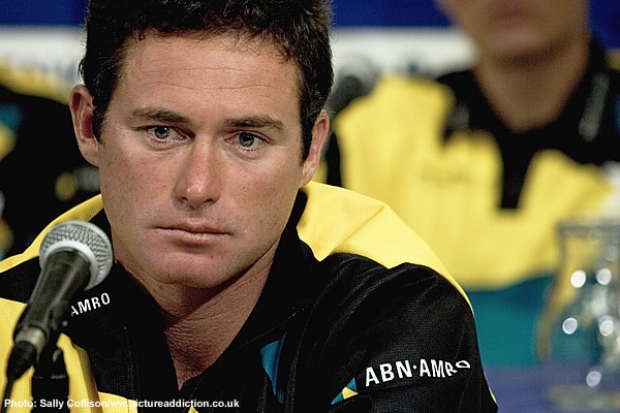
ABN AMRO Two crew, with the Team’s Sailing Technical Director Roy Heiner sitting front centre, faced the world’s press for the first time since arriving in Portsmouth last night at the end of the seventh leg of the Volvo Ocean Race.
The first question from the floor was answered by a visibly shell shocked skipper Seb Josse. Yes, Hans Horrevoets was not clipped on nor was he wearing a life jacket last Thursday when he was tragically washed overboard by a wall of green water cascading up the deck.
All nine of the crew onboard at the time were present at GunWharf Quay, Portsmouth with the addition of their extra Dutch team mate Gerd Jan Poortman, not sailing this leg.
Roy Heiner opened proceedings by addressing the room with an update on Hans Horrevoets arrangements. Since being transferred to the Dutch frigate HNLMS Van Galen yesterday morning his body has now been taken by helicopter on to Holland where his family were waiting. His funeral will be on Saturday.
While congratulating the ABN AMRO TWO on their outstanding seamanship, Heiner further added to the heavy atmosphere with the words: “We felt you should hear this courageous story. A story of the sailors.”
Frenchman Josse was struggling with his English when he described the scene on the night. He was steering with Nick Bice, Andrew Lewis and Lucas Brun in the cockpit with Horrevoets trimming the spinnaker sheet.
British navigator Simon Fisher went further to describe that the whole crew had been up at 2am to conduct a sailchange from the masthead kite to the fractional A6 with 12-14 knots of wind building rapidly to 25 knots at the time of the incident. After the change all the crew were in the process of getting their safety gear and the whole on deck watch were clipped on, with just Horrevoets to hand over the spinnaker sheet to do the same.
With the wind strength now at 25 knots the boat was moving rapidly. Then - nothing that hadn't happened many many times before - the boat dived headlong into a wave causing it to roll slightly to windward and a wall of high speed water to wash down the boat. When it cleared Josse raised the alarm that Horrevoets was no longer on board.
Down below Fisher immediately punched the man overboard button on the GPS recording the position of the incident and plotting a reciprocal course. Meanwhile on deck Scott Beavis and Simon Tienpont raced to the pushpit to deploy life rings, the Jon Buoy and smoke flares.
Fisher pointed out that a Volvo Open 70 sailing downwind at 25 knots covers ground quickly and yet by the time they had the spinnaker off, staysail furled and the daggerboard down and the boat turned around ready to go upwind they were just 1.6 miles from the man overboard position. The wind had now risen to 37 knots and the crew had to lower the main and start the engine to improve their headway back to the scene.
Half a mile from the GPS position with the help of searchlights they found a life ring and 0.2 miles away the Jon Buoy. Meanwhile down below American George Peet had broken out the medical supplies as bowman Simeon Tienpont slipped into his dry suit ready for a trip into the water. Once with the use of spotlights Horrevoets had been spotted it took three attempts to get close enough to pull Horrevoets out of the water.
Horrevoets was quickly taken down below as on board medic George Peet took on the task of performing CPR. During this time the team were in constant contact with and receiving advice form Derriford Hospital. At 04.20 GMT CPR was stopped and the Dutchman was pronounced dead. His exact cause of death will not been known until the conclusion of his autopsy in Holland.
It would appear that a tragic set of circumstances conspired to take Horrevoets and that the young crew of ABN AMRO displayed the highest level of seamanship to recover their man over board in the dark, in the Atlantic, in six metre seas, in 30 plus knots of wind in such a short period of time.
The question remains: Why wasn’t Horrevoets wearing a lifejacket and why wasn't he clipped on? In such conditions the spinnaker trimmer is as much in control of the boat as the helmsman and to simply cleat the sheet off, or quickly pass it to a team mate who is just back on deck is not an option.
In the building conditions time was to be against them. “All the people on the deck at the time, except for Hans, were clipped on,” explained Nick Bice. “Unfortunately Hans was on the spinnaker sheet and that was the most important sail at the time and any sailor knows that the last person to go down to get clipped on is on the sheet. Thirty seconds to one minute he would have been in there and put his harness on to come back on deck. Unfortunately that’s how it was, but everyone else at that time on deck was clipped on.”
Brazilian Lucas Brun, who was in the four man watch with Horrevoets described his feelings when they recovered him: “As soon as we got Hans on board it is a very tough situation to deal with. You are seeing the person who was joking with you and talking with you and the next thing you know you are dragging him out of the water. There is nothing that can prepare you for that. Then you put him inside and the whole group is working to get him alive. Then you have to sit on deck and you are doing you watch. Normally you are doing your watch with four persons and one of your watches is only three. You just can’t imagine it.”
The incident also opens the debate on how and when to clip on and there simply is no black and white answer. Yes, at night and or in big or building conditions. But often the wearing of a lifejacket or being clipped can be equally dangerous as it impedes the speed you can react or move around.

Simon Fisher
Australian Luke Molloy described the crews’ relationship with personal harnesses and lifejackets. “The first leg from Spain we had some lifejackets. They were really expensive ones with a harness around the legs and the lifejacket around the neck. That was our safety harness as well,” he said. “We found that with the lifejacket on your neck you are constantly slumped over. People were getting great pain down our back and spine and neck and shoulders. There were very uncomfortable to wear. For the next leg we took some different safety harnesses and we find them easier to wear. And that’s the thing - with safety you have to find something easy to wear and doesn’t hinder your performance. These harnesses we like wearing them so we wear them readily.”
All of the crew in the room were visibly shaken, Australian Watch Captain Nick Bice and the skipper Josse particularly removed from proceedings taking place in the room.
movistar
In the Atlantic the crew slowly brought ABN AMRO Two back to near full speed 20.00 GMT on Saturday when complete Horrevoets body on board they were called upon to go to the assistance of movistar, who's crew were highly concerned about how long their keel would remain in the boat. On Sunday morning at 08.30 GMT the movistar crew abandoned ship and transferred by liferaft to ABN AMRO Two.
The transfer was conducted during a drop in the wind as the centre of the deep depression moved over, preceding the north west sector winds touching Force 10. “If we had done it in 50 knots the odds would have been stacked against us,” said Simon Fisher.
Having another ten sailors on board gave the crew an opportunity to see some friendly faces and discuss (perhaps with the very small number of people who will really understand) the situation they faced.
Josse answered the difficult question of how he is personally coping in French. His words were translated: “The fact that they rescue the team from movistar was not exactly a satisfaction. They left as ten and wanted to come back as ten - but to go and get ten extra people and end up as twenty he feels it was the maximum seamanship they could show and to save extra lives have made things easier.”
Nick Bice gave his view: "As soon as I heard those words, we had obviously been through quite a lot, I just wanted to make sure those guys were safe as well. Having a lot of friends on board it was something that really made your heart sink. There was nothing more in my mind than to get those guys off that boat...When we got those guys on board and I don’t think you cold have seen 10 happier guys step on board. It was great to get them on board and back to shore safely."
What happens now with the young team is in their hands. The decision of whether they continue in the race is to be the sailors alone. Heiner, representing the views of sponsor ABN AMRO, reaffirmed that their decision would be supported by the Dutch Bank. "We decided to leave the choice to the sailors," he said. However there are stipulations. "But they have to do it as a team. We will not allow the team to be split. It is a possibility they will sail or they will not sail. The choice is up to them. After today we will start the process of thinking about that. But with respect to Hans we first have to get through today first."
With the press conference drawing to a conclusion, a couple of laughs from all in the room started to break the tension and there was a visible swelling of relief on the faces of most of the sailors. The first line in the sand had been drawn.

Most Read
Most Commented
Comments
Businesses

Pro businesses
-
United Kingdom
-
France
-
-
Editor's choice
Member blogs
-
 Ned Collier Wakefield: MOD70 round BarbadosWell that was intense. 12 hard fought for seconds for the win. In idyllic conditions, Tony Lawsons MOD ...
 -
 Mini Transat leg 2 reportThe second leg of the Mini Transat started on 31st October, just over a month after ...
 -
Leg 1 reportI’ve been working towards the Mini Transat now for three years. In 2013 I was part ...
Business blogs
-
 The Island Sailing Club in Cowes, Isle of Wight, is delighted that Prince Michael of Kent ...
 -
Peta Stuart-Hunt chats with the 25 year-old British solo sailor Lizzy Foreman before she sets sail ...
-
The 2015 Student Yachting World Cup (SYWoC), an ISAF-recognised event hosted and run by students for ...
Editor's Choice
All time favourites...
-
 Three legs down into Ian Walker’s
 -
 Winning all but two races at
 -
 For the first time in its
Latest Comments
Add a comment - Members log in