
Aussie impressions
Friday June 16th 2006, Author: James Boyd, Location: none selected
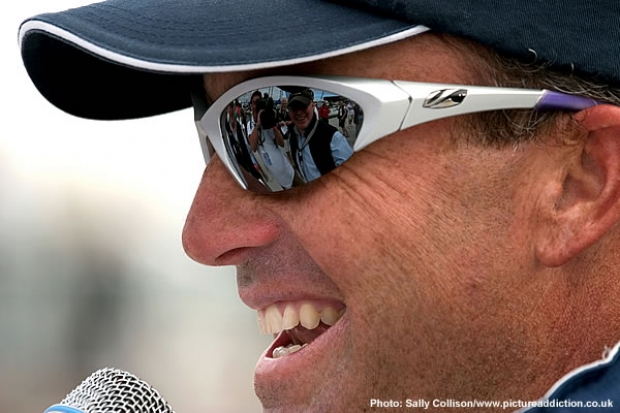
Grant Wharington is the man behind the Australian/Dutch Brunel campaign for the Volvo Open 70. Wharington also campaigns the Skandia maxi and is a man not short of a few opinions. He is keen to do the Volvo Ocean Race, but having struggled to have consistent funding for this race would prefer a more even ride if he were to compete in the Volvo Ocean Race again.
"My impression of the Volvo 70? I think they are fantastic boats," he kicks off. "They are very exiting to sail, very powerful, very fast. It is a good recipe and we should stick with it. There should a few little adjustments. I think there are too many sails for the number of people that are crewing the boats."
This time around Wharington has been running the lowest budget campaign in the race has is keen on the proposal to make it mandatory to carry some younger crew in the next race. "Obviously you spend an enormous amount of money on salaries and one initiative that I think is good for the sport of sailing as well as this race is to introduce a certain quantity of under 25s," he says. "I think that would be a really positive step, because we’ve seen what a successful program ABN AMRO Two has been and I think it is getting new people into the sport and obviously people at that level aren’t commanding the salaries that the guys who have been around the world three or four times are."
Wharington doesn't think they need any more crew on board but this argument works hand in hand with the sail inventory. He would like to see two less sails carried on legs.
"You’d take the two reachers off, because you can overlap them with the jibs. These boats are so fast and powerful you need really flat sails so the deep reaching jibs are a bit redundant. You can do without them. And the stacking of the gear is such a nightmare, so if you simply have less sails it is a lot easier."
At present stacking is legal and the crews are rigorous in ensuring that the weight of any sails not hoisted is used as ballast to the optimum either along the weather rail or at the back of the boat. What hasn't been discussed recently is whether this is still best practice.
"To me the stacking rule is a pain in the bum," says Wharington. "I would far prefer to have no stacking at all. I think with the cameras we have on the boat we could police it quite easily and say random photos are going to be taken and if you’ve got more than two sails on the deck then you’ll get penalised. But I don’t think that suggestion has gone down too well. However there has been the request to have one powered winch on board so that it is easier to move sails around. I think that is a good idea." It should be remembered that with his Skandia maxi, Wharington was the first person to campaign a serious race boat with powered winches, allowed under IRC if your boat is over a certain size. "We have all the hydraulics there to do it already, so if you have one powered winch you could speed up the hoists, which would help the in port racing situation, get guys up and down the mast quickly and you wouldn't have to get everyone out of their bunks for sail changes and therefore the crew don’t get so fatigued. That would be a really positive step. I think people need to get their heads out of the sand about the manual versus powered thing. I think whatever makes the boats enjoyable to sail is a positive step."
So would Wharington be in favour of an all-powered winch set up on board the 70s? "I would go fully powered, but a good compromise would be to have a single fully powered winch that could do halyard hoists, because it is not very nice to have these slow spinnaker hoists at the top mark, it doesn’t look that professional, but that’s all you can do when you have 11 people on board for the in port race."

Wharington is very in favour of the canting keel arrangement seen on the 70s. Having suffered a keel loss on his maxi, the canting mechanism on his 70 he says was substantially and probably overbuilt. "Obviously there have been some issues with the construction and design of some of them. We haven’t had an issues at all touch wood to date. But we have gone a bit overboard with our weights, but I’d rather be in that position than having to swim home. The next generation of boats will be much more similar in performance. I think there is no doubt they’ll have a maximum bulb weight next time instead of a minimum one and that will do a majority of the work in aligning the boats and making them closer. With that it won't drive even gram out of the structure to put it into the bulb, if everyone is happy to be around 14 tonnes [displacement] and we have a relatively conservative maximum bulb weight, people will be happy to paint their boats rather than clear coat them and build them in female tools and it doesn’t really matter so much because your righting moment will be the same."
And how about the proposal for a standardised hydraulic and fin package? "I think it is not a bad thing provided there is a reasonably economic solution. One of the proposals is to have a maximum bulb weight and the bulb can be anything you like and then to have a standardised fin and hydraulics package would be a very positive step, because Volvo will make sure that it’ll be very strong and overbuilt and it will be the same for everybody. We don’t want these problems in the future - we just want to go and race the boats. If they are indestructible it would be good."
He adds: "There are a couple of manufacturers of systems that they provide a V-shaped carbon fibre frame front and back, so you could specify in the rule that each boat will have a front and back keel frame say 800mm apart and into that will slot this cassette. Cariboni for example provide you with an aluminium box and you build the boat around that, pull the box out and drop in the keel mechanism."
When it comes to increased safety on board Wharington is keen on the idea of working with manufacturers to create safety gear that is easy to use. "I think the easier equipment is to be worn comfortably the more likely it is to be worn more often. In Australia there is some stuff made called Stormy Seas. They are a jacket that is like a zip-on fleece top, an outer layer and it has the lifejacket and the harness is all built-in. When it is cold you can put that on as an outer layer and it is not that bulky because it is all cleverly designed for the fleece and the outer shell so that is something we’ll be looking at in the future."
In this Volvo Ocean Race Brunel was unique in have a large, Open 60-style cabin top. Having used this in anger Wharington is in two minds about whether it worked. "It is fantastic offshore, to have the big area you can hide behind is great, it makes it a lot drier and more comfortable to sail, but it makes it much harder for spinnaker drops inshore. I would seriously consider it again but maybe with a hatch in the foredeck to do your spinnaker drops into. Our cabin is a bit further back than others and that hurts us in terms of cockpit area and our steering wheels are too close to the dome at the back and that doesn’t allow enough space for stacking. So you’d move all that forward. We are on maximum beam, so that was the right call, but maybe we are too soft in the bilges, but time and money fixes all that. We were going to have the double daggerboards put in before the start and we were going to do a keel fin and hydraulics change which would have got us another 500kg into the bulb and then we would have been right on the money. Hopefully Brunel have had a good bang for the buck and they will stick with us in the future. I’d like to do it again."
If Volvo lay on a race taking in Asia next time in three years instead of four as has been mooted this would be good for Brunel who have offices throughout that region.
"I think if they have the race every three races instead of four and they have this new route to Asia I think it will work out because the race takes about a year and then you have a year to build and plan and then you are into it again. Squashing these program down helps because they cost a lot of money to start up and stop, but keeping them going and scaling them up and down but having the continuity gives your sponsors return for their investment on a continuous basis - so that sponsors have something every year rather than having the 15 million crammed into one year’s budget. I think is the way forward. Traditionalists say ‘it doesn’t go through the Southern Ocean’ well unfortunately that doesn’t get boats on the start line and whatever does that is a good thing..."
Most Read
Most Commented
Comments
Businesses

Pro businesses
-
-
United Kingdom
-
United Kingdom
-
Editor's choice
Member blogs
-
 Ned Collier Wakefield: MOD70 round BarbadosWell that was intense. 12 hard fought for seconds for the win. In idyllic conditions, Tony Lawsons MOD ...
 -
 Mini Transat leg 2 reportThe second leg of the Mini Transat started on 31st October, just over a month after ...
 -
Leg 1 reportI’ve been working towards the Mini Transat now for three years. In 2013 I was part ...
Business blogs
-
 The Island Sailing Club in Cowes, Isle of Wight, is delighted that Prince Michael of Kent ...
 -
Peta Stuart-Hunt chats with the 25 year-old British solo sailor Lizzy Foreman before she sets sail ...
-
The 2015 Student Yachting World Cup (SYWoC), an ISAF-recognised event hosted and run by students for ...
Editor's Choice
All time favourites...
-
 Three legs down into Ian Walker’s
 -
 Winning all but two races at
 -
 For the first time in its
Latest Comments
Add a comment - Members log in