
McDonald's desires
Thursday June 15th 2006, Author: James Boyd, Location: United Kingdom
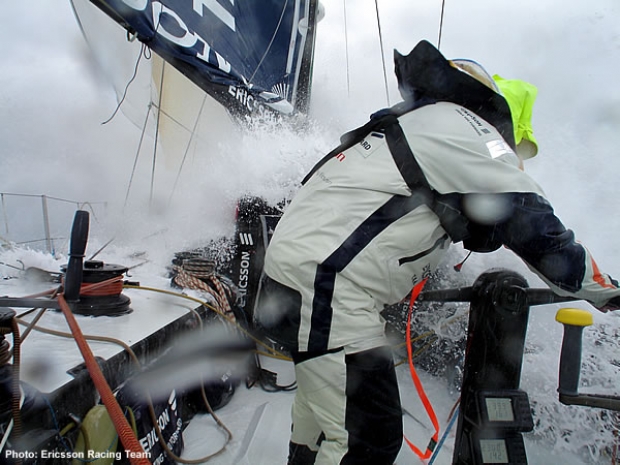
Following on from our interview with ABN AMRO One skipper, Mike Sanderson, so we posed a similar set of questions to Ericsson skipper Neal McDonald:
thedailysail: the Volvo Open 70 - has it been a success?
Neal McDonald: "There has obviously been teething problems, but in the last race six boats didn’t finish legs, so it is not an unusual scenario. If we want to move on and sail boats that are faster and more exciting then I think we have made a step in the right direction. Whatever people say about canting keels they are here to stay. You only have to be on the boat when you press the button and go from 0 to 40 degrees and you are three knots quicker. So we are achieving multihull speeds with a monohull. So in that respect I can’t say it has been anything other than a success."
tds: What would you do with the VO70 next time?
NMcD: "I think the world has learned a lot more about the keels. If we were all starting again and I’m sure we’d have a different approach, but I think we’d be on the right track. I think most teams when we started - and I’d include ourselves in that - probably didn’t know nearly as much as we do now and really there haven’t been a huge amount of keel problems since. We haven’t had any. As a fleet we have learned – you could argue too late but that was a function of when the rule came out and when sponsors came on board."

tds: There has been talk of all the boats having a standardised hydraulics and fin package. What do you think of that?
NMcD: "It is so difficult. If there was a race starting next year with these boats and there was a keel package that came out and you put it in the boat and it broke the first day - who’s fault is it? Then the race organisers take on a huge responsibility. So I think the concept is right - some people are talking about one design, but we obviously aren’t talking about that. A one design Laser is hard enough, so a one design 70 footer? That is quite a hard concept. I would advocate closing the rule down a little, taking away some of the variables..."
tds: Maximum keel weight?
NMcD: "I think that would solve a lot of the problems. Either that way or you could say there is a minimum keel canting system weight. There are lots of ways you could approach it. I don’t think any of us would have known what that number was a year ago, but we all know now. So there are lots of ways of making that problem not be the headache it was at the beginning of this race."
tds: Max bulb weight would prevent teams driving weight out of the boat...
NMcD: "Exactly and even if we started with the same rule now, people would probably present a boat that was more robust at the start. So I don’t think it needs any huge changes there to be honest."
tds: Following the loss of Hans Horrevoets - is there anything that can be done to improve safety on deck?
NMcD: "Maybe add freeboard at the bow? I personally wouldn’t restrict a boat like this to a one tonne aft water ballast tank. It should be five tonnes. It wouldn’t make it any more expensive to build and there are a lot of times I would have had it filled up! And I think the next generation of boats will be slightly more seakindly - I don’t know how you force that in the rule - maybe fuller in the bow. All the boats nosedive, but I don’t think that is unusual. It is a function of the power you have got and the righting moment you can generate - you are going to be throwing the bow in. It is a problem that is never going to go away. If you are going to go out in the ocean you are going to get water over the deck."
tds: What's your view on crew numbers?
NMcD: "Personally I would go for a bigger crew. I think it is a false economy at present. I’d like to go with 12, so two more. I certainly feel pretty vulnerable with a chute up in the middle of the night with four people on deck. It just doesn’t feel right. You look at the spots on the boat - someone is steering, someone is winding, someone is trimming, someone is on the main. Suddenly you have to call up people if you want to do anything. It is not the way we would go around the world normally, but there are lots of counter arguments such as cost, etc. If you went from 12 to 10 the people you are going to take off are the least well-paid and experience, so you get less new blood, etc. So I would put the numbers back up. I can see the counter argument."
tds: How about sail numbers?
NMcD: "You could have less sails, but then it makes it even harder. You’d still spend the same amount of money because the sails you have got have to work over a bigger range. So the sail selection becomes all the more critical. Maybe roller furling equipment could be made more attractive in the rule. I haven’t got a huge problem with that. I think furling the masthead gear if you had the option there would be other tunes you would play there. Getting the masthead chute down is hard enough inshore! It is just a nightmare, particularly at night in lots of breeze. If you ask an America’s Cup crew with 16 people about pulling one of those chutes down with just four people they’d say 'you have to be kidding'. Finally the sailors need to get involved with that discussion rather than designers or corporate people."
tds: What about the in-port races - have they worked out?
NMcD: "The people you should ask are the sponsors. It has been very successful for Ericsson. They think it has been a huge benefit to the race. Personally I think they are a lot of work, and it is hard to describe how tough it is – it is hard work on the body because you just don’t get a rest. If you took the in port away you would. You have to spend a few days warming into it and getting the boat ready and then you have to turn back to offshore mode. It is a lot of work. But It shouldn’t be us who decides that format. I think the bottom line is that it has to work for the sponsors and I think they like it. You could do two races....
tds: If you were to start again with your boat - what would be do differently?
NMcD: I think I’d put another rudder on it. In fact it is not so much the rudder but the beam. If you go wider you need two rudders and I think wider has proved itself. I haven’t given too much thought to it. At the end of it I’ll sit down and try and get a grip on what you’d do differently. During the race I don’t spend a huge amount of time on it. You've got what you've got.
tds: what having no jumpers a good idea?
NMcD: Difficult to know in isolation. I don’t think it has been a huge contribution one way or the other. One biggest concern about it was getting big enough overlapping jibs and we have. I don’t think it has made a big impact to be honest. Again we have got what we’ve got.
tds: Sail development was the main hold-up of your campaign?
NMcD: Yes, for sure. I think what cost us a huge amount was not doing the second leg. I think our lack of a fractional chute on the first leg probably masked some of our other problems, just things like the way the sail wardrobe fits together. I think we’re on the money now, but it has taken a long time. This A1 is a sail we have radically changed since the first leg. It was a runner and now it is more of a reacher. You can’t lift it now - but it is also the sail you have to use in 6 knots. And we didn’t have it right to start with. Five people to lift it and you use it in the lightest wind speed."
While Ericsson were being held up as one of the race favourites prior to the start of this Volvo Ocean Race, it would have been interesting to see what McDonald might have pulled out of the hat had they had a longer run in.
Most Read
Most Commented
Comments
Businesses

Pro businesses
-
United Kingdom
-
Italy
-
United Kingdom
-
Editor's choice
Member blogs
-
 Ned Collier Wakefield: MOD70 round BarbadosWell that was intense. 12 hard fought for seconds for the win. In idyllic conditions, Tony Lawsons MOD ...
 -
 Mini Transat leg 2 reportThe second leg of the Mini Transat started on 31st October, just over a month after ...
 -
Leg 1 reportI’ve been working towards the Mini Transat now for three years. In 2013 I was part ...
Business blogs
-
 The Island Sailing Club in Cowes, Isle of Wight, is delighted that Prince Michael of Kent ...
 -
Peta Stuart-Hunt chats with the 25 year-old British solo sailor Lizzy Foreman before she sets sail ...
-
The 2015 Student Yachting World Cup (SYWoC), an ISAF-recognised event hosted and run by students for ...
Editor's Choice
All time favourites...
-
 Three legs down into Ian Walker’s
 -
 Winning all but two races at
 -
 For the first time in its
Latest Comments
Add a comment - Members log in