

34 knots past Ouessant
Thursday May 4th 2006, Author: James Boyd, Location: United Kingdom
Having seen upfront and dirty most on offer in the yacht and dinghy racing worlds, including America's Cup yachts, Volvo Open 70s, Open 60s and even foiling Moths, we can still categorically state that there is nothing that comes close to matching a full-blown 60ft trimaran. Even tied up to the dock these French wonders look fast, on the water they prove themselves to indeed have blistering pace (on the ocean wave they are only outstripped by the larger but slightly more boring to sail G-Class maxi-multihulls). They are highly sophisticated having been evolved over a period of at least three decades and here we are not talking one hundredth of a knot America's Cup-style speed increases, but wholescale leaps in performance both in light winds and flat out. And the fact they are hard and potentially dangerous to race through the inevitable threat of capsize and that they have developed an appalling reputation for reliability following the 2002 Route du Rhum and last year's Transat Jacques Vabre causing the fleet to diminish to one third its size, almost adds to their mystique.
It is also extremely rare for someone non-French to get the chance to sail one. Outside of Damian Foxall, Brian Thompson, Knut Frostad, Marcel van Triest and semi-French Jan Dekker, 60ft trimarans crews are exclusively French or Franco-Swiss. So when the offer comes through to be part of the crew delivering one from La Trinite-sur-Mer to the centre of London the decision is not a hard one....we're there....
Newly rejigged as the 'Multi Cup' the class are keen to internationalise and this is the reason the 60ft trimarans are in London at present, moored amid the skycraper metropolis of Canary Wharf for their first event of the season, a race around the European coastline to Nice. However it is hard to see how internationalising the class will work. As Mark Turner pointed out in our interview with him last week a sponsor looking for exposure, internationally or even in France alone, would get better value out of an Open 60 campaign.
While 22-24 TP52s may be lining up in the Breitling MedCup this year and many of the owners involved in that class would be more than capable of affording to build and run a 60ft trimaran - roughly two to three times the price, but at least one hundred times the thrill... - there is still the perennial bias against anything without one hull and a keel. The racing wouldn't be close in the same way as near one-designs and the boats are extremely quirky with foils in their floats, canting wingmasts, etc. Newcomers to the class will find themselves up against crews who have been sailing these boats for years and have technical shore teams with experience to match. They may not have the R&D budgets of Volvo or America's Cup teams, but 60ft trimaran evolution has been going on for so long at 1:1 scale that they have learned a lot, usually the hard way. Then there is the whole glamour side - while the boats do visit the Med - they will be in Nice, Trapani and Marseille this year for example - the whole culture within the class is not just French, but Breton (ie northwest France) and this just isn't the same as having the best sailors from all over the globe sailing your TP52.
Bucking this trend of course is the man largely responsible for the 60ft trimaran not completely imploding following last year's Transat Jacques Vabre. Baron Benjamin de Rothschild is as passionate about large multihulls as say Ernesto Bertarelli is about the America's Cup. He presently is on his third and fourth 60ft trimarans - Gitana XI being the old Belgacom and Gitana XII being the former Bonduelle, near sisterships following their extensive modifications this year. Gitana is the only two boat 60ft trimaran team team and because of this they are set to rival Franck Cammas and his Groupama team's domination of the class. Such is the Baron's enthusiasm for these boats the Gitana team have also recently acquired the former Innovation Explore r/ Orange 1/ Kingfisher II maxi-catamaran. This is due to go back to its maker at Multiplast this coming week where it will be rerigged and repaired. Once back in sailing order, the boat - to be called Gitana XIII - will be campaigned by the Gitana team's new General Manager Loick Peyron, the boat's original skipper when she competed in The Race back in 2001.
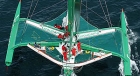
On Monday I joined up with the team in France to sail Gitana XI up to London. Here is my log:
1 May
Depart la Trinite-sur-Mer at 1800 UK time. After a miserable day of greyness and intermittent rain it has turned into a beautiful evening. The afternoon has been spent hovering around the massive Gitana base in St Philibert opposite La Triinte. This is essentially two factory units where over the winter there has been one 60ft trimaran in each. Both boats have undergone massive refits - Gitana XI for example has a completely new cockpit layout and has had the bottom half of her main hull cut off and a new one added with a flatter run aft and more curvature in her forefoot to her help her manoeuvrability in Grand Prix. The team have also been attempt to bring Gitana XII, a boat which hasn't been raced for a couple of seasons up to 2006 technology with new foils, a new cockpit, etc.
The square footage of the Gitana base is at least as big as the larger America's Cup equivalents in Valencia, minus the lavish hospitality suites. Hidden in a corner are two Open 7.50 sportsboats both decked out in Gitana livery. Today the Gitana shore crew are loading up their Formula 1-style articulated lorry which will be heading for London. Outside their base is a racing multihull graveyard presently home to the first Gitana trimaran (originally Elf Aquitaine) now sold, as has 'the pig' Gitana X, the 50ft Irens trimaran Nootka, the former Laiterie Mont St Michel and a potent looking orange trimaran, a bowsprit adding 50% to its LOA and clearly heralding from the Swiss lakes. The base for Thomas Coville's Sodebo team resides next door to Gitana. Indicative of the present split in the 60ft trimaran class at present Coville is planning another series of records in his boat rather than competing in the MultiCup.
Across the water in La Trinite the rather sorry form of the Kingfisher II maxi-catamaran has arrived, the Gitana team's latest acquisition. With just a stub of a mast remaining and some core damage to part of one of the hulls the boat by all accounts was purchased for a snip. The boat is booked in for a six month long appointment with the G-Class doctors at its maker, Chantier Multiplast nearby in Vannes.
1825 Gitana XII has left just before us and a couple of miles ahead. Meanwhile we are fitting the main, a beautiful golden carbon/Kevlar affair, a creation by Jean-Baptiste Le Vaillant at Incidences in La Rochelle. It is enormous - 198sqm, the same acreage as an America's Cup main only on a boat 20ft shorter...The head of the sail has a 4.6m square top. This is why god invented battens. Three of us man the coffee grinders to get the main up as Ronny (Ronan le Goff) feeds the sliders into the mast track. With intermittent breaks to thread reef pennents we get this giant sail hoisted with strangely little effort.
Unlike some of the other boats Gitana XI doesn't have the supposed structurally superior X-beam configuration, she has two crossbeams in a << configuration, but saves weight by not having an extra third beam for the mainsheet track.
The main is hoisted but still flogging and Ronny and Antoine 'Tonio' Mermod, the team's resident technical expert who previously had the same role with Karine Fauconnier's new Sergio Tacchini (Karine has just given birth to a baby girl we are told) rig up the outhaul - effectively a giant spectra lashing. Ronny sorts out the other reef points along the boom - again all spectra lashings. The mast at this stage is canted to weather.
We are presently motoring out into the Bay of Quiberon heading towards Belle Ile. The trimaran develops a strange lurching motion in the chop. This it takes a while to get used to. Our skipper former Tornado star Fred le Peutrec is sitting out helming from the starboard steering station half way out to the float on the forward side of the aft beam, protected from the worst of the elements by a perspex screen. On board we are six up the other crew being trimaran veteran Daniel Souben and former Olympic sailor and match racer Frédéric Guilmin.
Taking an opportunity to look around all the gear and systems seem business-like and well thought out. Some new features this year have included moving the two pedestals from the cockpit sole to the coaming - there is a small platform outboard of the cockpit allowing the grinders to do their business either side of the coaming. This frees up the central area of the cockpit. The gearing and linking of the winches is operated by draw cords on the side of the coaming, The mainsheet has been moved forward. The port primary is sheeted in reverse as on Cup boats.
1850 - with the reefing lines in place we take the first reef. Still motoring. We unroll the staysail (the trinquette) and we're off. Nice flat water. The apparent wind farm immediately switches itself on and suddenly from nowhere we are doing 17 knots. Wow! We're on starboard tack in 13 knots of wind from 215deg. The engine is switched off.
1910: on the wind heading for Belle Ile. Wind has dropped off to around 10 knots. Fred is still helming. In addition to the helm, compass, autopilot head and performance instruments, there are less obvious controls in each helming cockpit. One line runs forward under the netting and operates the trim tab on the daggerboard. This not only helps prevent leeway but helps balance the rudder Fred tells us. For Grand Prix there is another line used in Grand Prix that dumps the windward hydraulic ram on the shroud dropping the entire rig down to leeward prior to a tack or gybe. When singlehanding there another line that dumps the hydraulics for the main sheet.
19:25 We tack, heading up the channel between Port Haliguen and Belle Ile. 12 knots of wind. A chopper pops out of nowhere, the cameraman and photographer no doubt cursing that Gitana 11 and 12 are not closer together. Roast beef journalist with red (ie non-Gitana standard issue blue and gold oilies) is sent below.
19:30 sounds like the big gear is coming out upstairs. Bring on the Solent, the largest genoa at 120sqm. The foot of this has a cut out for the forward beam to maximise its area.
Down below in the main hull is the sole accommodation on this 60ft x 60ft beast. The space is narrow enough to wedge myself with legs not quite extended across ways and about 12ft in length. There is a small circular escape hatch either side, two bunks forward and to starboard. Off to port there is a small galley comprising a single camping gas bottle. Forward of this is the nav station. There is no table, merely a flat screen on a rotating panel with two B&G Hercules 2000 instrument heads beneath it. There is a tiny JRC LCD radar 1000Mk2, handsets for the Iridium and Nera Fleet 55 phones , a paper barograph, an electrics switch panel and an alarm panel. There is another black box called a Navex, which appears to be the small computer driving the display. There is stowage forward, accessible through the tiniest of hatches in the main bulkhead and in a more cavernous area aft beneath the cockpit, where there is a third bunk.
The motion is not too bad. Still lurching. Not entirely certain if my stomach has caught up with this yet. Pleased I had a sandwich for lunch and not 'plat fruit de mer'. There is an erry humming sound coming from the trim tab..
This article continues tomorrow.
More photos on the following pages...

Most Read
Most Commented
Comments
Businesses

Pro businesses
-
-
France
-
United Kingdom
-
Editor's choice
Member blogs
-
 Ned Collier Wakefield: MOD70 round BarbadosWell that was intense. 12 hard fought for seconds for the win. In idyllic conditions, Tony Lawsons MOD ...
 -
 Mini Transat leg 2 reportThe second leg of the Mini Transat started on 31st October, just over a month after ...
 -
Leg 1 reportI’ve been working towards the Mini Transat now for three years. In 2013 I was part ...
Business blogs
-
 The Island Sailing Club in Cowes, Isle of Wight, is delighted that Prince Michael of Kent ...
 -
Peta Stuart-Hunt chats with the 25 year-old British solo sailor Lizzy Foreman before she sets sail ...
-
The 2015 Student Yachting World Cup (SYWoC), an ISAF-recognised event hosted and run by students for ...
Editor's Choice
All time favourites...
-
 Three legs down into Ian Walker’s
 -
 Winning all but two races at
 -
 For the first time in its
Latest Comments
Add a comment - Members log in