
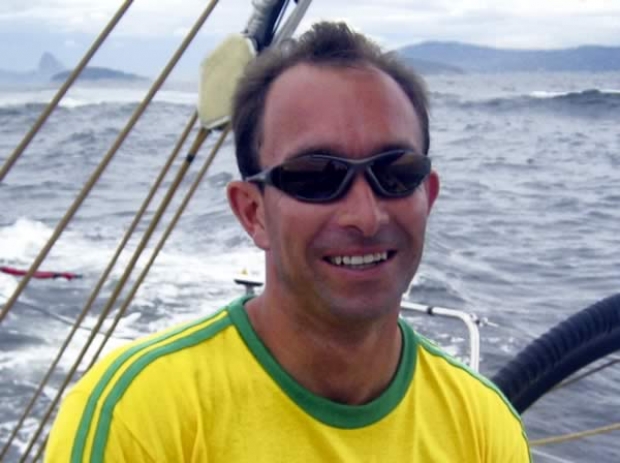
The latest Pirate
Monday May 1st 2006, Author: James Boyd, Location: United Kingdom
A Volvo Ocean Race virgin up until the Rio stopover was Scotland's finest, skiff and America's Cup sailor, Ian Budgen. In March the former GBR Challenge headsail trimmer became the newest Pirate taking over for the rest of the race from Rodney Ardern who with uber-bowman Curtis Blewitt was scheduled to hop off
the Black Pearl in Brazil to return to his day job at Alinghi.
"Ever since I started sailing the Volvo race has been one of my goals along with the Olympics and the America’s Cup," declared an excited Budgen. Prior to the start of this Volvo Ocean Race he says he tried to get on board a few other boats but his lack of oceanic and in particular Volvo experience worked against him.
In Budgen's favour has been not only sailing in the America's Cup but a background in a range of fast skiffs be they Laser 5000s, 49ers or 18 footers. He understands VMG racing. When it comes to big boats, aside from GBR Challenge he drove Peter Harrison's Farr 52 for 18 months and last year raced in the Rolex Transatlantic Challenge on Stuart Robinson's Swan 70 Stay Calm.
It also no doubt helped that Budgen sailed with skipper Paul Cayard on board George Andreadis' TP52 Atalanti last year as well as on Leonardo Ferragamo's Swan 45. He has also covered many many miles with Pirate navigator and fellow Brit and ex-GBR man Jules Salter.
Sailing with Cayard Budgie says is a fantastic learning experience. "He is a very analytical sailor, a numbers person. He is very different to me. I am much more gut feel, seat of the pants. So I enjoy sailing with him because we are quite different and I have a lot to learn from him. It is interesting to see how he analyses things - all the attention to detail. I also really enjoy sailing with him. He looks after the crew and the team really well. He is not a penny pincher. Paul won’t be afraid to throw money at the campaign if it will improve the result and make the team win. If he makes a mistake he is the first one to put his hand up and accept the responsibility. And that makes the guys on board actually work harder."
For Budgen the last leg of the Volvo Ocean Race from Rio up the Atlantic to Baltimore was his longest passage at sea. "I really enjoyed it, it was a fantastic experience and great fun. I was a little bit apprehensive before I left having not done the Volvo race before, but really anything I was concerned about before we left was unfounded. I certainly didn’t feel I had any troubles at all. One of the main reasons for wanting to do the Volvo race was to sail the boats. I really enjoy sailing fast exciting boats and I wasn't let down. Most of the time we are doing two knots of boat speed over our wind speed. So in 8-9 knots of breeze we are doing 10-11 knots of boat speed."
 On board with
the Black Pearl Budgen tended to be either driving or trimming main sheet but obviously got stuck into physical tasks such as sail changes, grinding, stacking and even the occasional foray up towards the foredeck...
On board with
the Black Pearl Budgen tended to be either driving or trimming main sheet but obviously got stuck into physical tasks such as sail changes, grinding, stacking and even the occasional foray up towards the foredeck...
The main drivers on board are Erle Williams, Cayard, Craig Satterthwaite and Dirk de Ridder. On this last leg stints on the wheel tended to change in duration according to the conditions, but were generally 45-60 minutes. "Sometimes when it is a bit more sedate then there are no so many people grasping at the wheel which is when I take the opportunity to do some driving and get some time in," Budgen says.
On the way up to Baltimore the most breeze they saw was around 24-25 knots. In these conditions the VO70 was flying. "The boat is a big high performance skiff really," Budgen describes it. "The canting keel technology has been given a load of grief in the press, but it really is a great improvement to big boat sailing. When it is light air you don’t need the righting moment so the keel sits in the middle of the boat, but as soon as you have got 5 or 8 knots of breeze then the keel is at max cant and it is like when you are dinghy sailing and you hike out more."
The top speed was around 28 knots - not the 30+ speeds the boats recorded in the Southern Ocean, but fast enough. Highest speeds were under fractional spinnaker or two sail reaching with the wind at 110-120degT.
Life on board the Black Pearl is rather different to Budgen's previous trans-oceanic rides, performance luxury cruisers such as Stay Calm or Peter Harrison's Farr-design ketch Sojana where there are feather duvets, hot showers and even a cordon bleu chef! "It is quite a happy boat and all the guys on board are really good and they have made it easy for me to fit in," says Budgen of his move from four-poster bed with sprung mattress to carbon fibre pipecot and shared sleeping bag on the high side. "The guys keep the boat very clean and tidy and that makes day to day living reasonably easy. I didn’t have any trouble waking up for the watch system every four hours even if it was the middle of the night. And sleeping in the bunks and freeze dried food - well, it is not your full on restaurant but I didn’t find it too bad. Life on board was pretty good."

No scrot rot, but an unpleasant dowsing in rotten baked beans for Equator newbies, Salter, Budgen and Ferris courtesy of King Neptune
In past race the leg up the Atlantic across the Equator and through the Doldrums is renowned for causing all manner of unpleasant fungal growth due to the sweltering heat, resultant sweat combined with limited personal hygiene on board. However the Volvo 70s may have put an end to this. "We were always very hot in general and it didn’t really get much hotter than when we were in Rio even up through the Equator and the tropics," says Budgen. "The boats generate so much apparent wind it was never too much of a problem and have very lightweight fans fitted downstairs to move the air around making it easier to sleep. So I didn’t suffer with any skin problems or spotty botty or any of the more renowned problems."
The greatest hardship was the incessant spray and water flying over the deck. "We did have some great moments spinnaker reaching which was very wet and the amount of water over the deck was very impressive. It was like being blasted in the face by a fire hose, when you’re doing 22 knots in 20 knots of breeze. And changing the headsail on the foredeck is always a major especially when it is one of the big reachers because it takes 5-6 people just to pull the thing down on the front. So we only changed [big reaching] sails at the change of watch when we have at least eight people on deck. All the difficult sail changes are when you are reaching when it is windy and when there’s a lot of water over the deck, especially at night."
Also what is rarely apparent is just the degree crews go to when it comes to stacking. Despite having canting keels the VO70s are still stacked every bit as agressively as the Volvo Ocean 60s were. "What was particularly apparent was how hard we pushed things and how full energy Paul is all the time in order to win," continues Budgen. "When it is breezy and when we stack gear on the side of the boat then everything is stacked apart from our sealed equipment which we aren’t allowed to move. Everything else be it the cups or the toothbrushes – every last piece of equipment is moved to the windward side or the back to stop the boat nose diving."
Volvo 70s are allowed to carry a tonne of water ballast inside their transom, but this doesn't appear to be enough to stop the bow burying sailing downwind at speed. "When we are downwind with the A4 masthead spinnaker up, then the boat does bury the bow often just as you jump from wave to wave," Budgen says.
For teams in the Volvo Ocean Race with four legs to go, plus two in-port races and one gate, 70 of the 109 points available have gone and Mike Sanderson's team on ABN AMRO One hold 63.5 of them with a 19.5 point lead over second placed movistar. The race is certainly not over but realistically the fight is now on for second place. "I came here with an open mind, yes we can still beat them [ ABN AMRO One]. But I think realistically most people are coming to terms with the fact that the boat is a knot quicker all round and really the battle now is for second. That is certainly our goal," admits Budgen.
In the Pirates favour is that in the limited sail wardrobe environment of the Volvo Ocean Race they perhaps have more sail cards still to spend than some of the other teams. New sails have been brought on in Baltimore and they are still keeping a couple in hand in case of disaster between here and the finish. "Having sailed with Paul before, he is pretty shrewd and doesn’t leave many stones unturned or leave anything to chance." Other than this they are still making small refinements to the boat. On board Justin Ferris and Dirk de Ridder handle the sail program.
Another aspect of the Pirates is that we believe they have the oldest crew. Cayard is now 46, while Volvo Ocean Race grand-daddy Erle Williams (who raced on Flier in 1981-2) is 47 and they have Jerry Kirby, the world's oldest professional bowman who has turned 50, thereby making him eligible for 'Big' Mike Howard's proposed over 50 crew for the next Volvo.
Despite Cayard being a fairly intense individual, Budgen is keen to point out he runs a happy ship. "The one thing about the Pirates team is that it is pretty settled and that is one of the strongest points of the team, because it means everyone works together and everyone is trying pretty hard and we are not a team where you still don’t know if you are still going to be on the boat tomorrow or in the next few days."
Most Read
Most Commented
Comments
Businesses

Pro businesses
-
United Kingdom
-
-
France
-
Italy
Editor's choice
Member blogs
-
 Ned Collier Wakefield: MOD70 round BarbadosWell that was intense. 12 hard fought for seconds for the win. In idyllic conditions, Tony Lawsons MOD ...
 -
 Mini Transat leg 2 reportThe second leg of the Mini Transat started on 31st October, just over a month after ...
 -
Leg 1 reportI’ve been working towards the Mini Transat now for three years. In 2013 I was part ...
Business blogs
-
 The Island Sailing Club in Cowes, Isle of Wight, is delighted that Prince Michael of Kent ...
 -
Peta Stuart-Hunt chats with the 25 year-old British solo sailor Lizzy Foreman before she sets sail ...
-
The 2015 Student Yachting World Cup (SYWoC), an ISAF-recognised event hosted and run by students for ...
Editor's Choice
All time favourites...
-
 Three legs down into Ian Walker’s
 -
 Winning all but two races at
 -
 For the first time in its
Latest Comments
Add a comment - Members log in