
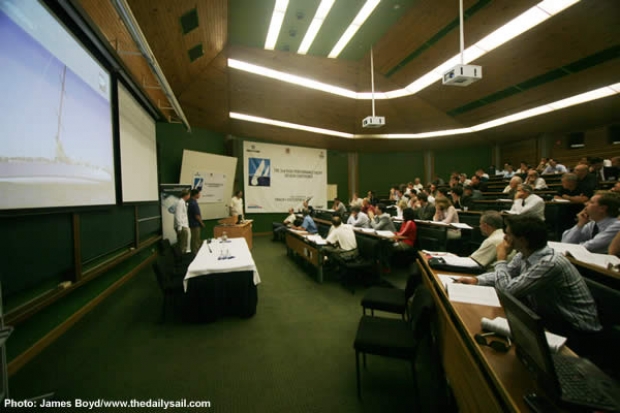
Scientists get together
Wednesday March 1st 2006, Author: James Boyd, Location: Australasia
Following the first High Performance Yacht Design conference held in Auckland while the 2002-3 America's Cup was in town, so the second conference took place over 13-16 February, again in Auckland.
Without the benefit of having the America's Cup taking place a couple of miles away, the delegates weren't of the same number or perhaps as high profile as they were in 2002, when attending were Cup 'names' such as Phil Kaiko, Andy Claughton, Clay Oliver and Rob Humphries. However this year it still included many top figures from the world of yacht science and proved a larger gathering than the organisers expected.
"Our challenge with this event was to maintain the momentum," says Michael Eaglen, of High Modulus and conference Chairman. "Last time we had 140 people. This time we were aiming at 70 so having more than 100 is terrific."
The momentum Eaglen refers to is down to the organisers desire to stage the next 'big' HPYD conference in February 2008 after the 2007 America's Cup is over. The AC remains the arena most prolific and where most funds are available for R&D into the minutae of ways to make boats go quick. "We had a lot of those comments in December 2002 - ‘oh, if only you could put off the conference for eight months.’ So we’ve taken the New Zealand summer straight after the AC for the next event," continues Eaglen. The idea is to have the Auckland event as the southern hemisphere answer to the Chesapeake Sailing Symposium in the US.
The first High Performance Yacht Design conference was born of Yacht Vision, a gathering aimed to help boost New Zealand's superyacht business. That proved extremely successful but at the time New Zealand was also the America's Cup defender and it was felt there was a requirement to stage an event covering the technical aspects of performance yachting as well as showcasing New Zealand's standing in this field. The University of Auckland for example, then as now, was setting the pace in several areas of the yacht research while the Massey University in Auckland was setting up their marine design course.
Since the first conference, the driving force of that event, the Naval Archiectural Society of New Zealand, has merged with the Royal Institute of Naval Architects becoming their New Zealand division.
From the speakers and delegates' point of view the recent conference fell at a very much worse time in the America's Cup cycle than the first. Despite taking place in Auckland none of even Emirates Team New Zealand design team were able to afford the time to attend, having recently launched their latest Cup boat. However while many of the attendees were not front line designers, many attending were involved carrying out research for Cup teams.
These included for example:
- Ian Campbell, a 30 year stalwart from the Wolfson Unit who currently holds the position of 'senior scientist' for Luna Rossa, overseeing their tank and wind tunnel test program.
- SP Technologies, composite structural engineer Luke McEwen was a finite element analyst for Prada in 2000 and subsequently was leading engineer for GBR Challenge
- McEwen's Australian colleague Tom Cowan who worked on the maxis Morning Glory, Pyewacket, Genuine Risk, Alfa Romeo and Wild Oats.
- Professor Richard Flay of the University of Auckland, and former director of their Yacht Research Unit. Flay was responsible for designing the world's first twisted flow wind tunnel in 1993. The research from this was embraced by Team New Zealand and many in the yacht science world believe it was this that was responsible for giving the Kiwi sail and rig program the edge in the mid-1990s. Flay has gone on to set up several of the largest wind tunnel facilities in the world.
- Professor Fabio Fossati runs the impressive new 'wing' tunnel (another facility where twisted flow can be investaged) at the University of Milan. Here much of Luna Rossa' wind tunnel work is carried out and the facility has also been used to update the aerodynamic side of the IMS VPP.
- Philippe Planquart of the von Karman Institute for Fluid Dynamics in Belgium, a fluid dynamicist of 15 years experience and who is presently team leader for the investigation into the aerodynamics of sails.
- two representatives from Marintek in Norway where they have a 300m long towing tank facility
- Professor Lars Larsson of Chalmers University of Technology in Sweden, who has been involved in several America's Cup campaigns and is best known as co-author of best-selling book Principles of Yacht Design.
- Associate Professor Peter Richards of the University of Auckland, the present Director of the Yacht Research Unit
In what would imagine might be an exclusively male environment, there were several women including Owen Clarke Design Group's Liz Tier, Dr Natasha Erriu of the University of Cagliari in Sardinia and computational fluid dynamics PhD candidate Sofia Werner from the Chalmers University of Technology.
The conference this year took place over three days at the University of Auckland. As ever subject matter for presentation and discussion at the conference was based upon the 'abstracts' received. For example this time canting keels were a point of discussion (particularly with the Volvo Ocean Race heading for New Zealand at the time) whereas they hadn't been at all at the first conference. Thanks to the University of Auckland's expertise in the field, this conference always tends to be strong in sail aerodynamics. In the event, this time there were sessions divided between Computational Fluid Dynamics for Sail Design, Canting Keels, Tank Testing, Sail Aerodynamics, Aspects of Performance Prediction, CFD for hull and appendage design, Hull and Rig Structures, Design and Construction.
Aside from canting keel technology, a more general area of development in yacht science at present - and as it has been for some years now - are the latest lessons and techniques for unifying test results generated in the virtual world through for example computational fluid dynamics (CFD) or finite element analysis (FEA) and the real world through full scale experimentation or tank/wind tunnel testing. Thus while writers talk about sharpening their pencils, yacht designers, engineers and scientists talk about refining their design tools with the ultimate objective of having their software able to mimic the real world perfectly.
More recently work has gone into adding velocity prediction programs (VPPs) into this mix - ie if your vessel has so much structure or if you alter a certain parameter it will go so fast. Resource has also gone into automating more of this process. At the HPYD conference a presentation of the new Wally 130 was made. This project benefitted from some of the automation work developed by Fabio Fossati.
"He’s looking at bringing computational fluid dynamics and velocity prediction programs into one," says Michael Eaglen who has been working on the Wally 130 for High Modulus. "They have a lot of work going on in aero-elastic modeling of sails so coupling the FEA that defines the flying shape of the sail with the aerodynamics, so you have a sail, wind comes on, sail loads up, sail stretches, changes the flow pattern and you iterate that through to get your flying shape. And of course the next progression from there is introducing dynamics and that is really only held back by computing power."
This type of research came on in leaps and bounds in the early 1990s with the introduction of the new International America's Cup Class yachts. Prior to this a huge amounts of data from tanks, wind tunnels and of the real world had been amassed for 12 metre yachts but this similar level of knowledge needed to be acquired quickly for the new class. This type of research has taken a quantum leap over the subsequent years helped immeasurably by the plummeting price of computing power. Thus for example with the change from Version 4 to Version 5 of the America's Cup rule, the bulk of the research has been handled this time around in the virtual world, computers being sent off to examine as thoroughly as possible the newly defined rule space.
Back to the conference and two of the most interesting papers looked at the latest research into computation fluid dynamics for sail design. Kai Graf and Hannes Renzsch presented their paper investigating the complex shapes of downwind sails, their aero-elasticity (how they change shape according to load) and how this could be integrated into the design process. In contast Steve Collie and Margot Gerritsen's paper 'the Challenging Turbulent Flows Past Downwind Yacht Sails and the Practical Application of CFD to them' described the more fundamental approach they had taken in their research into this subject, using the engineer's mean tool - a flat plate - which they have used to develop their CFD model. They particularly concentrated on the separation bubbles at the leading edge and trailing edge of headsails. A grand union between these two approaches is expected to take place by the time of the next conference in 2008.
In the canting keel session Ian Campbell gave topical insight into how the Volvo Open 70 rule was developed, to create a faster but hopefully as safe boat compared to the previous VO60. Campbell commented on the change from Kevlar/foam construction to carbon/Nomex, the change in the 'standards' to which race boat yachts are built (ie the American Bureau of Shipping phasing out their rules such as scantling requirements for racing yachts, used for umpteen years) and of course the advent of the canting keel compared to moveable water ballast used on the old generation VO60s. Campbell also discussed how the stability curve for a canting keel yacht becomes asymmetric compared to that of a fixed keel yacht and the effect of the cabin top on ultimate stability. Their R&D at the Woolfson Unit in the new Volvo rule also included a basic examination of how the weights of the different principle parts of a VO70 might change for boats with beams varying from 4-6m but with a maximum all up displacement of 14,500kg.
SP System's Luke McEwen presented his and Tom Cowan's paper entited 'Sink or Swim: the Fundamentals of Canting Keel Structures'. This included some interesting insight on the dramatic difference betweeen typical working loads and peak loads in fixed keel yachts compared to canting keel yachts, in particular the increased problem of keel root bending through vertical acceleration on canting keel yachts compared to their fixed keel equivalents. McEwen also expanded on how canting keel structures have developed - from the early Wallys where the canting keel mechanism came as a package that was slotted into the boat in one, compared to the modern but harder to build alternative where ram and bearing mountings form part of the boat's own composite keel support structure.
The highlight of this session came from the Owen Clarke Design Group in the form of Liz Tier's surprisingly honest and open presentation, providing much new information as well as some of the lessons learned from the keel foil failures that occurred to the Ecover and Skandia Open 60s in the last Vendee Globe. We'll be publishing this paper on thedailysail shortly.
Marintek gave their presentation entitled 'Added Resistance in Short Reflected Waves - sailing hull'. This research carried out in their enormous tank in Norway examined the effect of small waves on a model of a Swedish Match 40 hull, particularly focussing on how the results compared with typical resistance tests upwind in flat water.
Giorgio Contento from the University of Trieste presented a paper about their studies into the effects of different bulb shapes (ie long and narrow versus short and fat) with regard to the motion (particularly pitch and heavy) of America's Cup Class yachts in waves.
Philippe Planquart showed the results of wind tunnel tests made into a spinnaker fitted with 'an appendage' such as a horizontal series of boxes made of our lightweight cloth fitted to the apex of the spinnaker. His results showed that while the 'appendages' dramatically reduced the thrust of the spinnaker it also dampened pitching.
Milanese Professor Fabio Fossati gave a guided tour to his university's impressive wind tunnel facility where, like the University of Auckland set-up they can research twisted flow. The work between Auckland and Milan, we are told, is complimentary. Studies in Auckland have tended to concentrate on downwind sails where change in apparent wind dramatically increases the effect of wind shear while in Milan they are focussing more on the effects of wind shear upwind, also using an automated sheeting system on their model to keep trim optimised.
One of the most heavyweight presentations came from the University of Auckland team who described some of the alternative wind tunnel techniques they have been using including independent supports (for example of a Volvo Ocean 60 asymmetric spinnaker) and semi-rigid sails. Their CFD model for example now correctly predicts when the luff curl on spinnakers will occur... Related to this was Professor Richard Flay's subsequent insight into how to measure the pressure in sails using wireless sensors. This was trumped to a degree by the research carried out by the University of Cagliari's Mechanical Engineering department where they found a way to take full scale sail pressure measurements but on the very much more compact platform of a Tornado catamaran...
Claudio Fassardi delivered a paper on the dramatic developments he has made in the methodology used to investigate a given design space and optimising boats for it. This gave further insight into the future of automated yacht design and engineering using the 'Friendship-Modeler'. A presentation about automation of the design process was also made by Ulrich Remmlinger using another simulation program, while a duo from the University of New South Wales described their approach to writing design tools using a system called 'Knowledge Based Engineering' and fuzzy logic algorithms.
An Aussie team from the Australian Maritime College in Tasmania gave an extremely hi-brow presentation of their world into 'smoothed particple hydrodynamics', a new technique aimed at predicting the motion of ships and yachts.
Research heavyweight Professor Lars Larsson and PhD student Sofia Werner from the Chalmers University of Technology in Sweden gave their results from the CFD validation tests they had made in a wind tunnel, while studying varying parameters of a winglet keel (as used in the America's Cup, but with varying pitch angle and positioning of the winglets).
A local Auckland duo Mark Battley and High Modulus' Susan Lake presented their paper on designing composite structures for slamming loads (compared to the comparitively much simpler task of designing them for static loads) and what their research into this subject has uncovered.
Jarrad Wallace, a design engineer at Southern Spars along with professors from the Universities of Auckland and Wisconsin described the models they are now using for optimising the dimensions and minimum scantlings for carbon fibre rigs.
Conclusion:
While around 95% of what was said at this conference went way over this humble journalist's head, it is equally reassuring that there are people out there who do know a huge amount about the minutae of how sailing boats work. With every day that passes the science behind what makes boats go quick becomes less of a black art thanks to these people. Hopefully their research will not only end up in the domain of the America's Cup.
Most Read
Most Commented
Comments
Businesses

Pro businesses
-
Italy
-
-
United Kingdom
-
United Kingdom
Editor's choice
Member blogs
-
 Ned Collier Wakefield: MOD70 round BarbadosWell that was intense. 12 hard fought for seconds for the win. In idyllic conditions, Tony Lawsons MOD ...
 -
 Mini Transat leg 2 reportThe second leg of the Mini Transat started on 31st October, just over a month after ...
 -
Leg 1 reportI’ve been working towards the Mini Transat now for three years. In 2013 I was part ...
Business blogs
-
 The Island Sailing Club in Cowes, Isle of Wight, is delighted that Prince Michael of Kent ...
 -
Peta Stuart-Hunt chats with the 25 year-old British solo sailor Lizzy Foreman before she sets sail ...
-
The 2015 Student Yachting World Cup (SYWoC), an ISAF-recognised event hosted and run by students for ...
Editor's Choice
All time favourites...
-
 Three legs down into Ian Walker’s
 -
 Winning all but two races at
 -
 For the first time in its
Latest Comments
Add a comment - Members log in