
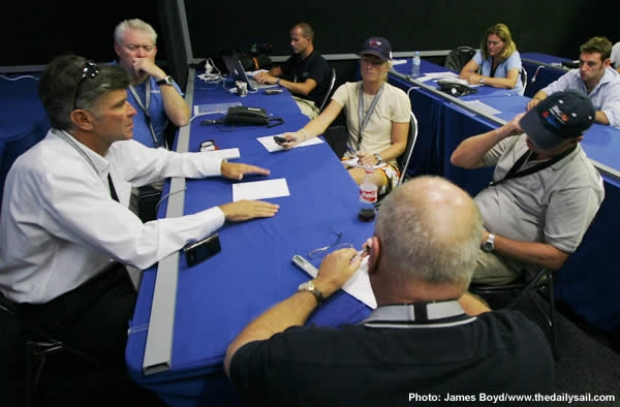
Volvo Ocean Race CEO Glenn Bourke in action
Safety and durability
Wednesday January 25th 2006, Author: James Boyd, Location: none selected
The sport of the moment within the yachting community following the large number of canting keel and structural issues their boats have suffered, appears to be Volvo-bashing. But is this justified?
Volvo seem equally keen to answer this question and with this in mind yesterday held a power meet between a group of their representatives, the three designers involved (Juan Kouyoumdjian, Russell Bowler and Brunel designer Don Jones), and members of the six teams and seven boats competing in the Volvo Ocean Race. Following this meeting Volvo Ocean Race CEO Glenn Bourke briefed the press about what had gone on:
"The meeting was to exchange and discuss information between the teams and ourselves about two specific items: The first was a safety review of the boats. The second one was a durability review - ie the ability for these boats to get around the track."
Volvo are keen to spell out the difference between safety and durability: Their boats may be breaking substantial gear, ie they lack durability at present, but they are 'safe' in as much as they are making port and no one has been killed.
The safety issues mainly involve procedure or extra gear that needs to be carried. The first is the potential dropping of the mandatory HF/SSB radio sched maintained between the boats that many teams feel is obsolete on 21st century boats bristling with satcom antennae. "One rational behind it was that they felt so comfortable with the duty office back at headquarters," said Bourke. "Moose [Mike Sanderson] gave the example of when they do a back up in the middle of the ocean, the duty officer will ring them up and find out if anything is wrong. And they’ll say, ‘no, we’ve got a little weed on or we’ve got a shark wrapped around the rudder’ or whatever and we are doing a back-down'. So they felt comfortable that someone was looking over their shoulder at all times which was heartening for us."
 In terms of gear Volvo are going to make it compulsory for boats to carry a portable satellite phone in their grab bag. "It will be sealed and won’t be used for general communications but can be used in the event of an emergency and is easily accessible." At the moment the emergency satphone is optional and it is thought around half the boats carry them.
Active radar transponders, that would give a Volvo 70 the radar significance of a frigate, are also likely to be made mandatory equipment for when the boats return to the North Atlantic, visting the US and Europe.
Finally boats are also likely to be fitted with high capacity water pumps. "Under the rule at the moment, there is a requirement for a water pump, but the volume of that pump isn’t specified," says Bourke. VO60s because they used water ballast were automatically fitted with a massive water pump. For the VO70s the pump will be kept in the safety box and used in the case of the boat suffering a collision and becoming holed.
Following the numerous canting keel mechanism issues that have occurred during the race so far, so Volvo are going to make it compulsory for boats to carry a minimum amount of spare hydraulic fluid. "In the case of movistar they used some olive oil in the rams and according to the experts that is fine, you can use water in the rams and have them operate," says Bourke. It is likely boats will have to carry enough hydraulic fluid to completely refill their hydraulics they carrt on board.
Weight-wise this gear will either fall within the standard limit of spare non-measured safety equipment brought on board, or Volvo will just mandate that it must be brought on board, says Bourke.
The meeting then moved on to the more thorny topic of durability. "The question we raised was - how can the race office or management assist you in creating a more robust boat to ensure that you’ll get around the track in a competitive sense. A lot of that conversation evolved around how much extra structure was required per boat. The next component of the conversation was whether the rule constrained you from complying with the structural requirements that you needed to get around the track," says Bourke.
Prior to the meeting there had been some talk of Volvo possibly relaxing the maximum weight limit of 14 tonnes in order to allow teams to add extra extra structure or change to heavier but more reliable rams. While this would have been fine for some of the boats suffering problems, there were objections to this from ABN AMRO and also Grant Wharington's Brunel team, neither of whom have suffered structural problems of any consequence - or none at least which have prevented them from racing.
 "It would have been very unfair if they had allowed that to happen," said ABN AMRO designer, Juan Kouyoumdjian, who had flown in from Valencia especially to make this meeting. And it was over this topic that many at the meeting were expecting it to go on for most of the day. In fact the head to head never occurred. "It became quite evident quickly that they [the teams] all felt that the rule didn’t preclude them from creating the structure in the boat that they needed to be robust enough to sail in these waters," says Bourke.
This was Juan K's take on proceedings too: "Very quickly there was a consensus throughout the teams that the rule is not to blame. The rule is very clear as it is. Right now it is producing really extraordinary boats and everyone should deal with their own situations within the limits of the rule. So everyone was quickly in agreement with that and what was supposed to be a 10 hour meeting ended up being about an hour an a half – and everyone was happy, which was great."
Another reason why the rule is off the hook, is that the problems the boats had suffered have been quite diverse. "Of the nine reasons that had caused boats to either pull out or pull into port, that five of those were related to the hydraulic systems and four were related to structural issues," said Bourke. "In terms of the structural issues, none were alike from boat to boat. We had different issues on each of the four occurrences which meant it was hard to determine where you would put weight even if you were allowed to put weight into the boat."
So if the responsibility for the carnage doesn't fall on Volvo then who is responsible? "The general feeling was that the rule didn’t stop you adding structure to your boat and it was the responsibility of the designers and the teams themselves to make that judgement call on how much structure they would want to add and where," continued Bourke. Rather than letting this extra weight merrily take the maximum weight of the boats above the 14 tonne maximum, so this extra weight would be compensated by removing lead from the keel.
"The rule is perfectly clear and is there to be respected," says Juan K. "If you are going to put 100kg of structure into the boat, you have to take it out of the bulb, likewe did in Cape Town before with the white boat."
Where Volvo had allowed some flexibility is over timings. All the boats were supposed to be reweighed prior to the Melbourne in-port racing on 4 February. However Volvo have extended this deadling to before the start of the next leg on 12 February, as a particular sop to the Pirates and Brasil 1. So how will measurement work for the in-port race? For this in-port race teams will have a sign a declaration that they are within class rules. "We will then weigh the boat afterwards and if they are over, it is their risk - the jury will have do whatever it has to do," says Bourke.
Aside from getting Volvo off the hook, the designers at the meeting went as far as to say to Volvo that they didn't want to be constrained by further rules. "The designers said to us 'please don’t mandate to us what we should do in order to make our boats seaworthy and robust - let us do that, that’s our job. We evolve these boats under certain philosophies so leave it in our hands. And the teams backed them up on that," says Bourke. "They felt that the specifications for the hull as they are in terms of the six collision bulkheads, the core, the hull skin laminates - they believe are right in the ballpark. They don’t believe they are the issues in terms of the structural integrity of the boats. So from our perspective given that they were the key criteria in specifying our scantlings of the hull and the rest was left to the designers, they are not saying they are wrong, which is probably why I have this relieved look on my face."
Juan K acknowledges this: "I would be in favour of making the VO70 rule more open. The crews, the teams, the designers and the skippers of the race should have the responsibility. They are entering a Grand Prix world knowing that and they expect to have the responsibility on their part as much as myself as a designer - I know that I am taking a lot of risk here as well – but that is the name of the game."
Given that there have been significant problems with some of the boats over the last two legs Bourke feels, or perhaps hopes, that there is a feeling within the teams now to go for more safety as it is more valuable to them in terms of points to finish legs. "I do think the boats will become more robust and we’ll see piles of lead out in the car park here."
Having seen videos in the past of boats burning to the waterline in a matter of minutes, we were quite concerned over the three electrical fires that had occurred on board the boats over the last two legs. We understand there was a small unreported flare up on ABN AMRO One again this leg. Oddly we understand this wasn't brought up in the meeting. The issue seems to be the lightweight, aeroplane grade wiring the boats are using. Bourke thinks this not to be an issue: "It doesn’t make sense to me that you get a fire inside a carbon fibre boat and you can’t put it out or the water that comes into the boat can’t put it out." True enough - generally boats which burn to the waterline in minutes are moored, however any sort of fire on board has to be considered a bad thing.
None of the above gets us any further to establishing why the Volvo Open 70s have suffered a spate of keel and structural problems.
We find it wholly unsurprising that there have been some significant teething troubles with the new Volvo Ocean 70s. The boats represent a new breed of ocean racing monohull and are showing unprecidented levels of performance as demonstrated by the fact that new world 24 hour records have been set on both the last two legs.
Just 10 years ago 563 miles in a day would have qualified ABN AMRO Two as the fastest boat in the world outright, monohull or multihull. Because of this the general consensus of those that sail them is they are very very cool pieces of equipment and Volvo are to be thoroughly commend for having the balls to create them.
But being able to charge through the ocean on at speeds exceeding 30 knots or upwind at more than 12 knots on a 14 tonne monohull is a genuinely new experience and represents a fresh challenge in terms of te design and, in particular, engineering of the new boats as well as for the crews in terms of how they sail the boats and survive on board.
For example with Open 60s everything possible is done to make sure that the boat is as light as possible. Whereas with the Volvo Open 70, bulb weight is such a driving factor in the rule that it outstrips having a light overall displacement.
Like racing multihulls, Volvo Open 70s are so fast that it is easily possible for them to be sailed to destruction unless the crew is sympathetic to waves and sea state and has some vague feel for how much their boat can take. It would of course be possible to build a VO70 stronger, so that it was as indestructible as the older generation Volvo 60s, and at times this would enable the crew to push the boat harder. However with VO70s, as with other boats of this genre such as Open 60 and 60ft trimarans, its seem that heavy indestructible boats are not as fast across the board as boats optimised for lower wind speeds that merely survive in bigger conditions.
Another reason for the failures was the considerable amount of inter-team bulb envy going on prior to the start of the race as all the boats were out of the water in Sanxenxo. This prompted teams to spend ages removing weight from inside of their boats including sensitive areas such as the keel rams in order to slap more lead on to the bulbs, to a degree that many teams such as movistar now admit was a little over-zealous.
Glenn Bourke acknowledges that there is nothing unusual about teams eyeing up the opposition before a regatta and responding to it. Just on this occasion most of the teams had less of a clue what they were dealing with. "My personal feeling is that whole weight chase has been over done," he says. "It has become far too important. I think in hindsight, if they had concentrated on making the boats more robust they would certainly have more points at this stage of the race."
We put it to Bourke that while the Volvo 70 rule contains all sorts of parameters governing scantlings, weights, even the exact design of various parts of the boat, etc one area it fails to limit is the keel canting system and the surrounding structure. Surely the Volvo 70 rule should not promote piling weight into the keel bulb from the hull (for example there seems to be no incentive to do this under the Open 60 rule) and certainly not allow it to be shaved off upstairs by fitting lighter weight rams and removing structure.
Bourke admits that if there was one change he'd like to make to the VO70 rule this would it. "There are some things we could do. We could nominate the keel canting mechanism and structural weight so you have to have 500kg in these components of the boat," he says. "But measuring it is really hard and is why we didn’t do it this time. The more rules you write the more avenues there are for twisting the words and finding a way around them."
An alternative would be to have less rules such as the Open 60 rule, which in truth is anything but 'open' or the rules for the ORMA trimarans. "One of the beauties of the Open 60 rule is that there are very few words in it," says Bourke. "But one of the problems with the Open 60 rule is that the boats aren’t robust either. In fact they have the worst track record of any ocean racing boat." We point out that the ORMA 60 trimarans in fact have by far the worst track record. However Bourke has a point. While there is furore at present over these horrid, dangerous unsuitable-for-offshore-racing canting keels the new Volvo boats are using, relatively little was made of the outrageous problems they suffered on Open 60s in the last Vendee Globe when the foils on both Skandia and Ecover snapped clean off.
Juan Kouyoumdjian believes that a radical new approach needs to take place over the engineering of this new generation of boats, an opinion probably equally valid for the Open 60s and large multihulls: "This is a very hot topic for me at the moment. What I can tell you right now is that the typical structural criteria we’ve been applying to boats so far, ie doing a static analysis and applying safety factors to it, doesn’t apply any more in this world. The Volvo 70s are going into a territory where the structural design criteria should be looked at differently.
"I hear the arguments of some people calling for extra reinforcements and I think that is the wrong approach. I think that if anything we have not strength problems, we have stiffness problems. In our case most of the problems we suffered were of too much stiffness rather than too much strength.
"I think the big difference between this static analysis and the dynamic reality happens a lot in the understanding of how the different structural elements work together on those dynamic peaks. The key is when you go into a dynamic world you start solving problems on a time-dependent basis. And on that basis you can see very high peaks of dynamic load and they are very difficult to simulate and very difficult to deal with but in essence what is happening is that the boats through a cycle of going through 1000s of waves they end up working at a stress average that is a lot higher than the static one. That increase of stress average is not linear with the increase of load in the forestay or in the runners or in the keel, so hence we are conditioning our models to give it a little more load on the forestay or in the runners or in the keel and that is our 'safety factor’ but when you get into dynamic time dependent problem this is completely non-linear. So maybe you have a 30% increase in the forestay load but a 600% increase in the junction between structural members that are linked to it. So it is very very delicate and this Volvo race is going to teach us a lot about that."
In short Juan K believes that all the safety standards from classification bureaus such as ABS, Lloyds, ISO, etc are inappropriate for boats of these type as these standards rely on the addition of safety factors to static analysis.
Glenn Bourke says that one solution to the type of problems they have been encountering is going one design. This would open up another can of worms in terms of the rule, he acknowledges and the rule would only be good for 10-15 years, according to the pace of technology, but it could create a more structurally sound boat, better competition and a more level playing field. However there does seem to be serious resistance to this.
"I had a really interesting conversation with Pierre Fehlmann and I wanted to understand, when we were trying to dream up this concept for the boat what happened to the Grand Mistral," says Bourke. "And he said 'the one piece of advice I can give you as a given is ‘don’t go one design’. Too many issues. I think it was a psychological thing. I think people perceived because it was a one design and therefore not high-tech or not their beast, etc, so sailing as a sport pilloried the idea. This is odd because at the end of the day, 90% of us came out of one design boats. But it is not Formula One when it is one design and in the second and third iterations it is increasingly classified as a dinosaur."
Another criticism levelled at Volvo is over the lateness of the rule being announced. Bourke thinks this had absolutely no bearing on the present situation. "It would have made no difference if the rule had been ready a year earlier. We weren’t fighting with sponsors over the rule being ready for them to go and build boats. We were fighting with sponsors over the business case of the Volvo Ocean Race as opposed to football or tsunami relief or the Tate Gallery. They were the only conversations we were having. In review of the last race, many of the guys who were putting programs together, they were saying ‘forget about the type of boat’ because that is not in the equation with the sponsor. The cost of it is and the return on investment is and what the sport embodies - sport, adventure, teamwork, environment, discovery, etc. No one says does it go 550nm or 540 nm?"
Most Read
Most Commented
Comments
Businesses

Pro businesses
Editor's choice
Member blogs
-
 Ned Collier Wakefield: MOD70 round BarbadosWell that was intense. 12 hard fought for seconds for the win. In idyllic conditions, Tony Lawsons MOD ...
 -
 Mini Transat leg 2 reportThe second leg of the Mini Transat started on 31st October, just over a month after ...
 -
Leg 1 reportI’ve been working towards the Mini Transat now for three years. In 2013 I was part ...
Business blogs
-
 The Island Sailing Club in Cowes, Isle of Wight, is delighted that Prince Michael of Kent ...
 -
Peta Stuart-Hunt chats with the 25 year-old British solo sailor Lizzy Foreman before she sets sail ...
-
The 2015 Student Yachting World Cup (SYWoC), an ISAF-recognised event hosted and run by students for ...
Editor's Choice
All time favourites...
-
 Three legs down into Ian Walker’s
 -
 Winning all but two races at
 -
 For the first time in its
Latest Comments
Add a comment - Members log in