
The Carolijn and Sebbe show - part two
This article follows on from part one here ...
It is fair to say that Carolijn Brouwer and Sebbe Godefroid have now fully been assimilated into the multihull racing world for in addition to their Olympic Tornado pretentions, they have also been sailing a Formula 18, and most recently they have been driving the Volvo Ocean Race's own VX40 catamaran.
"Herbie [Herbert Dercksen] and I have done some work together before and it was Herbie who asked me if I wanted to skipper one of the boats," says Brouwer of the hot new catamaran class. "Ironically we were just reviewing our Tornado campaign and saying that we should plan a little more rest - we had been pushing quite hard because obviously we wanted to close our gap with the guys at the top as quickly as possible, so you want to train more especially because we had to get hours in. And we were saying how we had to be very strict with our planning...and then this came up and now our whole year is fully booked!"
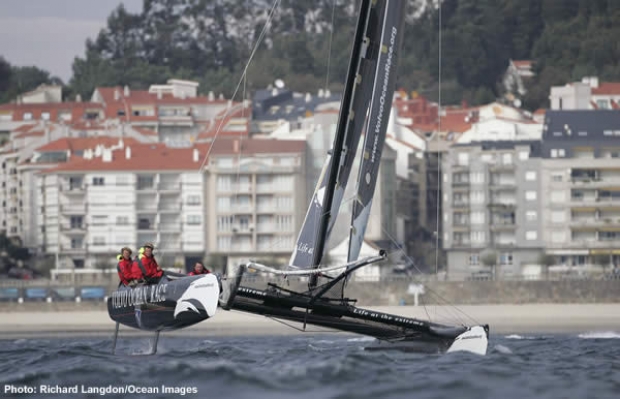
At the first Grand Prix for the new 40ft catamaran class, held in Sanxenxo between the Volvo Ocean Race's first in port race and the start of the first offshore leg, Brouwer and Godefroid were racing the Volvo Ocean Race VX40 together with team mates Jeroen van Leeuwen, a young Dutch Tornado sailor and offshore veteran Greg Holman.
The raison d'etre of the VOR having its own boat is as a corporate hospitality vessel and during the Grand Prix the mornings were spent taking guests out and entertaining/scaring them, while in the afternoon there were the races counting towards the Grand Prix. Even in the Grand Prix always on board was one guest, be it a VIP or a journalist or merely an interested party in addition to the four crew.
"The fifth man on board often doesn’t know about sailing, so you have to pay attention to them and put their safety first," says Godefroid. "Sometimes it is really hard - we would say to them from the beginning 'we are going to go racing full on, so don’t be amazed if we start shouting, as we are full of adrenalin. It is not because we are angry, but things have to happen and we want to make sure you hear...' We had a girl on board who’s eyes and mouth were wide open - she didn’t know what was happening, she’d never been on a boat before and we had a hectic race…"
The equivalent of the America's Cup 17th man spot, to race on board one of the fastest sailing boats afloat, is an opportunity not to be missed especially when it is with some of the greatest Tornado sailors on the planet - Mitch Booth, Randy Smyth, Leigh McMillan, Hugh Styles, etc. "Everyone is so enthusiastic about it and all the guys who come sailing are so happy, grins from one ears to the other," says Brouwer. "And then in the afternoons you get into full on racing and you have to switch into a different mode."
While the Volvo Ocean Race sponsor their boat, it is owned by a Brit who wishes to remain anonymous, but who is both a multihull enthusiast and shares class co-ordinator Herbert Dercksen's vision of using the VX40 to help bring exciting round the cans racing to the masses.
"On the first day we had a crash," recalls Brouwer with a shudder. "Here we are, not five minutes into the first race of the first ever grand prix and the boats fully crash. And the owner is on board and I’m like ‘my God this isn’t happening - the owner’s on board’. But he was fully into it. It was like ‘get closer, get closer!’ - bouncing on the trampoline..."
Sebbe takes up the story: "We thought we should stop the boat and see what we could do and we were slowing down and he went ‘this is real racing, this is the way I like it: let’s go on!’ So I looked at Caro and said ‘let's go’." They won the race, and went on to score three bullets on the first day, despite Brouwer being the rookie cat sailor among the four other Olympic Tornado veteran helms.
"Our owner is basically doing it for the best of the sport," says Godefroid. "He likes the sailing world and he thinks this is a way of bringing it to the public and to make it open to everybody. And he says it has to be a show, spectacular and we need crashes and we need capsizes and it has to be full-on and I don’t care if it costs money - it is the show that counts. And that is great for us because he is really supporting our sport and the sailors." Oh, for more owners like this...
"When he is out on the boat he is always keeping an eye out for how many people are watching," Brouwer butts back in. "If there is not enough people watching then he is disappointed because we’re not getting the message through. That is really important for him.
Over the course of the five day Grand Prix in Sanxenxo, Brouwer and her Volvo Ocean Race team were leading up until the final day when double Tornado Olympic silver medallist, ex-Formula 40 champion and sailmaker Randy Smyth started to show his talent.
"I think once the breeze is up a bit we showed we can sail the boat well so the boat is balanced well in the water," says Brouwer analysing how they fared in the first Grand Prix. "Our crew work was really amazing considering the number of hours we had in the boat, it was running really well. And in the light stuff it was just a lack of experience and that is where Randy nailed it really well - more so than even Mitch or the others. He had that little bit more feel for the boat in the light stuff and that is where we struggled as well. So there was one day with strong wind and three days with light breeze and Randy was just getting it right, sailing smartly. So we need to work on that and that is something which comes with experience and time and hours in the boat."
Godefroid adds that this being the first Grand Prix they much much to learn about how to make the boat go. "We still have to learn how to trim it perfectly. On the water now there are totally different approaches. The sails are trimmed in quite a different way and the mast rake is different and everyone is still looking to really sail these boats fast. It will take at least a year before we start to know what the important things are on the boat."
Brouwer and Godefroid are using the VX40 as part of their training so while Brouwer steers the boat, Godefroid does much the same job as he does on the Tornado - operating the main, traveller and calling tactics. "Already we're doing F18 and Tornado together," says Godefroid. "On the Tornado it is more physical and quite often I was close to my physical limits and therefore you are only thinking about that and you lose your attention for other things. On the Formula 18 the spinnaker is like a handkerchief so I can just do it with one hand easily and suddenly you have more time to look around and play more the tactics and it is like 'mmmm that really helps, maybe I should do that on the Tornado too...' So you really change the accents in your sailing and also now on the VX40, especially downwind, we have got two guys in the front to do the spinnaker, so I am only doing the main and the tactics and that gives you so much time to think about things. So it is really good to do the same things in different boats - the accents are different and hopefully in a few years we will control most of the important parts."
At the end of the day the VX40 is not only about racing, it is about racing fast and in this respect it is almost unbeatable. The VX40 speed record at present is 34-35 knots and it is thought that 40 knots can be had from it, in the right conditions from a crew with large enough cajones. "It has been designed to reach up to 40 and it wouldn’t surprise me at all if we reach that number," says Brouwer. "It is just we have to get used to it and we have to find a way to push it really hard. Randy pushed it really hard already but he didn’t control it fully at that stage, so on the windy day our basic tactic was to be safe - don’t make any serious mistakes and it turned out that all the others were having big problems at some stage and that’s where we got our advantage."
The next time the VX40s will be out sailing in public may be at the Volvo stopover in Melbourne, but this, if it happens, may just be an exhibition event. The next Grand Prix proper will be in Brazil when seven or eight boats are expected to be racing, then Baltimore when the fleet will have swelled to its maximum of 10 (more than this and they become particularly awkward to berth).
While they now have their big boat sailing signed off for the next few months, both Brouwer and Godefroid still have aspirations of racing offshore, although this will be hard to fit into their schedule until after the next Games in 2008.
"I always like to try and do a combination of both," says Brouwer. "I think that is very good and you are seeing that more and more often - dinghy sailors ending up on big boats, because they bring the feel along into the boat. And I enjoy sailing in a team, being part of a professional crew. But at the moment it is hard to plan anything more with the Olympic campaign and now with the VX40."
Godefroid says he would really liked to have competed in the present Volvo Ocean Race but at the time he was contemplating this no teams really existed. "I like big boats big time and I think there is another reason on top of it - you are never going to make a living out of Olympic sailing and I am slowly coming to an age where I should think about making money - not spending it! In big boats there is an opportunity to make money. On the other hand we have started an Olympic campaign, we have got pretty good support in Belgium for what we are doing now and it’s like ‘I’ve started it, so I want to finish it’ and I am not going to stop halfway unless there is a really really good reason."
For more on the Volvo Extreme 40 - see our report here and video .
Businesses

Pro businesses
-
-
United Kingdom
-
United Kingdom
-
Editor's choice
Member blogs
-
 Ned Collier Wakefield: MOD70 round BarbadosWell that was intense. 12 hard fought for seconds for the win. In idyllic conditions, Tony Lawsons MOD ...
 -
 Mini Transat leg 2 reportThe second leg of the Mini Transat started on 31st October, just over a month after ...
 -
Leg 1 reportI’ve been working towards the Mini Transat now for three years. In 2013 I was part ...
Business blogs
-
 The Island Sailing Club in Cowes, Isle of Wight, is delighted that Prince Michael of Kent ...
 -
Peta Stuart-Hunt chats with the 25 year-old British solo sailor Lizzy Foreman before she sets sail ...
-
The 2015 Student Yachting World Cup (SYWoC), an ISAF-recognised event hosted and run by students for ...
Editor's Choice
-
 Three legs down into Ian Walker’s
 -
 Winning all but two races at
 -
 For the first time in its
Latest Comments
Add a comment - Members log in