
The explosion continues
Tuesday November 1st 2005, Author: James Boyd, Location: United Kingdom
| Boat | Owner | Nat | Designer | Builder | Launch | Notes | |
| Transpac 52s | |||||||
|
1
|
Braveheart | Charles Burnett III | USA | Bakewell-White | Lloyd Stevenson | ||
|
2
|
Flash | Mark Jones | USA | Alan Andrews | Westerly Marine | ||
|
3
|
Rosebud | Roger Sturgeon | USA | Reichel Pugh | Westerly Marine | ||
|
4
|
Lightwave | David Ford | USA | Laurie Davidson | Cookson | ||
|
5
|
Yassou | Jim Demetriades | USA | Nelson Marek | Goetz | ||
|
6
|
Beau Geste | Karl Kwok | HK | Farr Yacht Design | Southern Ocean Marine | Spring 2003 | |
|
7
|
Bright Star | Richard Breeden | USA | Farr Yacht Design | Goetz | Spring 2004 | |
|
8
|
Bambakou 52 | John Coumantaros | USA | Farr Yacht Design | Goetz | Spring 2004 | Ex-Esmerelda |
|
9
|
Sjambok | Michael Brennan | USA | Farr Yacht Design | Goetz | Spring 2004 | |
|
10
|
Trader | Fred Detwiler | USA | Jim Donovan | ML Boat Works | Summer 2004 | |
|
11
|
Patches | Eamoon Conneely | IRE | Reichel Pugh | Green Marine | Spring 2005 | |
|
12
|
Cristabella | John Cook | GBR | Judel/Vrolijk | Green Marine/Neville Hutton | Spring 2005 | |
|
13
|
Caixa Galicia | Vincente Tirado | SPA | Farr Yacht Design | Cookson | Spring 2005 | |
|
14
|
Bribon | Jose Cusi / H.M. Juan Carlos | SPA | Farr Yacht Design | Cookson | Spring 2005 | |
|
15
|
Sirius | Spanish Navy | SPA | Farr Yacht Design | Cookson | Spring 2005 | |
|
16
|
Atalanti | George Andreadis | GRE | Farr Yacht Design | Goetz | Spring 2005 | |
|
17
|
Orlanda | Alessandro Pirera | ITA | Bottin & Carkeek | Latini Marine | Spring 2005 | |
|
18
|
Pisco Sour | Vasco Vascotto | ITA | Bottin & Carkeek | Longitude | Spring 2005 | |
|
19
|
Quantum Racing | Doug de Vos | USA | Reichel Pugh | Barcos Deportivos, Spain | Spring 2005 | |
|
20
|
Pegasus 52 | Philippe Kahn | USA | Farr Yacht Design | Goetz | Summer 2005 | |
|
21
|
World Force | SPA | J. Jaudenes/Theys | Richie Faulkner | Summer 2005 | ||
|
22
|
Team Balearia | Toño Gorestegui | SPA | Bottin & Carkeek | Summer 2005 | ||
|
23
|
Rush | Thomas Stark | USA | Farr Yacht Design | Cookson | Autumn 2005 | |
|
24
|
Warpath | Steve and Fred Howe | USA | Bottin & Carkeek | Cookson | Autumn 2005 | |
|
25
|
Mean Machine | Peter de Ridder | NED | Judel/Vrolijk | Hakes Marine | Autumn 2005 | |
|
26
|
Frank Pong | HK | Juan Kouyoumdjian | Compania de Barcos | Autumn 2005 | ||
|
27
|
Stay Calm | Stuart Robinson | GBR | Farr Yacht Design | Goetz | Autumn 2005 | |
|
28
|
Sotto Voce | Arien van Vemde | NED | Judel/Vrolijk | Hakes Marine | Autumn 2005 | |
|
29
|
Fram | H.M. King Harald | NOR | Farr Yacht Design | Cookson | Spring 2006 | |
|
30
|
Team Astro | Rainer Wilhelm | AUST | Luca Brenta | Maxi Dolphin | Spring 2006 | |
|
31
|
Platoon | Harm Muller-Spreer | GER | Judel/Vrolijk | Goetz | Spring 2006 | |
|
32
|
Pinta | Michael Illbruck | GER | Judel/Vrolijk | Cookson | Spring 2006 |
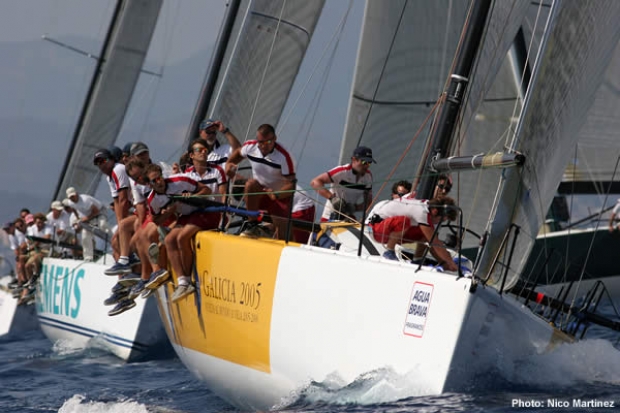
Never in the history of our sport have we seen the take-up of a class of large race boat happen to such a degree as is at present in the TP52 class.
Considering new TP52s cost in the order of 1-1.3 million Euros according to where they are built, and at least 50% of that figure to campaign annually, the Breitling MedCup peaked in this its first year, with 11 boats and as many as 20 are expected to compete in the circuit next year. By this time 32 boats will have been launched in total - including the original US West Coast Transpac boats.
While the Breitling MedCup in 2006 looks set to double its fleet size in 12 months, equally impressive as the soaring numbers is the quality of the owners and sailors involved. Peter de Ridder, Arien van Vemde and Steve and Fred Howe are making the transition across from the Farr 40 class as, it is believed John Kilroy may do in due course. Hong Kong industrialist Frank Pong already owns two maxis, the G-Class maxi-monohull Maiden Hong Kong and one of the former Pyewackets and is now set to try his hand in the new class, as is King Harald of Norway, the second monarch to join the TP52 party, who needs little introduction following his series of Frams. This year the King's Fram XV won the European IMS Championship.
The class' most recent launch - Thomas Stark's Rush will feature Alinghi's Ed Baird as tactician, while former Swan 70 owner Stuart Robinson's new Stay Calm II is being run by Adrian Stead and will no doubt have a wealth of UK south coast sailing talent on board to rival Ian Walker's team on Eamon Conneely's Patches.
The latest to stick their head above the parapet is Michael Illbruck who intends to campaign a new Pinta - continuing the tradition establish by his father Willi - with his Volvo Ocean Race winning skipper John Kostecki running the show.
Of these new boats some will be ready to race in Florida at the beginning of next year. At present Patches, Philippe Kahn's Pegasus, Rush, Trader and Stay Calm II are officially entered in Key West Race Week while nine or ten TP52s in total are expected to be racing there. Following this with be the class' inaugural Global Championship to be held in Miami over 7-12 Match, running alongside Miami Acura Race Week. 12 boats are currently entered in this.
While John Coumantaros and his Bambakou team were the only pure-US team competing on in the Breitling MedCup this year, so they are to be joined in 2006 by Tom Stark's Rush and the Howes' Warpath who are also making the trip across to the Med.
German Harm Muller-Spreer's Platoon, a Judel-Vrolik design under construction at Goetz, is also expected to compete at the Global Championship before heading to the MedCup. New designers are entering the class in the form of Juan Kouyoumdjian and Luca Brenta, the latter having designed the new Team Astro (below) for Austrian owner Rainer Wilhelm.

There are rumours floating around about George Andreadis, John Coumantaros and the Lexus team getting new boats ( Atalanti is believed to be on the market for around $1 million), the latter possibly running a two boat program, and two more commissions for Juan Kouyoumdjian designs coming out of the Compania de Barcos yard in Argentina.
Interest in the TP52 class is also being shown by the Sport Club from Russia, who have been campaigning an IMS boat in the Med this year.
The only team to have backed out of the circuit are the 2005 Breitling Med Cup winners, Vasco Vascotto's Pisco Sour. Crewed by mostly Mascalzone Latino sailors, they intend to concentrate on their America's Cup duties in 2006 and their boat has been bought by Inaki Castaner's Ono Sailing Team in Spain. However an Emirates Team New Zealand squad is expected to be regularly sailing on board the Howe's Warpath.
Chief architect of the TP52 class as ever is Executive Director, Tom Pollack, who as one might imagine is overjoyed by the phenomenal rate his class is expanding.
"My job is to try and get as many of these guys on the same starting line as possible," says Pollack. "As many good decisions as the class has made, we have also not made a lot of decisions either, to get the class on track. You have to make decisions which the market will support. You can’t just make up rules and hope guys show up.
"I went across to Sardinia, and I spent time over there were attempting to recruit new owners. You try to keep 'bad' owners away. A guy who shows up and thinks he is going to spend $200-300,000 and win - well that’s not going to happen. These guys are going to spend $500,000 to 1 million to win. And I am real honest with all the people before they buy a boat in telling them what the deal is, because it’s not like I am the central designer or builder here."
One measure of the success of the class is the value of secondhand boats. "They are trading for $800,000 to one million, the good ones," says Pollack. "That shows the health of the class when the resale value of the boats is 60-80% of their new price. Under IMS it was more like 20% maybe."
Part this success is down to the TP52 rule which in a nutshell (we have written about it extensively before) is based on the IMS and is a very tight box rule. In Pollack's view this is standing up well. "Even those people who lost this year, I didn’t hear anyone blaming the rule for losing like they might under other rules. It was more of a one design attitude of why you win or lose.
"We spend a lot of time making sure the boats are in the box. The measurement guys are doing a great job over there, making sure the playing field is level. We had no protests this year for weight - we have a weight rule that works. They measure the guys after they race - that seems to be easy. There is no dipping. So there were no measurement protests on the entire circuit and that is a testament to the measurers in getting the job done.
"And a hats off to the owners – they are sportsmen. They understand the game and they want to win and when they win they want it to mean something. Plus the sponsor game has changed. No one wants to get disqualified for a measurement protest and then have to go and explain that to your sponsor - that is just deadly. So that is keeping itself honest too."
In terms of developments within the class this year, a considerable amount of work has gone into sails, in particular spinnakers. However at the end of the day with the boats being so similar in performance, good crew work has been the biggest factor contributing to success.
"Next year you are going to double the fleet size and you will probably see even more of a premium on crew work and good sails," believes Pollack. "The sails will be a bit more even boat to boat, then it will be down to team work and the ability to grind back - to be in 19th place and work your way back to seventh or eighth or something as a keeper."
Under the TP52 constitution rule changes can only be made with 80% agreement of the owners. However some modifications have slipped through the net such as the requirement of the measurer to take core samples, and a different interpretation to the IMS regarding cockpit interior volumes and cut-outs for jib tracks have been made without owner's agreement. Clearly there is no reason why a group of owners should or would want to have their hand in voting on every single technical minutae of the class, but exactly what they do or don't vote on needs to be decided upon by the class and built into the constitution.
In terms of design developments Pollack is of the view that designers are all but done with hull shapes other than making small refinements. "I’m guessing they’ll spend more time on the appendages in terms of trying to figure out how small to make the rudder and a keel fin and still get off the line in a 20 boat fleet. Holding your lane is going to be very important next year. This year with only 8-10 boats you had more runway. Downwind they’ll make progress next year with their spinnaker shapes. This year it started out with Pisco Sour which had a good sail selection from the outset. And the Quantum guys they probably built 40-45 sails for the circuit and by the time it was over they had an excellent product, but it took them a few regattas to get there."
With their new Team Astro for example Luna Brenta's office have carried out an extensive R&D program including:
-Fleet observation in America and Europe
-weather & wind data studies for the different race venues
-Parametric studies of existing fleet
-Hull shape optimisation for Med conditions in the towing tank together with CFD analysis
-Waterline Beam and Max. Beam refinement for venues
-Prismatic Coefficient & Immersed Volume distribution + WSA studies
-Effective Sailing Length Studies for heeled and Upright condition
-Cockpit ergonomic studies optimised with and for the Astro Sailing crew
-extensive VPP (Velocity Prediction Program) studies for Keel and rudder size
-Appendage size and profile optimisation with CFD, Towing Tank maybe wind tunnel if necessary.
-Finite Element Analysis for Keel Area
-Weight & weight distribution optimisation
-Structrual optimisation and Building refinements
A potential issue with the TP52 is over exactly whether it is or isn't a development class. The class rules state "Development is allowed in such factors as hull shape, foil shape, construction, interior, deck layout and rigging." Following our publication of the images of his new backstay and rudder arrangement ( click here to view), designer Juan Kouyoumdjian clearly believes the class is open to development, but it seems the class as a majority might not take such a liberal view. As TP52 one skipper pointed out to us after seeing the Juan K drawings: "The class is a development class - if you read the rule it says you can develop the rigs. Sometimes they carry on as it were a Farr 40, so it does need to be controlled a bit, but at the end of the day, if you build a new boat every year it will just be quicker - that’s just the way it is."
Pollack is also responsible for putting together March's Global Championship. This will be run hand in hand with Miami Acura Race Week. The Global Championship will start two days before with an offshore race, possibly if conditions allow, to the Bahamas and back, and then a coastal race, before the fleet joins up with the Race Week boats.
"Peter Craig of Premier Racing will do all the race management there, so we are guaranteeing ourselves proper race management," says Pollack. "Miami is a great venue. March is a good time of year." The winner of the Global Championship will get to put a Gold TP52 logo on their mainsail.
While the Global Championship is lining up to be a good regatta, there has been a disappointing take-up by the Spanish and Italian teams. Unlike the Breitling MedCup circuit, the Global Championship will require the boats to be steered by either the owner or a Category 1 helm. Conversely a majority of the Spanish fleet are pro-driver it is easy to imagine that this is what has been putting them off. Yet oddly, the King of Spain, who alongside John Coumantaros is one of the few amateur drivers on the MedCup circuit, is not competing in the MedCup, an event at which he might excell.
Pollack is obviously keen to play down the divide between the pro- and amateur-driver lobbies within the class but says the reason for the lack of Spanish take-up at the Global Challenge is economic. "I think the market forces are such that if you have a local sponsor in Spain or Italy and that is where they get the most press, that is where they are going to want their boat to sail. If they don’t think they are going to get a good market share out in America - why go to the expense of sending the boat over there?"
The Global Championship, is called this rather than 'World' Championship because the class have yet to be blessed by ISAF and Pollack says this may happen in due course. "It is on the table, but right now we are trying to get boats built first and get the measurement process worked out. ISAF has a lot to say about classes and measurements and I think as a development class it is always tough. The ORC people they would like us to join with them as well. So far we are doing our own thing and it is working so far. Some owners would like that to happen and other are concerned, but I think it can all be worked out."
Plans are afoot for the Global Championship in 2007 to be held in Europe almost certainly in Spain - Barcelona and Majorca are the most likely contenders - and by then Pollack expects as many as 30 boats to be taking part. And 2008? "Who knows - I have proposals from yacht clubs all over the world to host the world championship. But I guess we’ll find out where the owners show up from from."
Following this year's event teams can then put their boats on a ship with enough time to reach Palma with six weeks in hand prior to the kick-off the 2006 Breitling MedCup. Other teams are considering heading down to Rolex Antigua Sailing Week from where there is still the opportunity to whisk their boats across to the Med by ship.
While the TP52 is going supernova at present, it will be interesting to see how much longer the massive expansion will continue. Surely there is a finite number of owners and sponsors prepared to shell out the sums involved for such campaigns?
Pollack's ultimate vision for the TP52 is to have fleets racing actively in the Mediterranean, west and east coasts of the US and in Australasia culminating in some form of annual World Championship. We would never have predicted two years ago that the TP52 class would have achieved 25% the numbers it has to date, so maybe Pollack's dream stands a good chance of coming to pass.
Our concerns are twofold - firstly with increased competition so it seems inevitable that costs will spiral upwards with ever more ambitious R&D design and sail programs, more expensive sailors, two boat teams, etc. Secondly for how long can an ever expanding owners association remain harmonious and free from dispute?
Most Read
Most Commented
Comments
Businesses


Pro businesses
-
United Kingdom
-
-
Italy
-
France
Editor's choice
Member blogs
-
 Ned Collier Wakefield: MOD70 round BarbadosWell that was intense. 12 hard fought for seconds for the win. In idyllic conditions, Tony Lawsons MOD ...
 -
 Mini Transat leg 2 reportThe second leg of the Mini Transat started on 31st October, just over a month after ...
 -
Leg 1 reportI’ve been working towards the Mini Transat now for three years. In 2013 I was part ...
Business blogs
-
 The Island Sailing Club in Cowes, Isle of Wight, is delighted that Prince Michael of Kent ...
 -
Peta Stuart-Hunt chats with the 25 year-old British solo sailor Lizzy Foreman before she sets sail ...
-
The 2015 Student Yachting World Cup (SYWoC), an ISAF-recognised event hosted and run by students for ...
Editor's Choice
All time favourites...
-
 Three legs down into Ian Walker’s
 -
 Winning all but two races at
 -
 For the first time in its
Latest Comments
Add a comment - Members log in